Shock: DPReview.com to close!

This is an incredible sad news:

Dear readers,

After nearly 25 years of operation, DPReview will be closing in the near future. This difficult decision is part of the annual operating plan review that our parent company shared earlier this year.

The site will remain active until April 10, and the editorial team is still working on reviews and looking forward to delivering some of our best-ever content.

Everyone on our staff was a reader and fan of DPReview before working here, and we’re grateful for the communities that formed around the site.

Thank you for your support over the years, and we hope you’ll join us in the coming weeks as we celebrate this journey.

Sincerely,

Scott Everett
General Manager – DPReview.com

Here are my thoughts:
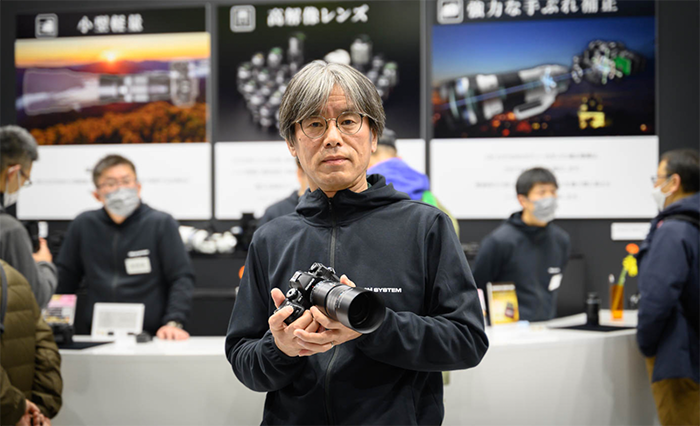
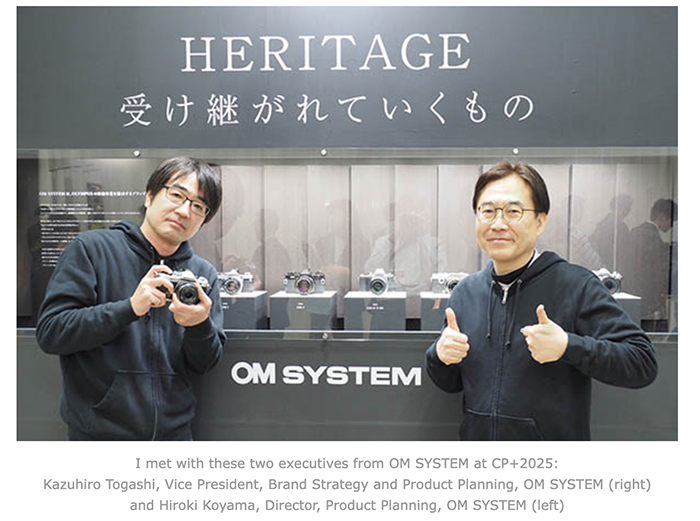
OM Digital Interview: We do not intend to stick to the existing camera lines!

Phototrend interviewed Yoshiyuki Nada, marketing manager at OM Digital Solutions. And here are couple of interesting tidbits:

  • What is the vision of the photo market according to OMDS today? We would also like to expand our products and improve our sales to people who like to shoot outdoors, capture beautiful nature scenes in the field.
  • Does OM System intend to “stick” to the existing camera lines (M10, M5, M1) offered by Olympus or explore new segments? We do not intend to stick to the current range. We will make our best products by listening to the voice of users and considering the market situation.
  • No Full Frame plans
  • The PEN-F device is very popular in Japan, as well as in some European countries. Unfortunately, we cannot inform you of our future schedule, sorry.

What are your thoughts on this?

Revealed: Sony manager confess that back in 2008 they were close to join the MFT system!

Nikkei Business has published an interview with Mr. Shigeki Ishizuka, Vice Chairman of the Sony Group, looking back on the company’s digital camera trajectory. And he confessed that back in late 2008 they were close to join the MFT system:

  • Around 2007, the Micro Four Thirds camp asked me if I wanted to join the family.
  • It was the fall of 2008. We had a brainstorming session for the medium-term plan for the next three years. Of course, Sony’s interchangeable-lens cameras would have to be made smaller and mirrorless. The question was, what kind of system should be used? One option was: “Let’s go Micro Four Thirds”. Option two was: “Let’s shift to mirrorless while maintaining the assets and brand of α, and do a miniaturized version.” I had a few other ideas, but these two were the most realistic.
  • “If you do it with Micro Four Thirds, it will definitely be smaller,”. But if we would have done that, we would have been completely on the same playing field as your competitors. And we would have wasted all α assets from Konica Minolta. So we decided it was better to develop an in-house mirrorless solution. That is the “E-mount” that continues to this day.
  • To be honest, at the time I thought the mirrorless idea was to make a small camera that could fit in a pocket and was aimed at general consumers. That’s why I didn’t intend to create a full lineup of lenses, only the standard series.
  • And no, I didn’t think at that moment that mirrorless would go Full Frame.

Really interesting!

via  Digicameinfo

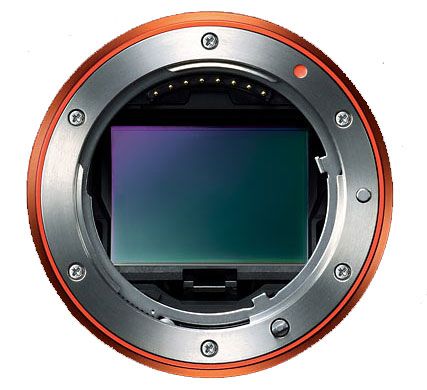
Press text: Development of organic CMOS image sensor technology that achieves excellent color reproduction under all types of light sources

Panasonic Japan issued the following press text (google translated):

Development of organic CMOS image sensor technology that achieves excellent color reproduction under all types of light sources

Panasonic Holdings Co., Ltd. has developed excellent color reproduction technology that suppresses color mixture by thinning the photoelectric conversion layer using the high light absorption rate of the organic film and by using electrical pixel separation technology. In this technology, the organic thin film that performs photoelectric conversion and the circuit that stores and reads out electric charge are completely independent of each other. This unique layered structure reduces the sensitivity of each pixel in green, red, and blue in wavelength regions outside the target range. Since it can achieve spectral characteristics with low color mixing, accurate color reproduction is possible regardless of the type of light source.

Read more