

a bit of everything…
the best Micro Four Thirds camera is… already here?
Today deals at Amazon, BHphoto, Adorama, Amazon DE, Amazon UK, Amazon FR, Amazon IT, FotoErhardt DE, FotoKoch DE.
Landscape Photography on a Grey Day OM-1 MKII (Guido Van De Water)
Gifts for the Photographer Who Has It All (Explora)
The MOST DRAMATIC Landscape in Iceland, Captured ONLY Using Micro Four Thirds Cameras (Gary W).
Top 10 Photography Spots to Visit This Winter (42West)
Plenty of news on the facebook OMD group, Panasonic FF and the GH5 group.
I kindly invite you all to follow me on Youtube, Instagram, Threads for more broader camera talk.
Today only at BHphoto: Save $75 on the Lexar SD dual pack
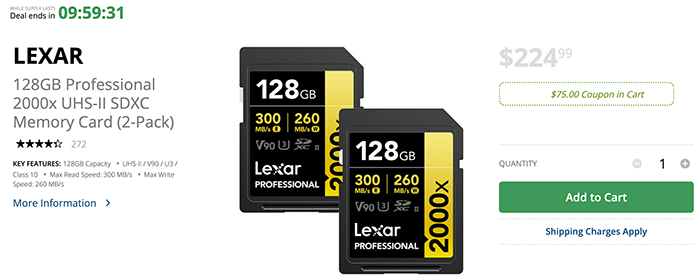
Save $75 on the Lexar fast SD dual pack at BHphoto.
But there are many more deals! Check out these special Holiday Deal pages at BHphoto, Amazon, Adorama.
MFT deals:
- Save big on Om Digital cameras/lenses at BHphoto, Amazon, Adorama.
- Save big on Lumix cameras/lenses at BHphoto, Amazon, Adorama.
- Save big on Sigma lenses at BHphoto, Amazon. Adorama.
- Save big on Voigtlander lenses at BHphoto, Amazon, Adorama.
- Save big on Samyang lenses at BHphoto, Amazon, Adorama.
- Save big on Mitakon lenses at BHphoto, Amazon, Adorama.
- Save big on Lensbaby lenses at BHphoto, Amazon, Adorama.
- Save big on Astrhori lenses at BHphoto, Amazon, Adorama.
Storage and card deals:
- Save big on Sandisk cards+storage at BHphoto, Amazon, Adorama.
- Save big on Lexar cards+storage at BHphoto, Amazon, Adorama.
- Save big on OWC cards+storage at BHphoto, Amazon, Adorama.
- Save big on Nextorage cards+storage at BHphoto, Amazon, Adorama.
- Save big on PNY cards+storage at BHphoto, Amazon, Adorama.
- Save big on Seagate storage at BHphoto, Amazon, Adorama.
PetaPixel: 8 Micro Four Thirds Myths, Exposed by Four Full-Frame Converts
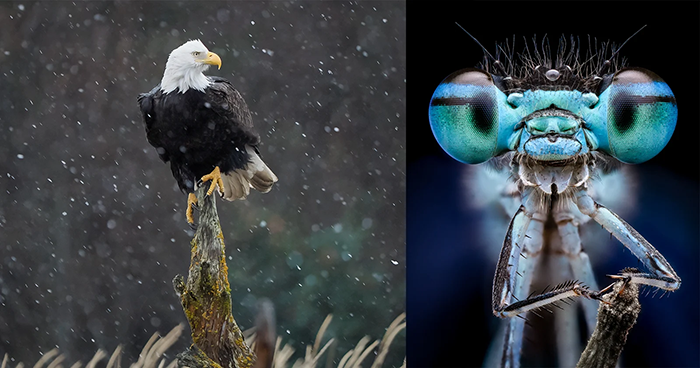
Petapixel listed the 8 MFT myths:
- The Resolution Myth – High-MP full-frame bodies like the Sony A7R IV don’t always outperform Micro Four Thirds. Advanced features such as focus bracketing and stacking often produce more usable detail for macro photographers.
- The Lens Quality Myth – The OM System M.Zuiko 90mm F3.5 Macro IS PRO is described as one of the sharpest lenses the ambassadors have ever used, offering 2× (4× equivalent) macro with outstanding optical quality.
- The Professional Conditions Myth – Full-frame bodies such as the Canon EOS R and Nikon Z7 II were often left behind because of their weight. Lighter OM gear made it easier to shoot in harsh environments.
- The Low-Light Myth – Modern sensors and IBIS in cameras like the OM System OM-1 allow handheld 1–2 second exposures, keeping ISO low even without the heavy full-frame systems.
- The Speed & Print Myth – Features such as Pro Capture and Handheld High-Res on the OM System OM-1 produce ~50MP files suitable for large prints up to 40×60 inches.
- The Bokeh Myth – Lenses like the Olympus 40–150mm F2.8 PRO and OM System 300mm F4 IS PRO give smoother backgrounds while keeping more of small subjects in focus—ideal for frogs, insects, and birds.
- The Landscape Tripod Myth – With extreme IBIS and Handheld Hi-Res in the OM System OM-1 Mark II, landscape photographers can capture sharp high-resolution images without carrying bulky tripods.
- The Computational Gimmick Myth – Tools like Live ND, Live Composite, Live GND, and Starry Sky AF — available on cameras such as the OM System OM-5 — replace many physical filters and streamline long-exposure workflows.
a bit of everything…
AstrHori 9mm F2.8 – The New Ultra-Wide for Micro Four Thirds!
Today deals at Amazon, BHphoto, Adorama, Amazon DE, Amazon UK, Amazon FR, Amazon IT, FotoErhardt DE, FotoKoch DE.
BEAUTIFUL Photos, Captured By You: Long Exposure, Portraits, Travel, Street – Collective Gallery (Gary W).
Is Low Light A Problem For Micro Four Thirds? Let’s Talk! (Robin Wong).
Strobe vs. Continuous: Which Should You Add to Your Lighting Setup? (Explora)
Analog Photobooths: Vintage Memory Makers (42West)
Plenty of news on the facebook OMD group, Panasonic FF and the GH5 group.
I kindly invite you all to follow me on Youtube, Instagram, Threads for more broader camera talk.
George Holden: You Don’t Need a Full Frame Camera for Street Photography
George Holden explains why Micro Four Thirds cameras are uniquely powerful tools for street photography: they are small, discreet, inexpensive, and offer a natural advantage for layered compositions thanks to their deeper depth of field and 4:3 aspect ratio. He argues that full-frame is unnecessary for most street work, and that Micro Four Thirds lenses provide outstanding versatility at a fraction of the size and cost. Holden also demonstrates how aperture equivalence helps street photographers achieve bright exposures while retaining deep focus for complex, multi-layered images.
Recommended Micro Four Thirds Lenses
12mm prime (BHphoto),
14mm prime (BHphoto),
15mm Leica prime (BHphoto),
17mm prime (BHphoto),
20mm prime (BHphoto)
Holden says these compact primes (24–40mm FF equivalent) are ideal for layered street images.
Kit Lens Option
12–42mm kit lens
A very cheap, flexible way to explore the Micro Four Thirds system.
Filter System Mentioned
KN&F Concept magnetic filter kit (Variable ND, CPL, Black Diffusion 1/4)
Camera Suggestions
Micro Four Thirds beginner cameras
Holden recommends an ultra-budget model for newcomers and a slightly more advanced option depending on needs.
Key Technical Points
• Micro Four Thirds 4:3 aspect ratio gives taller compositions.
• f/2.8 on MFT ≈ f/5.6 full-frame depth of field, ideal for layered street scenes.
• Smaller sensors make achieving deep focus effortless without stopping down to f/8 or f/11.
• Small lenses and bodies make the system discreet and travel-friendly.
a bit of everything…
Why Is This LUMIX Camera So Popular Now?
Today deals at Amazon, BHphoto, Adorama, Amazon DE, Amazon UK, Amazon FR, Amazon IT, FotoErhardt DE, FotoKoch DE.
Panasonic Leica 35-100mm F2.8 Zoom Lens Tested on Lumix G9II/GH7 (Geeky Nerdy Techy)
Is Bigger Better? Sensor Size Examined (Explora).
How I Dial In PERFECT Long Exposure Settings on the OM-1 Mark II (Chris Baitson).
Photographer’s Guide to Short-Form Content in 2025 (42West)
Plenty of news on the facebook OMD group, Panasonic FF and the GH5 group.
I kindly invite you all to follow me on Youtube, Instagram, Threads for more broader camera talk.