Panasonic is considering adding phase detection AF on future cameras

Share

Imaging Resource had a chat with Panasonic and here are a couple of take always:

  • Regarding the new L2 partnership with Leica:
    Until now it was a relationship in which each company provided each other’s technologies and both sides used what the other had. From now on, it will change to a form of collaboration in which we create new things together.
  • Imaging Business success:
    Our imaging business in fiscal year 2021 achieved double-digit growth and profitability. In particular, the GH6, which was introduced in the 4th quarter of FY2021, realizes picture creating with a sense of 3-dimensionality and depth different from other Micro Four Thirds cameras so far and it has a slow-motion movie ability that gives a feeling of floating while still maintaining high definition, with modes such as 4K120p, FHD240p, 300p, etc. It has been very positively evaluated by creators, and sales are good.
  • The creator market is enormous:
    The “creator” market is enormous, and an obvious area for Panasonic to focus on. I knew there were a *lot* of people making videos on YouTube, but had no idea of just how massive that market is until I looked up some stats while writing this article. I didn’t do any deep research, but the stats in this article blew my mind: (https://influencermarketinghub.com/creator-economy-stats/) Upwards of 50 million people consider themselves to be online creators), with 3.3 million of those viewing themselves as professionals. While the vast majority of YouTube’s 37.5 million channels don’t make enough money to reach the US poverty line of ~$12,000 annually, globally, 2 million creators earn six-figure incomes from their craft. Given all that, there are a lot of people looking for affordable cameras able to produce high quality video like Panasonic’s GH series.”
  • About PDAF:
    “It is a fact that PDAF is one of the elements to improve the AF performance of LUMIX for the future.However, PDAF alone does not improve AF performance, and factors other than PDAF are required to determine “which to focus on”. With PDAF as an AF detection system in mind, we will continue to make every effort to improve the total performance of AF. We are positively studying PDAF for future products. We know that PDAF will enhance the total AF quality, so that’s why we’re actively studying it. We haven’t decided yet though.”
  • An affordable lens for the S5 owners:
    And now, for the next model, we are developing a wide-angle zoom in the popular price range. With this lens, the system lineup centered on S5 will be completed.
  • Both the GH5 and GH6 are both selling well:
    Between the two, the GH6 is selling more than the GH5 Mark II. [This is probably] because when we announced the GH5 Mark II, we made a development announcement for the GH6 as well, so the customers could get the right product from the GH series. So some people wanted to wait for the GH6 to come.
Share

Petapixel says the Kiboko City Commuter Camera Backpack is the “Best Day-Use Backpack for Photographers”

Share

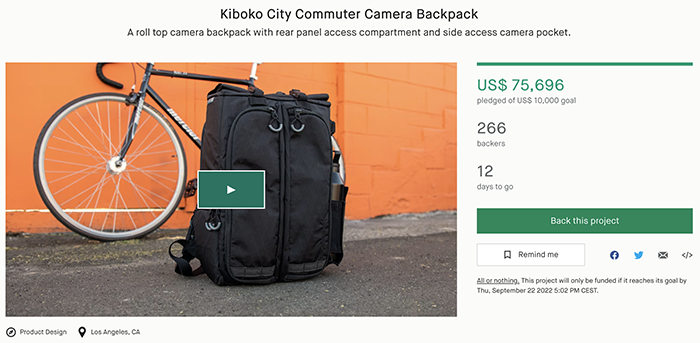
You have 12 days left to order the new Kiboko City Commuter Camera Backpack on Kickstarter (Click here). According to PetaPixel tested the bag is the “Best Day-Use Backpack for Photographers”:

The “day-use” backpack is perhaps the most difficult to sift through as it is the most popular style and therefore the most manufacturers compete to earn your attention. It is also the category where the most concessions are made to appeal to the widest group of photographers, making it very difficult to find one bag that does everything right for every possible use case. For years, the best choice was Peak Design Everyday Backpack V2 despite numerous issues with it because it was able to be the most for the most people. That finally changes with Gura Gear’s Kiboko City backpack, which does everything the Everyday Backpack does better — and more.

Gura Gear managed to make a smaller backpack that can actually carry more equipment. While it’s not deep enough to hold a larger camera like a Nikon Z9 or a Canon 1DX, it easily holds other cameras like any from Sony, the Canon R5, or the Nikon Z7 II. It features a roll-top so it can expand to carry soft items like a sweatshirt or jacket, has multiple pockets all around the bag for various accessories, and has a properly divided interior that holds a variety of lenses and other camera equipment.

The material and build quality of the Kiboko City is top notch and while the bag isn’t waterproof, everything but the zippers will repel water thanks to being fully encased in X-pac fabric.

Beyond those basics, the Kiboko City has side panel camera access, a magnetic hiding water bottle side pocket, a center channel tripod holder, high-quality shoulder straps, and Fidlock magnetic fasteners. The bag is a little bit more expensive than Peak Design’s backpack, but you get your money’s worth.

Other solid picks include the aforementioned Peak Design Everyday Backpack V2, the WANDRD PRVKE, or the LowePro ProTactic.

Share

a bit of everything…

Share


The Rarest Olympus Camera

Today deals at Amazon, BHphoto, Adorama, Amazon DE, Amazon UK, Amazon FR, Amazon IT, FotoErhardt DE, FotoKoch DE.
Best Micro Four Thirds cameras for 2022 (popphoto).
Panasonic Lumix G Vario 7-14mm f/4 ASPH review (DigitalCameraWorld).
Samsung T7 Shield—One of the Best Portable SSDs Made Rugged (Explora).
Shallow Depth of Field | 6 Factors To Consider (42West).

Plenty of news on the facebook OMD group, Panasonic FF and the GH5 group.

Share

a bit of everything…

Share


Why I Don’t Like Olympus 17mm F1.8?

Today deals at Amazon, BHphoto, Adorama, Amazon DE, Amazon UK, Amazon FR, Amazon IT, FotoErhardt DE, FotoKoch DE.
How that new Leica-Panasonic camera could be a letdown (ThePhoBlographer).
Just repaired this old boy’s zoom error after few years. Now that camera’s like this aren’t used anymore what can I do with this? (Reddit).
Adobe Announces Creative Cloud Express (Explora).
Spot Healing Brush Tool: Everything You Need to Know (42West).

Plenty of news on the facebook OMD group, Panasonic FF and the GH5 group.

Share

Press text: Meyer Optik Görlitz – Biotar 58 f/1.5 II available

Share

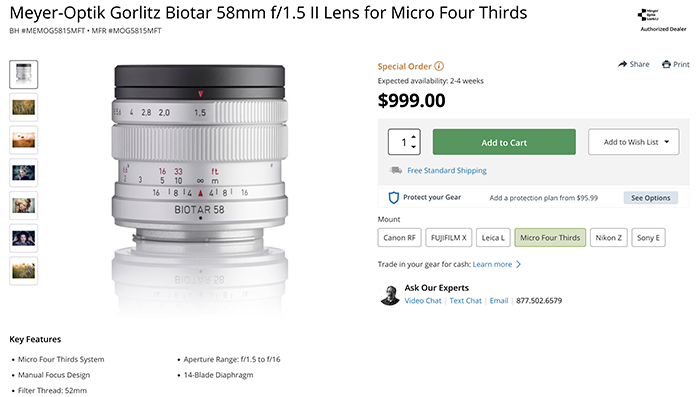
The new lens is now available at BHphoto. This is the press text:

Meyer Optik Görlitz – Biotar 58 f1.5 II available!

Bad Kreuznach, Germany – September 07th, 2022 – Meyer Optik Görlitz releases the Biotar 58 f1.5 II, the long-awaited new edition of the world famous lens and adds another unique imaging style to its existing portfolio, of high quality character lenses. The Biotar 58 II is available now and can be purchased directly from the manufacturer & from well-stocked photo retailers.

“After several delays simply due to the current unforeseeable circumstances, we are extremely pleased to welcome this very exciting lens to our family and introduce it to the public,” says Timo Heinze, Managing Director Meyer Optik / OPC Optics. “Even though the Biotar is not a classic Meyer lens, it fits perfectly into our portfolio of creative tools, with unique characteristics. Nevertheless, to honor its foreign origin, we decided to manufacture it with a Biotar-exclusive coloring.”

About Biotar 58
Originally, the Biotar 58, among other focal lengths and versions, was designed by the ingenious optical designer Willi Merté. After its launch in the mid-1930s, it was offered for about 25 years, making it the longest and best-selling Biotar in that series to date. The new version of that extremely popular, highly versatile lens also delivers its incomparable charm and comes up with excellent imaging characteristics as the Biotar 58 f1.5 II. With the help of the Görlitz-based designer, Dr.-Ing. Wolf-Dieter Prenzel, the new edition of the Biotar 58 has been significantly improved in terms of light intensity, image sharpness and contrast behavior, and the wonderful characteristics of the original Biotar 58 have been transferred to the new version of this classic lens.

What makes the Biotar 58 f1.5 II stand out?
Biotars have always been appreciated for their wonderful bokeh options, a creamy image look, particularly harmonious focus gradients and good sharpness performance. In the out-of-focus area, with the right setting, a swirl of light circles can be created (also called ‘Swirly-Bokeh’), which particularly emphasizes the focused main subject. The captured light points near the center of the image appear circular and take on a more elliptical shape toward the edge of the image (also called ‘cat eyes’). The Biotar 58 f1.5 II is already characterized by high image sharpness at open aperture and at the same time delivers the beautiful effects in the out-of-focus area of the image. It also impresses in difficult lighting situations – the Biotar 58 II produces little to no color fringing even in strong backlighting and with an open aperture, and still achieves excellent results even in low light situations thanks to its speed. The targeted use of the effects, the many design options and the high sharpness make the Biotar 58 II the perfect choice for many different genres of photography and videography.

The fastest and sharpest Biotar 58 ever
In the course of redesigning the Biotar 58 and optimizing its optical system, the initial aperture of the lens has been increased from the original f2 to f1.5. There has never been a faster Biotar 58 and at the same time the Biotar 58 f1.5 II now represents the ‘fastest’ lens in Meyer Optik Görlitz’s portfolio. In addition to the higher speed, the Biotar 58 II, through various optimizations of the optical system, achieves a sharpness that its predecessors could not reach. This high sharpness or extreme resolution is a particularly noteworthy advantage for close-up and portrait photography.

Well-proven mechanical design and optimized aperture
For the Biotar 58 f1.5 II, the proven mechanics of the previous new editions were used and the individual optical elements were thus combined in a well-proven, highly precise and durable mechanical system. Compared to the original Biotar 58 lenses, 14 steel blades now form the stepless & silently adjustable aperture of the new edition. The circular aperture is particularly noticeable in the bokeh of the image and draws more harmonious points of light than its historical predecessors. All mechanics were, as with all Meyer Optik Görlitz lenses, sourced from renowned German precision mechanics manufacturers and were produced to the highest quality. The aluminum- / natural-colored anodizing used for the Biotars is intended to represent a connection to the historical origin and offers an excellent feel as well as a precious appearance at the same time.

The Biotar 58 f1.5 II, as well as all other Meyer lenses released to date, can be purchased at www.meyer-optik-goerlitz.com.

What follows?
Series production of the Biotar 75 f1.5 II has also begun and is expected to take until the end of the year. In addition, new lenses are in planning / development and will be released in the foreseeable future.

Share