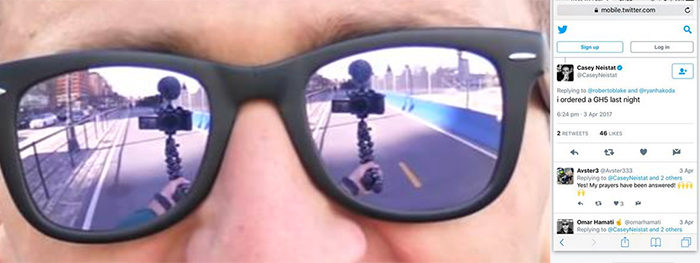
GH5 Facebook group member Victor Bart spotted a curious fact: World famous Youtuber Casey Neistat is using Panasonic GH5. You can see the camera in the reflection of his Sunnglasses. This will be a disappointing news for Sony as they kept praising the fact he is using Sony camera gear for his videos (Source: Alphauniverse)
NOTE: Casey has almost 7 million subscribers on his Youtube channel!
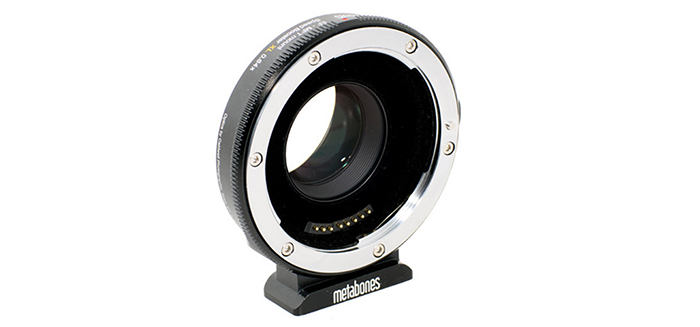
Metabones Firmware Upgrade Adds Cinema EOS Lens and GH5 Support
Vancouver, Canada, April 13, 2017 – Metabones App 2.7 (E-Mount Version 56) is released today, adding support for the Canon CN-E 18-80mm T4.4 L IS KAS S lens to Metabones EF mount Speed Boosters and Smart Adapters.
Servo zoom can now be controlled using the wide-tele zoom rocker on supported cameras (for example JVC GY-LS300), with a touch screen interface (most Panasonic cameras), or from PlayMemories Mobile App for Sony cameras.
For supported Sony cameras, the Record button on the grip of the Cinema EOS CN-E 18-80mm T4.4 L IS KAS S lens can be assigned to one of more than 50 functions on the A7 series and other supported cameras. By assigning it to the MOVIE function, the user may start/stop recording and zoom with the lens’ hand grip which is handy for a small-form-factor camera like A7R Mark II.
Whereas a typical EF mount lens changes the iris at 1/8 stop granularity, a Cinema EOS lens permits much finer control. Metabones takes advantage of this improved precision resulting in footages in which auto iris movements are virtually imperceptible.
Autofocus is supported, but to set expectations properly, AF performance of a supported Cinema EOS lens on a non-Canon camera is significantly below that of a genuine Cinema EOS camera equipped with dual pixel AF technology.
Never has any cinema lens received such comprehensive electronic integration across disparate lens mounts and brands like Blackmagic, JVC, Panasonic, Sony and of course, Canon Cinema EOS natively.
Important notice: not every Cinema EOS lens supports every feature. At the time of writing only Canon CN-E 18-80 T4.4 L IS KAS S supports auto iris, autofocus and servo zoom.
Also added to the new firmware release is support for the new Panasonic GH5 camera, with the usual set of features: user selectable optical image stabilization/5-axis in-body image stabilization (no dual I.S.), fast contrast detection autofocus (no DFD), smooth iris (requires lens support) and detailed EXIF.
Metabones App 2.7 (E-Mount Version 56) is available immediately from Metabones’ web site. The same download upgrades every Metabones product with a micro USB port. See the accompanying release notes for compatibility and other important information.
Metabones Speed Booster XL with Sigma 18-35 on GH5 Issue & fix
Olympus E-M1 Mk.II Lens Image Samples (Wrotniak).
What is a ‘bokeh pano’? (Bokehpano.com)
Gh5 image samples at CameraJabber.
Tips for HDR Video-Editing Workflow (Explora).
Gear of the Week 04 – Panasonic GH5 & Zhiyun Smooth-Q Gimbal Unboxing and Impressions (youtube).
Gh5 test at Mapcamera.
David: “There are lots of reviews of the Olympus OM-D, EM-1 Mk II, but I’ve seen nobody testing the Mk II with the older, FourThirds lenses. So, I thought your readers might enjoy a test of the 50~200/2.8-3.5 SWD +1.4X anc the Mk II, on Ice Racing … the crazies who race motocross bikes across frozen lakes in -25C weather, at speeds up to 130kph (80mph). Now, that’s a test of tracking AF! My results can be found at: http://www.furnfeather.ca/Reviews/E-M1mk2.html If interested, my older Olympus & Leica reviews are here: http://www.furnfeather.ca/Reviews.html“
Dpreview interviewed Mr.Masamichi Handa from Olympus. These are some key info:
About the High Price of the E-M1II: “We opted for a price that would allow us to achieve higher performance levels and offer higher value to the customer. We had many discussions, and we chose to be bold and aim for a hit a higher consumer value point.“
About a possible Video Oriented Olympus camera like the GH5 he says: “We should never ignore [a potential audience] but right now, we have no plans.“
About the improvements to be expected on future cameras: “autofocus speed, AF tracking performance and so on – we can always do more. We want to improve image stabilization technology, too, so our users can use longer lenses without needing a tripod, for instance.“
So in short: Don’t expect Olympus to experiment on the market with new kind of cameras (video oriented). They will stick to what they have and improve it further. Which sounds pretty much ok to me :)
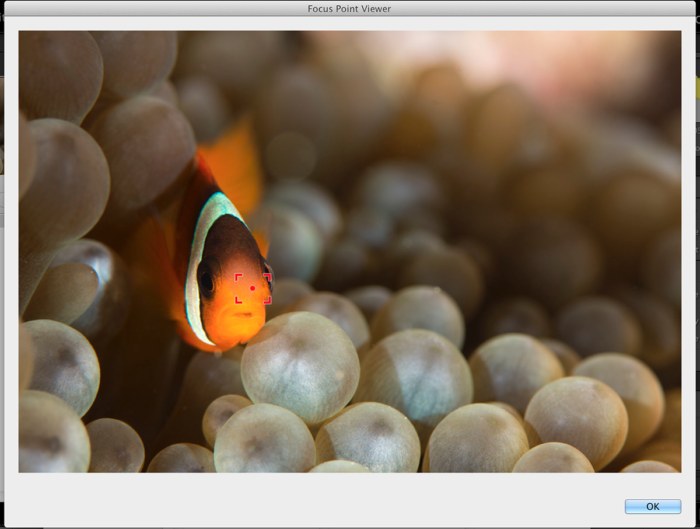
Whizzle created a plugin for Lightroom (on Mac) to show which focus point was active when the picture was taken. it supports Panasonic and Olympus cameras and you can download if for free here: github.com/musselwhizzle/Focus-Points
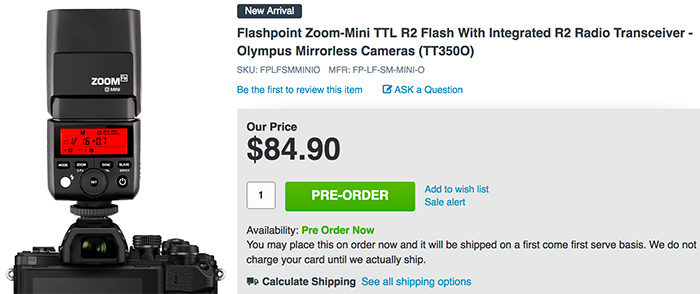
Flashhavoc released the new Zoom Mini R2 TTL for Olympus MFT cameras. It’s already available for preorder at Adorama (Click here). Here is the Press text:
–
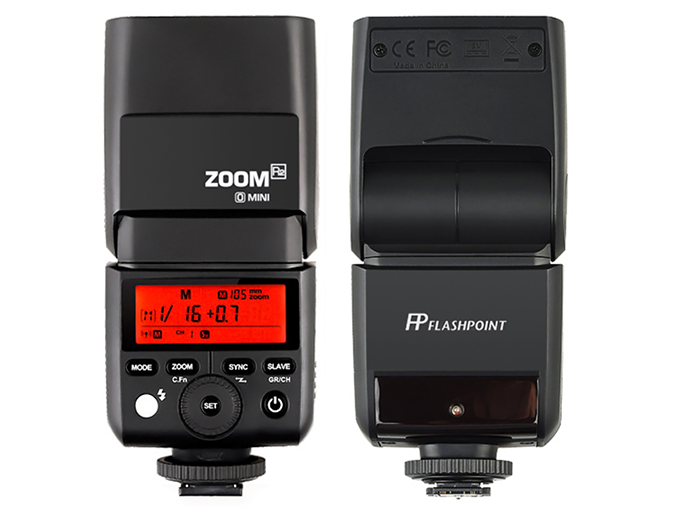
After a very long wait, Flashpoint and Godox TTL and HSS support will soon be available for Micro Four Thirds cameras, with the release of the Flashpoint Zoom Mini R2 TTL Speedlite for Olympus!
The Zoom Mini R2 TTL for Olympus are Flashpoint’s version of the compact Godox TT350 radio Master Speedlite, and are now available for pre-order from Adorama for $84.90. Most significantly the Zoom Mini R2 TTL (and Godox TT350) provide a 2.4GHz radio Master mode, which can fire and control the complete Flashpoint and Godox 2.4GHz Flash System. Which finally opens up the Olympus Micro Four Thirds camera system to a range of popular large and small off camera strobes, with full TTL and HSS supported!
NOTE – Many of the current flash units will also require a user installed firmware update to add the Olympus radio slave mode.
A stand alone transmitter unit for Olympus will be available later in the year. And as Flashpoint and Godox are currently in the process of developing a new X2 transmitter, there is a good chance the Olympus version may go straight to the new design once ready. The Zoom Mini R2 TTL provide simple control for 3 remote slave groups, with a radio range of approximately 30 meters. Powered by just 2 AA batteries, and provide a guide number of 24 meters (ISO 100, @105mm). Recycle times are from approximately 0.1 – 2.2 seconds, and provide up to 210 full power pops per battery charge.
FLASHPOINT ZOOM MINI TTL FEATURES
GN 24m (ISO 100 @ 105mm)
Powered by 2 x AA batteries
HSS to 1/8000th
Flash Mode – TTL /M / Multi
1st Curtain Sync / 2nd Curtain Sync
FEC / FEB – 1/3rd Increments (±3 stops)
Manual Flash – 1/128 – 1/1 output control (1/3rd increments)
Flash Zoom 24 – 105mm
Radio Master & Slave Modes for Flashpoint R2 / Godox 2.4GHz X Radio System
3 Remote Groups A / B / C
16 Channels
Range to 30m
S1 and S2 Optic Slave Modes
Recycle Time: 0.1 – 2.2 Seconds
210 Full Power Flashes (using 2500mAh Ni-MH Batteries)
The Zoom Mini R2 TTL provide a USB port for firmware updates, now located inside the battery compartment. There is also no PC sync port provided. (Though a communication port for legacy clip on external radio receivers is not included in the compact speedlite).
That’s a unusual new camera: Boxfish Research released their 360 degree and 5K capable camera. In their press release they write that it is “utilising Micro Four Thirds sensors and specially calibrated lenses“. I guess that by MFT sensors they mean Four Thirds sensor as this camera has no MFT mount:
Boxfish 360: large sensors deliver crisp underwater 360 degree video
Just released, the Boxfish 360 underwater camera allows professional content creators to capture sharper, more colourful and more exciting perspectives of the underwater world.
–
Auckland, New Zealand – 06 April 2017: Boxfish Research has today announced the release of their professional underwater virtual reality camera, the Boxfish 360. By utilising Micro Four Thirds sensors and specially calibrated lenses, the videos and photos captured by the Boxfish 360 offer higher clarity and better colour rendition than rigs based on action cameras. First unveiled at CES 2017, the Boxfish 360 has since undergone extensive user testing and the company is now taking orders.
While 360-degree virtual reality story telling has made huge leaps since the early days, underwater content creators are still hampered by the soft focus, muddy colours, and obvious seams introduced by action-camera based rigs. “The physics of small sensors, small domes, and light filtered by water simply limits what you can achieve with action cameras underwater,” said Richard Robinson, award winning Photojournalist and Underwater Photographer who has tested the Boxfish 360 extensively on assignments. By using larger cameras, Boxfish Research managed to halve the camera count of existing rigs, while increasing the sensor area almost five times. This is a win across the board: Better image quality, fewer seams, longer runtime, and a faster workflow. “The beauty of the Boxfish 360 is that the cameras stay inside the waterproof housing at all times, and a single hatch provides tool-less access to the recorded files and for charging,” said Axel Busch, company co-founder. “It only takes a minute to swap batteries and cards. You are back in the water faster and the production workflow is much more streamlined”.
The Boxfish 360 features three frame-synced MFT cameras, with images from each combining to create a single immersive, 5K 360-degree video and DNG RAW photo. With up to 90 minute runtime and an anodised aluminium housing rated to a depth of 300m (1000ft), the camera is the perfect tool to tell any immersive story. As an exciting bonus the Boxfish 360 features electronic recording of depth, water temperature and camera orientation during the dive. This creates an entirely new scope for stabilization, rich data overlays, HUD style displays or scientific research opportunities.
Boxfish Research is innovating underwater observation with remotely operated vehicles and video equipment built for cinematographers, scientists, educators, and adventurers. By focusing on ease of use and high quality data capture, Boxfish Research is expanding the possibilities for humans to understand and experience our underwater world.