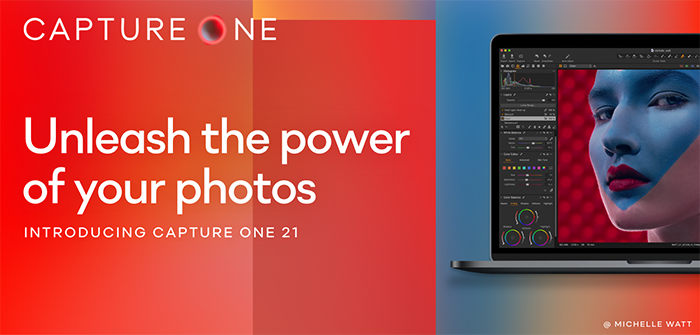
Phase One released the new Capture One 21 software (full info here).It brings new features like the “Dehaze” tool, HEIC support, Speed Edit and more. You find the full press release down below as well as a number of videos that introduce some of the new tools.
COPENHAGEN, Dec 8th, 2020: Capture One, the premier name in photo editing software, celebrates the release of the newest version, Capture One 21.
Linking our heritage to our future, this new version of Capture One reimagines the relationship between form and function to create a seamless bond between creator and creation. Combining its best-loved elements like personalized Workspaces and powerful Color Editor with new and exciting features like Speed Edit for immersive editing and Dehaze, to improve atmospheric conditions, Capture One 21 brings a new type of user experience; one that helps creators push the boundaries of their creativity by removing distraction and making it easy to exploit one’s creative potential.
Carrying on the tradition of development driven by user feedback, Capture One 21 is rooted in developing solutions to current challenges and anticipating tomorrow’s needs. With new ProStandard Color Profiles Capture One 21 introduces color technology that preserves authentic colors to overcome the challenge of unwanted hue changes when applying adjustments, and new HEIC support means Capture One is ready to work with cameras of today and tomorrow. It is also now easier than ever to learn Capture One with enhanced tooltips and easy access to tutorials right from within the software. Complimenting this suite of new features are improvements to current ones, bringing faster asset management and an improved importer to make organization effortless and quick.
Furthering its commitment to providing unparalleled raw processing and tethering with more than 500 different camera models, Capture One is delighted to launch a new collaboration with Leica Camera AG to bring industry leading tethering support to a growing catalog of Leica cameras, starting off with the Leica SL2 and Leica S3.
“Capture One 21 bridges our heritage to the future, carrying forward the achievements of our team and the creative community we are inspired by,” says Jan Hyldebrandt-Larsen, VP Product Management, CPO at Capture One. “We understand that art and tastes don’t stop evolving, so we provide performance that won’t stop advancing. We are very excited about Capture One 21 and look forward to seeing what photographers create with it, and to embrace new generations of creatives.”
New features and tools in Capture One 21
- Speed Edit
Revolutionize how fast you edit photos. Speed Edit lets you work seamlessly without touching a slider on the interface – simply hold down selected hotkeys and scroll, drag or use the arrow keys to make rapid edits. You can even adjust multiple photos at once for the fastest ever batch edit.
- Dehaze
Eliminate haze and the most undesirable atmospheric weather conditions with the ease of moving one slider. The groundbreaking new Dehaze tool uses deep analytic algorithms to assess and automatically adjust contrast, saturation and a matrix of other parameters to remove haze and reveal the image you want.
- Faster Asset Management
Get seamless asset management. With increased power and speed, it’s now faster than ever to import, search and browse photos in Catalogs and Sessions.
- Improved Importer
With better selection, high-resolution thumbnails, and faster importing, it’s smoother, easier, and quicker to select images directly in the importer – and cull the ones you don’t want. Plus, import images from different folders all at once.
- Enhanced Tooltips
The onboarding experience and familiarization with Capture One is now smoothest it has ever been, thanks to the new enhanced tooltips. Navigate the Capture One interface with ease – simply hover over a tool for a quick explanation of how it works and links for more learning. Enable or disable them from Preferences as you like.
- Learn
It’s never been easier to get started and master Capture One. Together with the enhanced tooltips, the new “Learn” button allows users to quickly access a curated selection of tutorials designed to help you learn step-by-step, right from within the software, and immediately put new skills into practice.
- HEIC Support
With support for HEIC files (8-bit), you can now edit photos from your Apple devices and more in Capture One.
- ProStandard Profiles
Stay true to real life with the most authentic colors yet, using the new color science/technology in the new ProStandard Profiles. These new camera profiles overcome the challenge of unwanted color shifts while making adjustments, protecting hues from changes caused by contrast. This is a true game changer for portrait and product photography – and any image that relies on authentic color.
Available for select camera models that can be found at support.captureone.com
- Easy Brush Adjusting
It’s now possible to easily change the size, hardness, opacity, and flow of any brush by using modifier keys and a mouse / trackpad / pen, removing the need to right-click.
- Capture One & Leica
Unlike other raw processors, Capture One’s camera profiles are uniquely developed for each specific camera model, a process that requires the use of the camera in and out of a controlled lab in Copenhagen, where a team of specialists engage each new model in various scenarios. They then evaluate all the performance parameters such as color, sharpness, and noise across hundreds of images and uses that data to deliver a truly tailored profile, which ultimately provides the best post-processing experience. Capture One 21 brings this level of support to a growing list of Leica cameras, and for the first time brings tethering capabilities to those models.
Read all about Capture One 21 at: www.captureone.com
New camera and lens support
Capture One provides users with the most accurate and powerful image editing available, and the wide-ranging support of cameras and lenses is a hallmark of the software. For enthusiasts and professionals alike, Capture One continually evolves to handle the newest cameras and lenses.
Capture One carefully evaluates and interprets each camera’s RAW formats, allowing Capture One to present images with the utmost fidelity, often bringing out nuances that other programs can’t even perceive.
Currently offering RAW support for more than 500 cameras, Capture One also provides profiling and image correction support for more than 500 lenses. As with the RAW file interpretation, Capture One carefully measures the optical characteristics of each supported lens and builds correction algorithms that compensate for the various optical imperfections of various designs. As a result, Capture One can correct for numerous common optical issues such as vignette, and chromatic aberration as needed for each of the supported lenses, providing you the best version of your image possible. And they are always adding support for the newest camera bodies and lenses.
Check out more details and pricing at the Capture One Page.