Can a camera really make you a better street photographer? George Holden explored this question in a recent video, and his answer might surprise you. While high-end gear can help refine your technical skills, it won’t necessarily improve your ability to spot great moments on the street.
He compared the Olympus Pen F to the technically superior Sony A9 III. On paper, the Sony—with its global shutter and 120 fps RAW shooting—is flawless. But Holden argues that the Olympus Pen F, with its manual controls and vintage charm, better captures the essence of street photography: simplicity, intuition, and imperfection.
Interestingly, his Olympus 17mm f/2.8 lens broke down over time, forcing him to use manual focus. That accident turned out to be a blessing—it recreated the “Leica-like” shooting experience through zone focusing, where you pre-focus about 1.5 to 2 meters ahead and shoot freely within that range. According to Holden, this limitation brought back the joy and creativity often lost with modern cameras overloaded with automation.
He admits that his Sony A7C II is the better camera for video and professional work, but it feels more like a “work tool” than a creative companion. The Pen F and Fuji X-T2, on the other hand, make him want to shoot for fun again.
Holden ends on a simple truth: image quality isn’t about megapixels. A 10MP CCD DSLR in great light can beat a 100MP medium-format camera in bad lighting. What matters most is how you see, not what you shoot with.
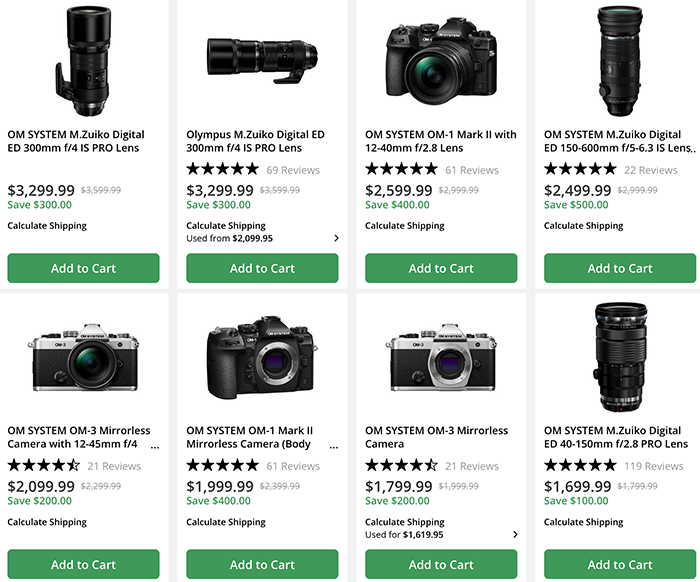
Wildlife photographer Scott Keys set out to prove that full-frame systems outperform Micro Four Thirds in macro work — but the results surprised him. After testing the OM System OM-1 II with the M.Zuiko 90 mm f/3.5 Macro IS PRO against the Nikon Z6 III with a 180 mm macro lens, he found the smaller OM System consistently delivered sharper detail and greater usable depth of field — even at f/22, where diffraction should have ruined sharpness.
Despite theoretical disadvantages from its smaller pixel pitch, the OM System somehow mitigated diffraction better than expected, producing crisp, contrasty macro images with deeper focus. The Nikon setup still offered richer files and better cropping flexibility, but in practical, real-world close-ups the Olympus/OM combo simply performed better.
Keys’s takeaway: for pure macro photography, OM System wins on portability, depth of field, and surprising image quality. For broader wildlife work and heavy cropping, full-frame still holds the edge — but for anyone focused mainly on macro subjects, the OM System may now be the smarter choice.