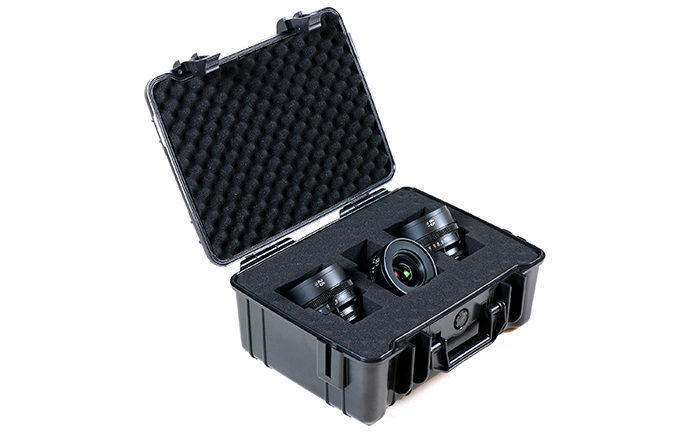
NEW: SLR Magic APO-HyperPrime CINE 25mm T2.1 and SLR Magic APO-HyperPrime CINE 85mm T2.1

SLRM_25_50_85_set

PRESS RELEASE

Hong Kong, China (April 15, 2016) – SLR Magic will add two new members to the APO-HyperPrime lens family, the SLR Magic APO-HyperPrime CINE 25mm T2.1 and the SLR Magic APO-HyperPrime CINE 85mm T2.1. They achieve outstanding images under challenging lighting conditions. When taking pictures with many image-dominant, open light sources, it is common for correction defects to show up. These apochromatic (APO) lens, longitudinal chromatic aberrations are corrected by its unique optical design and special selection of optical elements. The color defects are therefore significantly lower than the defined limits. Bright/dark transitions in the image, and especially highlights, are rendered with no colourful artefacts.

Thanks to the low level of longitudinal chromatic aberration, there are no visible aberrations. So an illuminated portrait scene by night with many light sources in front of and behind the actual focal plane appears close to reality, without displaying complementary, color contrast edges. The excellent performance delivered by the SLR Magic APO-HyperPrime CINE 25mm T2.1 and SLR Magic APO-HyperPrime CINE 85mm T2.1 is consistent for all shooting distances. Its high performance with an open aperture also makes this lens a good choice for close-ups or portraits. The SLR Magic APO-HyperPrime CINE 50mm T2.1 takes full advantage of modern high-resolution 4K camera sensors as support for 6K sensor size, resulting in impressive resolution in the images, even for the finest detail.

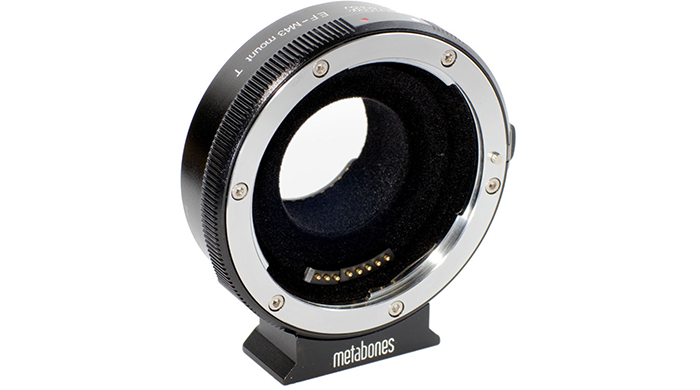
The lens has a completely new optical and mechanical design, which was developed taking into account the special and increasing requirements of high-resolution cameras. The APO-HyperPrime CINE lens series comes standard in PL mount and can be easily adapted to numerous camera systems with the optional PL-mFT adapter, PL-E adapter, EF adapter and NF adapter. The lenses feature standard focus rotation angle of 300 degrees and uniform measurements. This combination makes the lenses ideally suited for every demand on the film set. All APO-HyperPrime CINE lenses have an attachment of any standard follow-focus system.

As a continued dedication to anamorphic lenses, some of the lenses in the APO-HyperPrime CINE lens family would be compatible with the SLR Magic Anamorphot adapter.

SLR Magic will start shipping the APO-HyperPrime CINE 25mm T2.1, SLR Magic APO-HyperPrime CINE 50mm T2.1, and SLR Magic APO-HyperPrime CINE 85mm T2.1 lens set by Q3 2016.

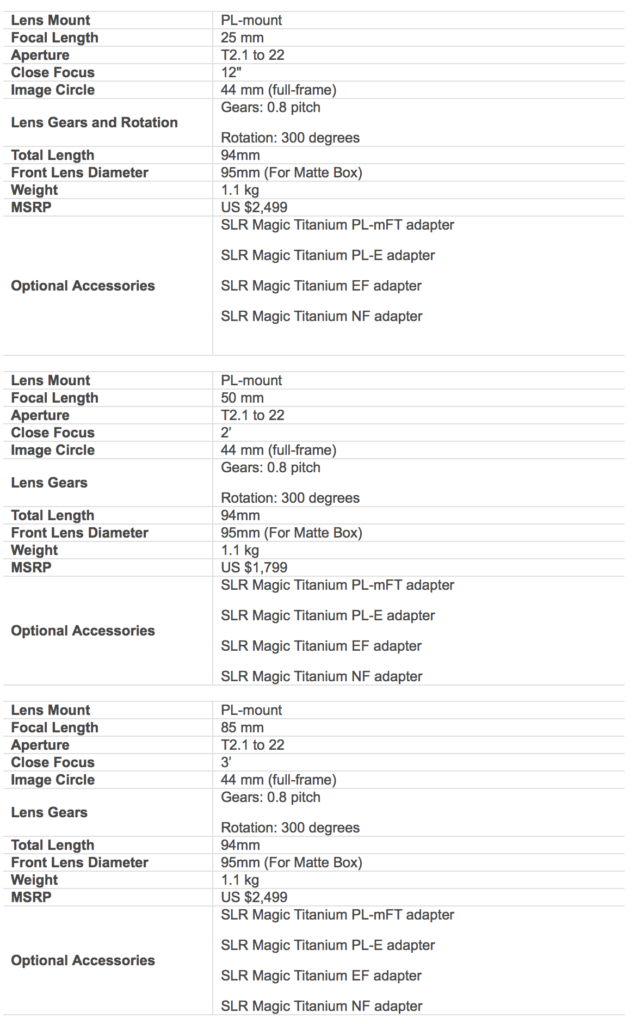
Technical Data

Bildschirmfoto 2016-04-15 um 09.06.00

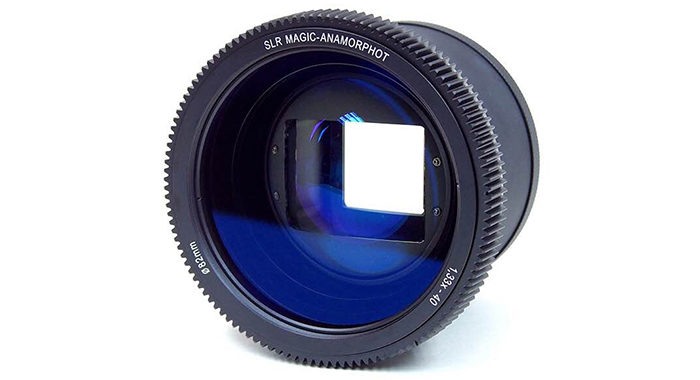
New SLR Magic Anamorphot 1,33x – 40

SLRMANA40_133a

PRESS RELEASE

Hong Kong, China (Apr 15, 2016) – SLR Magic is proud to announce the SLR Magic Anamorphot 1,33x – 40 for indie filmmakers.

Many indie filmmakers who wanted to shoot anamorphic had to depend on rare vintage lenses, which was not always reliable.  In hopes to provide a reliable and available solution for indie anamorphic shooters, we introduced the SLR Magic Anamorphot 1.33x-50 and 2x-50 adapter. These two adapters offered maximum compatibility for third party taking lenses.

The new SLR Magic Anamorphot 1,33x – 40 adapter is a single focus anamorphic adapter designed to work specifically with the SLR Magic HyperPrime CINE 25mm T0.95 III @2.8 on micro four thirds and the SLR Magic 50mm F1.1 CINE @2.8 for E-mount S35 and APS-C sensor.

To achieve the much loved 2.35:1 scope aspect ratio, which gives a very pleasant, epic effect, filmmakers must crop off the top and bottom of standard 16:9 footage when using spherical lenses with modern digital cameras. As a result, 25% of sensor/negative information is discarded.

As a commitment to the film industry, SLR Magic developed this 1,33x anamorphic adapter to help filmmakers maximize their image quality by preventing this loss of vertical resolution. The unique 1,33x squeeze factor uses the entire 16:9 sensor/negative area to achieve the desired 2.35:1 aspect ratio. The Anamorphot 1.33x – 50 does this by compressing a 33% wider field of view to fit the width of the 16:9 sensor/negative without compressing image height.

Modern professional cinema cameras have large sensors capable of capturing an image in the 2.35:1 format directly, using spherical lenses, but film makers still desire the anamorphic “look” which often limits them to using rare vintage lenses.  These present a number of difficulties in practice such as size, weight, lack of close focus, availability, and high price.  We sought to overcome such issues with the SLR Magic Anamorphot.

The SLR Magic Anamorphot 1,33x – 40 create a unique “artifact” such as horizontal lens flare, commonly referred to as anamorphic streaks, and may create slightly elongated bokeh when achromatic diopters are used.  Over the history of cinema, these same stylish effects have contributed to the cinematic “look” of epic motion picture photography.  Characteristics that shape this anamorphic “look” come from “front-mounted” anamorphic adapter designs such as the SLR Magic Anamorphot while “rear-mounted” anamorphic designs have more suppressed anamorphic characteristics.

The SLR Magic Anamorphot 1,33x – 40 will be available from authorised SLR Magic resellers by June, 2016.

Technical Data:
SLR Magic Anamorphot 1,33x – 40
Lens Type: Anamorphic adapter
Compatible Cameras: Micro Four Thirds and E-mount s35 or APS-c
Objective front filter thread: Φ82
Objective rear filter thread: Φ52
Lens Coating: Multi Coated
Focus range: 4ft – infinity

Taking lens compatibility:
SLR Magic HyperPrime CINE 25mm T0.95 III @2.8 can be used for mFT sensor.
SLR Magic 50mm F1.1 CINE @2.8 can be used for S35 and APS-C sensor.

MSRP   : US $849 for SLR Magic Anamorphot 1,33x – 40

Andrew Chan
Product Manager

SLR Magic

a bit of everything…


Olympus 300mm f/4 IS PRO Review

Panasonic Lumix DMC-FZ1000 Disassembly (iFixit).
An event photo report, shot with the Panasonic GX8 (Eyesuncloudedphoto).
Sony A6300 and Panasonic ZS100: Best Hybrids of 2016 (TheDigitalDigest).

Pascal:I would like to share on 43 rumors a very short video I made with the old but still good GH about a trip in frozen Iceland early 2016. https://vimeo.com/152671856

Gabriel Fung‎:https://youtu.be/6WwVfHQU0ak Post focus testing on GH4 with firmware ver 2.5


Panasonic Lumix DMC-ZS100 IS Comparison

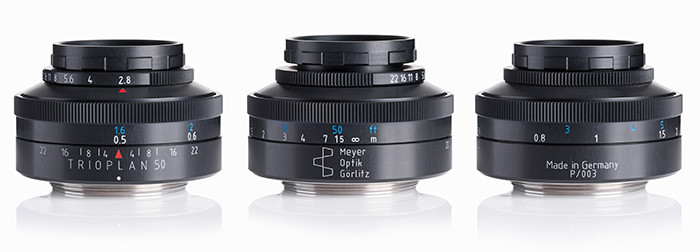
Meyer Optik announces the new Trioplan 50mm f/2.9 Micro Four Thirds lens.

trioplan-50-d

The German company Meyer Optik announced a new Kickstarter fundraising campagn for the 50mm f/2.9 Trioplan (Click here). The lens will be available in different mounts including Micro Four Thirds. The lens will cost you $449.

Press text:

New Lens Celebrates 100 Years of History by Delivering Soap Bubble Bokeh in Any Situation

Atlanta, GA — Meyer-Optik Görlitz announced today a new Kickstarter to fund the Trioplan f2.9/50, the next lens to restore the brand’s historic soap bubble bokeh to the modern market. One hundred years ago Meyer-Optik Görlitz announced the Trioplan lens, which soon became a legendary lens that helped establish the golden age of photography.  The new 2016 Trioplan f2.9/50 offers creative photographers the most versatile Trioplan yet with a built in front element that provides a macro capability of 1:4 and the brand’s famous soap bubble bokeh.

Image samples by Guido Karp:

mgo01_1123 Meyer Goerlitz Trioplan 50 kickstarter shoot (c) Guido Karp for GKP-LA_full res cc-2 mgo01_1466 Meyer Goerlitz Trioplan 50 kickstarter shoot (c) Guido Karp for GKP-LA_full res cc

“I am always looking for tools that offer me visual options,” said Guido Karp, professional celebrity photographer. “So I jumped on the opportunity to capture this incredible ‘bokeh’ in my images using a not so usual lens. I would have never thought of using any 50mm lens to shoot a portrait, but I am now so glad I tried – and now use the Trioplan 50 as one of my prime lenses.”

A modernized lens built with its historic ideal in mind, this new Kickstarter project takes the legendary Trioplan 50 design and updates it with state-of the art materials and handmade manufacturing capabilities. The new innovative front focus lens for the Trioplan f2.9/50 gives users a second way to focus, and allows nature and macro photographers to take 1:4 images, reducing the minimum focusing distance to 0,28 m from originally 0,8m..

The Trioplan 50 offers photographers a new level of artistic capability by producing great quality photos in a wide variety of scenarios; including landscape, street, nature, events, portraits, and more. The photographer can play with the lens’s numerous capabilities to produce the famous Trioplan bokeh backgrounds.

Image samples by Tamara Skudies:

IMG_8347

“The ultra lightweight and compact Trioplan 50 is so very versatile that I take it everywhere,” said Tamara Skudies, professional studio photographer, outdoor lover and connoisseur of historic lenses. “No matter if I shoot a super sharp portrait or a dreamy flowery landscape, the Trioplan 50 is my current choice.”

The ultra compact Trioplan 50 Kickstarter begins on April 14 and continues through May 13. Kickstarter backers will be able to fund the lens and get it at an extraordinary low price, starting at $499. Meyer-Optic expects the lens will retail for $1,299 (or higher?) once Kickstarter fulfillment is completed next winter.

“The Trioplan 50 offers photographers an unprecedented creative tool. You might describe it as the more delicate brother of the Trioplan 100 creating finer bubbles and adding more features” said Dr. Stefan Immes, CEO and creative director of the project. “Carrying a heavy lens kit is a luxury that most photographers have to shed at some point. Our new lens offers a compact versatile lens for almost every situation, including macro opportunities, all with the ability to deliver the unique soap bubble bokeh that Trioplan lenses are famous for.”

“I am always searching for the special and unique picture,” said Firat Bagdu, professional wedding photographer. “The Trioplan 50 offers a lot of character to underline a special moment. It’s much more than adding an effect, it’s about preserving a special mood or feeling when capturing a moment. Since I am a professional wedding photographer, the abilities of the lens are a real enrichment to my portfolio.“

Last year 452 backers made history and committed $359,000 to return the legendary Trioplan 100 with its soap bubble bokeh to the marketplace.  The Trioplan 50 is the newest entry to the brand line, extending it with a wider more compact lens to meet any situation.

The Trioplan 50 will be available for both mirrorless and DSLR cameras, including Canon, Nikon, Sony, Fuji and Leica brands. A full list of specifications is listed below.

The new lens will be available with mounts for
Canon EF
Nikon F
Sony-E
FujiX
Micro-Four-Thirds
M42
LeicaM (rangefinder not supported/focusing via live view)

The new Trioplan 50 is compatible with full format cameras and APSC (mirrorless) cameras. Here are some more tech specs at a glance:
Optical Construction: Classical Cooke Triplet, 3 lenses in 3 groups
Aperture: 1:2,9 to 1:22
Focal length: 50mm
Minimum Focussing Distance:  0,25 m using the front focussing mechanism (ß‘=-0,245 / 1:4)
Filter: 35,5mm
Clip-On Diameter: 39mm
Size:  Ø 62 mm, length 39 mm
Weight: 200g
Number of Aperture Blades: 12, AR-coated
Lenses: Anti Reflex Coating/ Supplier: Schott Glas
Format: 24 mm x 36 mm (Compatible with Fullformat and APSC Cameras)
Angle: 21°
Image Ratio: up to 1:4 using the front focusing element

About Meyer-Optik-Görlitz  
A brand with a proud tradition and reputation for exceptional products, Meyer-Optik-Görlitz started manufacturing innovative, high-quality lenses in Germany in 1896.  In 2014, net SE revived the traditional spirit of the lenses once known throughout the world and started developing new lenses under the Meyer-Optik-Görlitz brand in Germany. Manufacturing handmade lenses started in 2015 with first generation prototypes.  Serial production began in early 2016.
In May 2015, net SE created a new subsidiary, Meyer-Optik USA Inc. headquartered in Atlanta, GA. Meyer-Optik USA is online at http://www.meyer-optik-goerlitz.com and on Facebook and Twitter.  net SE (http://www.netag.de) is a publicly listed company (NETK) founded in 1997.

Poll: Should Panasonic join the T-mount system with FF cameras?

leicatmount
The Leica T FF mount

The “noise” is increasing about Olympus and Panasonic working on larger sensor cameras. There is yet no solid info a part of some Olympus patents. And as you know recently Leica launched the new SL FF system which has been co-developed with Panasonic.

The current Micro Four Thirds system has the best lens line up of all mirrorless system: And maybe the time has come to “expand” the possibilities by launching a new large sensor system. So let us know:

Should Panasonic join the Leica T-mount FF system?

View Results

Loading ... Loading ...