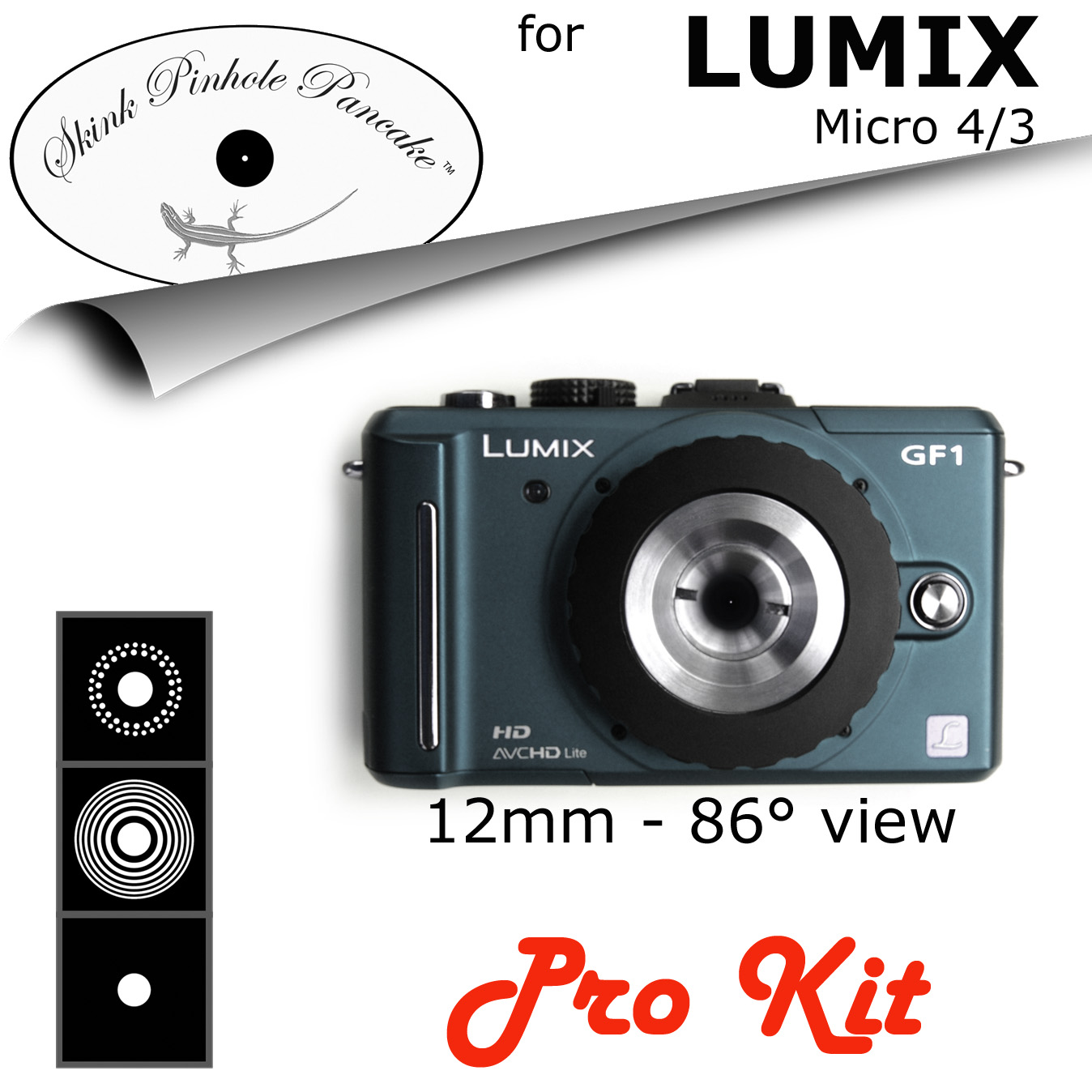
I was one of those guys that played some time with the old medium format Holga Pinhole camera. What I didn’t know is that there are [shoplink 16969]Pinhole kits on eBay[/shoplink] that do tranform your Micro Four Thirds camera in a digital Holga. [shoplink 16969]Check out the current auctions on eBay (Click here)[/shoplink]. You can also find some image samples!
With the release of the Nikon D90 and the Canon 5D MarkII (over two years ago) the age of the VDSLR (DSLR with video cameras) began. But according to the director Frank Glencairn that age is already past: “Okay, this is it. VDSLR is dead. It was cool, it was fun, it was great but it was also a major pain in the ass. It´s over. Panasonic came out with the [shoplink 16841]AF100[/shoplink] at IBC and then there is Sony and the Scarlet soon. We finally come back to real camcorders, without moire and all the other problems to deal with. Sorry Zacuto.”
Panasonic is about to release the very first professional (bye bye Sony NEX-VG10), useable (bye bye Canon 5D) and cheap (bye bye RED) big sensor videocamera. I am one those guys that shot documentaries and I really like that camera. That’s why my production company preordered the AG-AF100 ([shoplink 16841]at BHphoto[/shoplink]). It’s great news for the Micro Four Thirds folks (even if you don’t care about video). I hope the success of that camera will push Olympus-Panasonic and other third party lens makers to delivers us new lenses!
A message to our european readers: BHphoto is the only worldwide store accepting preorder. [shoplink 16841]Click here to add the camera to your basket and select your country[/shoplink]. They have an online calculator that tells you how much taxes you have to pay for your country and they will manage all the burocratic stuff!
Biofos published a very interesting interview with Mr. Terada from Olympus! De facto Olympus confirms that the classic Four Thirds system will continue and every customer will be supported for a very long time.
This are the most interesting parts of the interview (but please read the complete interview because there is really a lot of information!):
– Asked if Olympus is contractually tied to Panasonic MR. Tarada answered that “We always look for all possibility to have better product” and “We will choose whatever we think is best for our products. We are free and have selected current sensors as the best ones for our products.”
– “We said pixel race was becoming less significant than before, and thought 12MP would be able to satisfy most of the customers. But we are not sticking to any specific MP.”
– “Although there are no Four Thirds lenses currently under development, it does not mean that there will be no future lenses based on this technology.”
– He gave a “positive answer” when asked if there could be a Pro-level, weather-proof m4/3rds body and lens(es) at some point.
– “Having a large magnification optical finder with small body is a difficult to design. One of the benefit to have a EVF is to overcome this difficulty.”
– About the high price of the new Olympus E-5: “The price reflects both the performance we believe the camera delivers and the cost of producing it. To meet the professional level of robustness, we pay some costs on it.”
– When asked about the modular camera concept he said that “We can’t say concrete product plan.”
The Panasonic AG-AF100 will start shipping on December 27th. Reminder: [shoplink 16841]BHphoto is the only shop accepting preorders (Click here)[/shoplink].
PANASONIC PRESS RELEASE:
“SECAUCUS, N.J.–(BUSINESS WIRE)–Panasonic Solutions Company today announced that the AG-AF100, the industry’s first professional micro 4/3-inch video camcorder optimized for high-definition video recording, will start shipping on December 27th at a suggested list price of $4,995. Highly anticipated since its introduction at NAB earlier this year, the AF100 is poised to set new benchmarks in digital cinematography.
“The design of the AF100’s best-in-class 4/3-inch sensor affords depth of field and field of view similar to that of 35mm movie cameras in a more affordable camera body”
Targeted at the video and film production communities, the AF100 delivers the shallow depth of field and wider field of view of a large imager, with the flexibility and cost advantages of a growing line of professional quality, industry-standard micro 4/3-inch lenses, filters, and adapters. The full HD 1080 and 720 production camera offers superior video handling, native 1080/24p recording, variable frame rates, professional audio capabilities, and compatibility with SDHC and SDXC media.
“The design of the AF100’s best-in-class 4/3-inch sensor affords depth of field and field of view similar to that of 35mm movie cameras in a more affordable camera body,” said Jan Crittenden Livingston, Product Line Business Manager, Panasonic Solutions Company. “What’s more, Panasonic engineering ingenuity has resolved the aliasing and moiré that has haunted the DSLR shooter. Indeed, the proof of concept of the AF100 was based on what we heard from and saw customers doing: purchasing DSLR cameras because they liked the look of the image, but then agonized over all of the workarounds required to come out with an acceptable high definition recording.”
The AF100 incorporates a large 4/3-inch,16:9 MOS imager that minimizes skew with fast imager scanning, and incorporates low pass filters for elimination of aliasing and moiré. Additionally, it has a built-in optical ND filter. The camcorder records 1080 at 60i, 50i, 30P, 25P (Native) and 24P (Native), and 720 at 60p, 50p, 30p, 25p and 24p native,in AVCHD’s highest-quality PH mode (maximum 24Mbps). The AF100 also records in AVCCAM’s HA (17 Mbps) and HE (6Mbps) modes, 1080i only. Ready for global production standards, the camcorder is 60Hz and 50Hz switchable. Equipped with an interchangeable micro 4/3-inch lens mount, the AF100 can utilize an array of low-cost, widely-available still camera lenses as well as film-style lenses with fixed focal lengths and primes.
Variable frame rates are available in 1080p, selectable in 20 steps from 12p to 60p at 60Hz and 20 steps from 12p to 50p at 50Hz. Standard professional interfaces include uncompressed 4:2:2, 8 Bit HD-SDI out; HDMI out; and USB 2.0. It records SMPTE timecode and is able to perform timecode synchronizing via the video output seeing timecode in. It has a built-in stereo microphone and features two mic/line, switchable XLR inputs with +48V Phantom Power capability. The camera can record 48-kHz/16-bit two-channel digital audio recording (in PH mode only) and supports LPCM/Dolby-AC3 in any of the modes.
This newest Panasonic AVCCAM camcorder is the first to enjoy the benefits of advanced SDXC media card compatibility in addition to existing SDHC card support. SDXC is the newest SD memory card specification that supports memory capacities above 32GB and up to 2TB. With two SD slots for continuous recording, the AF100 can record up to 12 hours on two 64GB SDXC cards in PH mode, with automatic clip spanning across the two cards.
Weighing only 3.5 pounds (without lens or battery), the AF100 is packed with high-end features including Dynamic Range Stretch in all modes and frame rates; six built-in, customizable scene files that are exchangeable for quick and easy matching between multiple cameras; seven built-in gamma curves with four selectable color matrices; Syncro-scan shutter; and a high-resolution LCD and viewfinder.
It also offers a focus assist that can be used while recording, which is color-on peaking and a focus bar; two sets of adjustable zebras; two manual black and white balance choices, and preset White Balance at 3200K, 5600K or variable; a waveform monitor and vectorscope for more accurate monitoring of broadcast safe levels. Other essential features include pre-record; an intervalometer function that can be set for up to 24 hours, programmable User Buttons; a Smart Battery interface for recording up to four hours with a 5400mA battery; metadata recording; and a wireless infrared remote controller.
Panasonic will support the AF100 with a three-year limited warranty (one year plus two extra years upon registration).”
Preorder the [shoplink 16841]Panasonic AG-AF100 at BHphoto (Click here)[/shoplink].
The german store Bayern-Fotoversand is selling three new [shoplink 16903]Voigtländer 25mm f/0.95 for Micro Four Thirds on eBay (Click here)[/shoplink]. They told me the lens will be available in “in den nächsten 10-14 Tagen” which means 10-14 days! They only ship to Europe. I didn’t find any bigger online store having the lens available for preorder and usually Germany is one fo the first place where one might get Voigtländer stuff. If you [shoplink 15659]perform a worldwide search for the lens on eBay[/shoplink] you will only find germans resellers.
UPDATE: One of our readers just told us that Robert White (UK) is accepting preorders!
The Flickr user “Itemsis” just sent us an email to his latest images samples taken at Photokina using the new [shoplink 15659]Voigtländer 25mm f/0.95[/shoplink] on a Panasonic G1. You can see two more pictures here at Flickr.
The Panasonic AG-AF100 is the first professional Micro Four Thirds camcorder. According to [shoplink 16841]BHphoto[/shoplink] the camera will be in Stock within 6-10 weeks. The price without lens is $4,795.00 ([shoplink 16841]Click here to preorder the AG-AF100[/shoplink]).
We collected some of the recent comments made by Barry Green at DVXuser forum:
– In PH (24Mbit/s) mode the AF100 supports uncompressed LPCM audio in addition to the AC-3 audio supported by the HMC series.
– Three chips still deliver superior color to a single-chip system. The reason everyone’s going with a single chip is NOT increased color fidelity; a Bayer chip is inferior to three chips for color fidelity, and that’s why every broadcast camera on the market has three chips and a prism. But there are some things that just can’t be done with three chips — primarily, emulating the way a film camera works and the ability to use lenses that have been developed for film cameras. A single sensor directly emulates the way a film sensor works, and you don’t need to make accomodations in the lens design for a beam-splitting prism.
– I expect we’ll see many comparisons just like the 5D vs. Red comparisons, where people show a whole bunch of shallow-DOF headshots and say “see, the 5D is just as good as the Red One.” If people shoot AF100 vs. 5D/7D and they limit themselves to those kinds of shots, then they’ll probably look quite comparable and there won’t be any “blowing away” going on. Where the AF100 will be hugely superior is in wide-angle deep focus shots, in terms of actual resolved detail, and in features and usability.
– So, is AVCHD a “step down” from DVCPRO-HD? In some ways, yes, in some ways no. It’s 4:2:0 instead of 4:2:2. And it’s long-GoP instead of intraframe. However, it’s also 2001-era technology, vs. 2010-era technology. So would it be fair to say that AVCHD can deliver comparable images as compared to DVCPRO-HD? Possibly. An intriguing question.
– DVCPRO-HD is 4:2:2, but it also prefilters the recording resolution down from 1920×1080 to 1280×1080. AVCHD is 4:2:0, but it retains the full 1920×1080. So DVCPRO-HD will have twice the color resolution but only 2/3 the horizontal resolved detail.
– And DVCPRO-HD is bulletproof as far as motion artifacting, whereas AVCHD is a long-GoP codec. However, as a long-GoP codec, it’s really good; I compared it against XDCAM-EX and found AVCHD to be much more robust regarding motion artifacts from cases where the codec gets overloaded. So while it isn’t a true intraframe codec, it’s much less susceptible to the issues that caused long-GoP codecs to get the reputation they got in the early days of HDV.
Samyang just announced the availability of the new 35mm f/1.4 lens since February 2011. Samyang lenses are manual focus only but very cheap with with good image quality! Read for example the Samyang 85mm f/1.4 Photozone review (Tested on the Canon 5d).
You can check current Samyang auctions on [shoplink 16768 ebay]eBay by clicking here[/shoplink].


 [/shoplink]
 and the
  : “The price reflects both the performance we believe the camera delivers and the cost of producing it. To meet the professional level of robustness, we pay some costs on it.”
 [/shoplink]

 and found AVCHD to be much more robust regarding motion artifacts from cases where the codec gets overloaded. So while it isn’t a true intraframe codec, it’s much less susceptible to the issues that caused long-GoP codecs to get the reputation they got in the early days of HDV.
 [/shoplink]