




New Single Lens 3D tech from Panasonic.

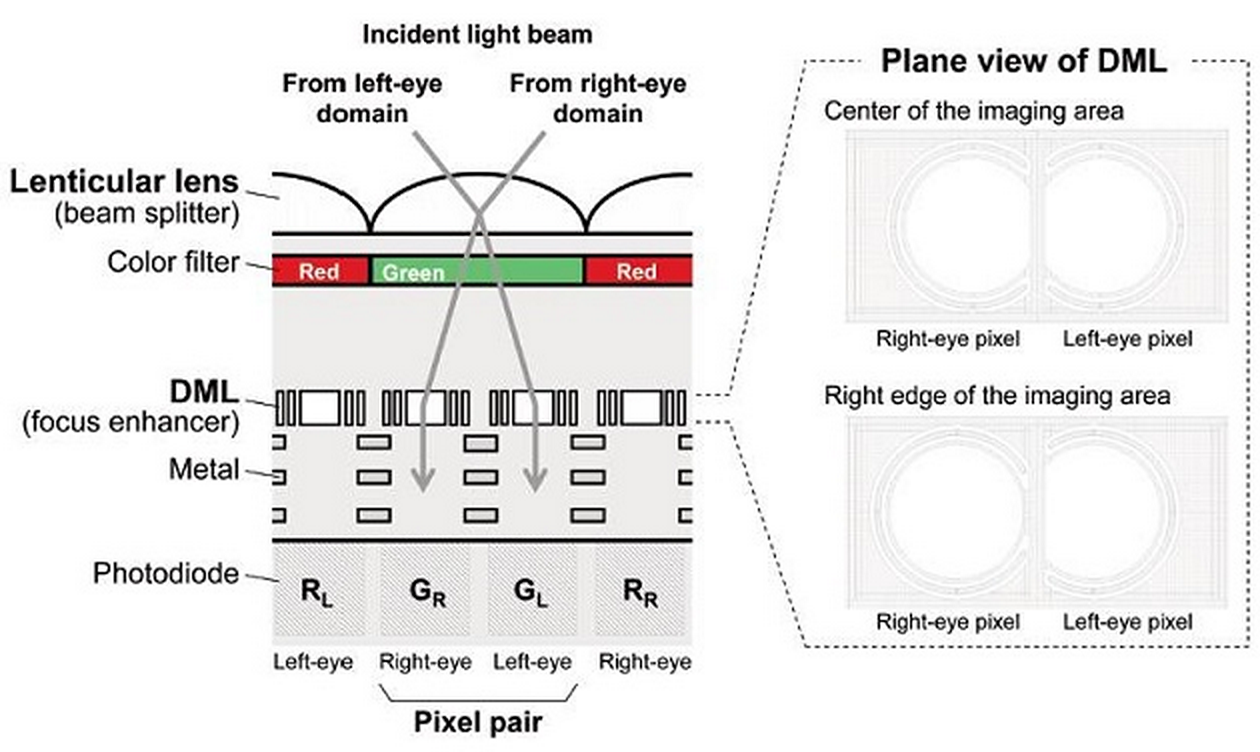
There was a time when everyone was talking about the 3D future. And we MFT users also got the first 3D lens for a digital mirrorless system from Panasonic (the 12.5mm f/8 here at Amazon). Now the hype is over but I am sure 3D will come back. Image Sensor World spotted that Panasonic design explaining the new Single Lens technique. Instead of using special 3D lenses you focus on the use f special 3D sensors. I guess smartphones and compact cameras may will be released with the mentioned technique. Don’t believe Panasonic will make a MFT 3D camera but if they do you may be able to use all your MFT lenses for shooting 3D. Nice.


JimD
3 months ago |I thought 3d for cameras and TV died and was put to rest. Trying to resurrect it would be an expensive project. It would have a lot of negativity to overcome and I don’t think Panasonic is in a position to do that on their own.
At present only a 3d TV could be used as the output. So how do you show your friends your ‘snaps’ over coffee?
Wt21
3 months ago |just…don’t…care
J Shin
3 months ago |I don’t see how this could work, unless there are two lenses as well? You can’t extract stereo information from a mono signal.
Dolo
3 months ago |You can extract 3D information from a single lens. That’s what the lenticular lenses do, they split the light coming into the left half of the lens from the light coming into the right half of the lens. Unfortunately, to get good 3D, you need the left half to be far away from the right half, and in this design the left half and the right half will be as close together as the entrance aperture of the camera. On most cell phone cameras the entrance aperture is under 1.5mm, and good 3D needs the left and right halves to be 50mm apart or more (like the spacing of human eyes).
Riley
3 months ago |actually there are similarities between this and phased detect AF
but being that the microlens is in effect a single lens it will reverse the image
hence you see left where right is and right were left is
no doubt fixed in processing
J Shin
3 months ago |I guess if the lens is big enough to encompass both human eyes, 100mm or so, you could separate photons from the “left side of the lens” and the “right side of the lens”, which, as you say, will be flipped on the image plane. Otherwise…
Like, if you have a ball in front of another ball, the left eye sees the front ball as being further to the right, and the right eye sees it being further to the left. If the lens isn’t that big, it will mostly see the ball directly in front of the other ball; phase prism will not change this. With lenses where the aperture is smaller than the front glass–i.e., anything but long lenses fully open–in fact, the field of view will be completely different on the left side of the lens and the right side. You can see what I mean by taking out your large-glass lens and blocking the left side vs. right side.
I wish I could post images to show what I mean. (Can I switch my vote to DISQUS?
They butcher posted images, tho’…)
Like with Wt21, I don’t care. Just more needless intellectual fodder and genuine curiosity/puzzlement.
EASY
3 months ago |Wasting of time and money…
Bob B.
3 months ago |Based on the sale of the MFT 3 D lens….why would Panasonic pursue this? I could be missing something, as I only shoot stills and totally have no interest whatsoever in anything 3D (I have my hands full with 2D. LOL!). Is this a video thing?
Anonymous
3 months ago |” I guess smartphones and compact cameras may will be released with the mentioned technique.”
Actually, the proposed technique would only work properly with big lenses. Really big lenses.
Wouldn’t work well for the smaller MFT lenses.
martin
3 months ago |I’d assume that industrial use is the primary target. Here, 3-d imaging often is an asset and the cost of a wide-aperture lens may be less of an obstacle, in particular if it gives you a robust single-sensor, single-lens package relieving you from the adjustment hassles otherwise connected to 3-d imaging.
Riley
3 months ago |sure, they invented it for themselves because they know it wont work
bzzzzz
Anonymous
3 months ago |Oh please, Riley, tell me more.
Preferably without the crap attitude.
Ulli
3 months ago |a good photo is 3d enough for me
Dear Panny,
3 months ago |We asked for 3D, not cross-eyed 2D.
Mike1
3 months ago |The technology sounds logic to me. Using phase detect AF to map out the distance between any 2 points on the Z-axis (the depth), then using the 2D-3D conversion technique to render the 3D image.
Harry
3 months ago |It looks more like a mechanism for doing phase focusing than 3D.
JimD
3 months ago |Consumer wise its not much of a go. However as an imaging device in the medical area it may have some success, also in security and defence, even have fibre optic input from 2 seperate lens systems with adapters, it does not have to record at human eye width it could be viable depending on the need. Or simply recording 2 channels of an event that requires 2 separate synchronised devices at present.
For the home forget it. For the neck trophy brigade has a chance if the price is high enough (just imagine a Gtwin5 with gold plated adapters and twin 50mm ‘lux lenses, take all day to focus, but what a neck trophy).
For quite a few commercial applications yes definite possibilities.
Also put it in a GH3 and sell it to IMAX.
oluv
3 months ago |3d photography is acutally pretty cool and a pity it isn’t developed any further.
i bought a fuji W3 quite cheaply as i wanted to play with 3d a little bit and it really caught my attention. the 3d-display is acutally very awesome. the 3d-effect is very convincing and one of the better autostereoscopic screens i know.
unfortunately the camera itself is crap. both lenses have different sharpness and the sensor is also rather sub-par. the images look as if they were scaled up.
if there was a 3d-kamera of really good quality, i would definitely be interested.
Mat
3 months ago |Consider, if you were to look through a big magnifying glass, would you not still see in 3D? If you have eye-glasses, just hold one of the lenses in front of your face, with one eye closed, and move side to side – the image changes just as it would without glasses.
Dummy00001
3 months ago |“Now the hype is over but I am sure 3D will come back.”
I hope not. Not until 3D is more accessible and universally compatible.
The only interesting application of the 3D tech is the manipulation of DoF: to allow OOF blur even very small sensors. Think of it: AF acquisition at literally infinite DoF, but output image with shallow DoF – all that without changing aperture. Though I doubt the first samples of the tech would be as useful (for more, see Lytro which allows for DoF manipulation, but in very limited capacity).
Koseng
3 months ago |I think 3D is undergoing what is called “new tech hype cycle” and has passed the initial stage of “high expectation”. It may has entered the next stage of development.
I’ve heard the porn industry has already been playing around something called “life size 3D”. Probably the porn industry would lead the way in 3D photography
))
JimD
3 months ago |Getting an eye full would be a hole new experience.
Riley
3 months ago |video,hence 3d, is the future for marketing
cirrostratus
3 months ago |Is this, in effect, creating even more, even smaller, noisy pixels?
DIY
3 months ago |This seems familiar, yes a like a simplified version of lytro, and maybe like one of my old designs.
As for phones, it might lack performance on the smaller slower aperture lens. It is more suitable to wider lens, sensors like medium firm at of mft, as the extra spacing from side to side of the lens gives more stereo 3d effect. However, the faster the aperture, the likely more aberrations you might experience. Probably not really a worry at f1.8 but maybe more so at f1.4 or faster, depending on how much the micro lens can handle. Look on the sensor site for the Samsung version.
So, yes 43rumours, a definite possibility on micro 43rds, or digital stills too, but might limit the speed of lens you can use. So, definitely something for the cheap mft, as professional might be limited a little. However, this might be seen as a luxury feature and end up costing, or primarily a video camera sensor, which I hope not.
Now such a scheme on a 3 color pixel camera that would be interesting due to less low pass filtering.