

a bit of everything…
YOU Should Buy A Panasonic G85, And Here’s Why!
Prime or Zoom? Can one lens really replace three? (Matt Sulanto).
DPReview TV: Why Shutter Angle Is Better Than Shutter Speed (for video)
Costa Rica | 24 Stunden im Regenwald | Mini Doku 4K by GH5shooter
Full-Tilt Manual: Going Analog with your Digital Camera (Explora).
Share your best pictures on our new Instagram MicroFourThirdsGallery.
Plenty of news on the facebook E-M1II group, Panasonic FF and the GH5 group.
Olympus 40-150mm f4.0-5.6 R for $99!!!
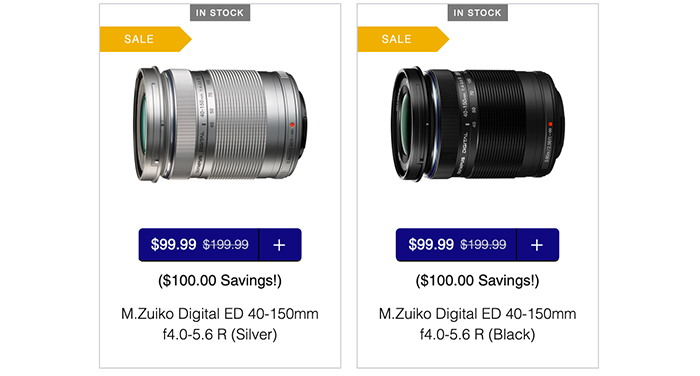
You get the Olympus 40-150mm f4.0-5.6 R for $99 at GetOlympus and BHphoto. This is the new version and not a reconditioned item!
a bit of everything…
Pro Lens Adapters for Micro 4/3 Cameras
Wise C-Fast, SD & SSD for the BMPCC 4K
Godox Introduces Round-Head V1 On-Camera Flash (Explora).
Sony A6400 VS Panasonic Lumix G95! THE Dishonest Comparison! (TheEveryDayDad).
Leica 8-18mm -BEST wide zoom for Lumix? (Matt Sulanto).
Share your best pictures on our new Instagram MicroFourThirdsGallery.
Plenty of news on the facebook E-M1II group, Panasonic FF and the GH5 group.
Ending today: The Travel Tripod by Peak Design raised $11 million dollars on Kickstarter

The Peak Design tripod Kickstarter funding will end tonight. Amazingly they raised $11 million dollars with this!!!
The new Irix 150mm T3.0 Macro 1:1 Olympus/Panasonic MFT mount will cost 1195 € / US$1195
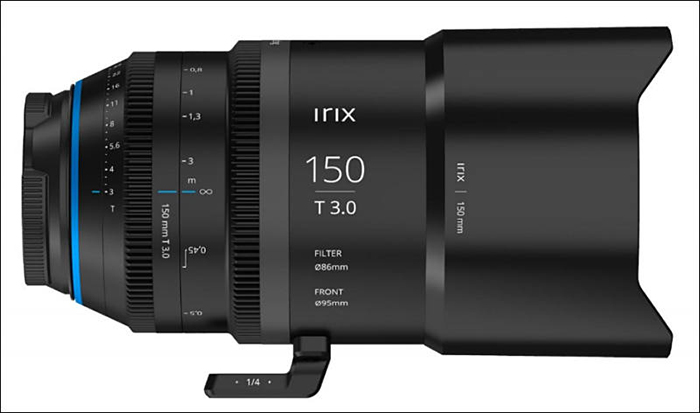
Press text:
Irix announces prices and availability of Irix Cine 150mm T3.0 Macro 1:1 – the very first of Irix Cine lenses lineup.
Irix 150mm T3.0 Macro 1:1 is a full frame (43.3 image circle), 8K ready lens with T value 3,0 to 32. The lens will be available in four mounts (Canon EF, Sony E, Olympus/Panasonic MFT, PL mount) and delivered to dealers early August 2019. Suggested retail prices are as follows:
Irix 150mm T3.0 Macro 1:1 Canon EF mount 1195 € (VAT incl.) / US$1195
Irix 150mm T3.0 Macro 1:1 Sony E mount 1195 € (VAT incl.) / US$1195
Irix 150mm T3.0 Macro 1:1 Olympus/Panasonic MFT mount 1195 € (VAT incl.) / US$1195
Irix 150mm T3.0 Macro 1:1 Arri PL mount 1295 € (VAT incl.) / US$1295
The launch of our 150mm T3.0 Macro 1:1 is a special moment for the Irix team. The first ever Irix Cine lens is a result of not only hard work, but also countless hours of extensive development filled with passion, innovative creation and cooperation between engineers and the design team. The project, now finalized, brings us pride – and lets us present to the world an entirely new Cine lenses line.
The close collaboration between Irix designers and professional filmmakers showed how powerful are close-up shots as a medium of expression. With the Irix Cine 150mm such freedom of creation can be expanded even more – to create countless new artistic possibilities.
From the very beginning, our intention was to provide the cinematographers with the most advanced and versatile lens in this particular focal range. The moderate focal length of the Irix Cine 150mm T3.0 Macro 1:1, combined with its exceptional functionality, makes it a fantastic tool to discover new fields of creation – ones that were not easily accessible for enthusiasts of filmmaking before. Release of the 150 mm T3.0 Macro 1:1 as the first lens in the Cine line is a great opportunity to share ideas and unique solutions developed especially for the Irix Cine lenses.
Compatibility.
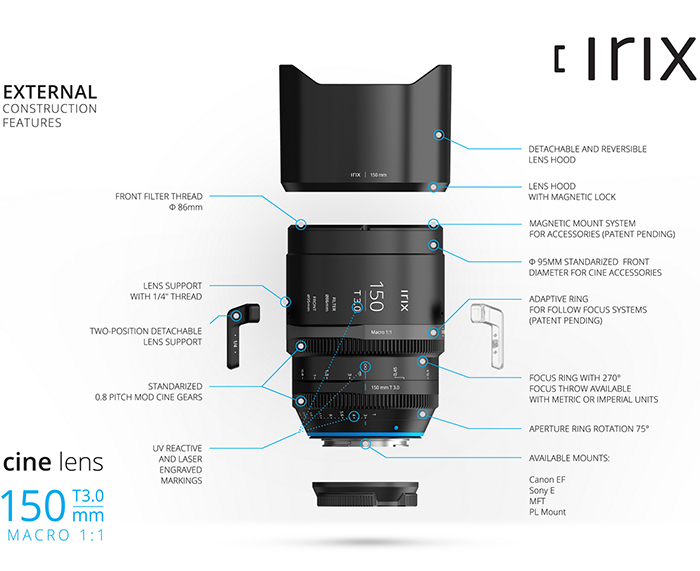
The lens is compatible with standard sizes and systems used in cinematography. It’s equipped with a lens hood that can be easily replaced with a typical matte box of a 95mm diameter. The front of the lens is equipped with a 86mm filter thread. For extra stability when filming, the lens can also be fixed to a cage with a lens foot (included in the kit) with a typical ¼ mount thread. All future Irix lenses will have gears at same height for greater comfort of use.
Ease of use.
Without a doubt, focus ring rotation aka focus throw is a very important factor in the macro lens. For that reason, we constructed a MST mechanism with a 270 degrees rotation angle. The aperture ring can be rotated within a range of 75 degrees for more accurate light control.
Loaded with functionalities.
The lens was crafted with numerous new solutions and fresh ideas in mind. The front of the lens is equipped with the Magnetic Mount System (with an innovative lens hood as its first element) for an effortless installation of additional accessories. The Adaptive Ring for follow focus not only lets the filmmaker enjoy full functionality of the follow focus systems, but also makes the lens more user-friendly when follow focus is not used. All for one reason – greater versatility.
Ready for action.
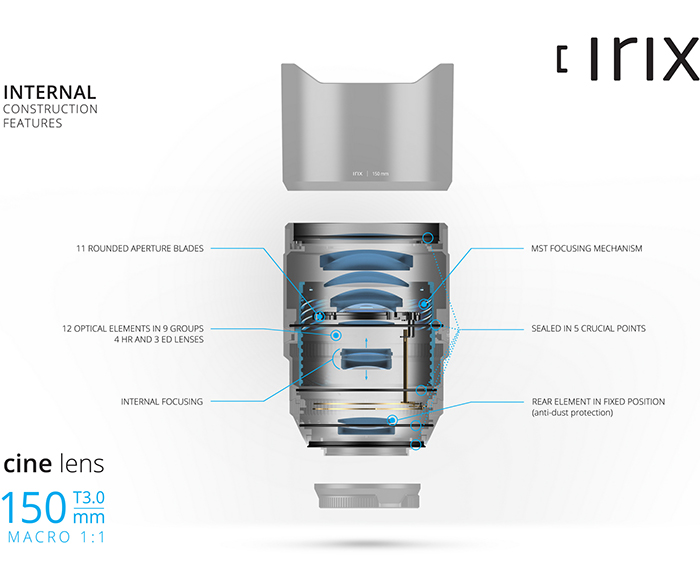
The lens is weather-sealed (equipped with 5 rubber rings, PL mount 4 rings) and lightweight. The construction is made of durable magnesium alloy, which provides endurance but weights only 1105g (Canon EF version). The built makes our lens well-balanced in use with mid-size camcorders as well as DSLR/mirrorless cameras. Engraved letters are filled with UV reactive paint for better readability in low light conditions. All to make your work easier and more pleasant.
Quality as top priority.
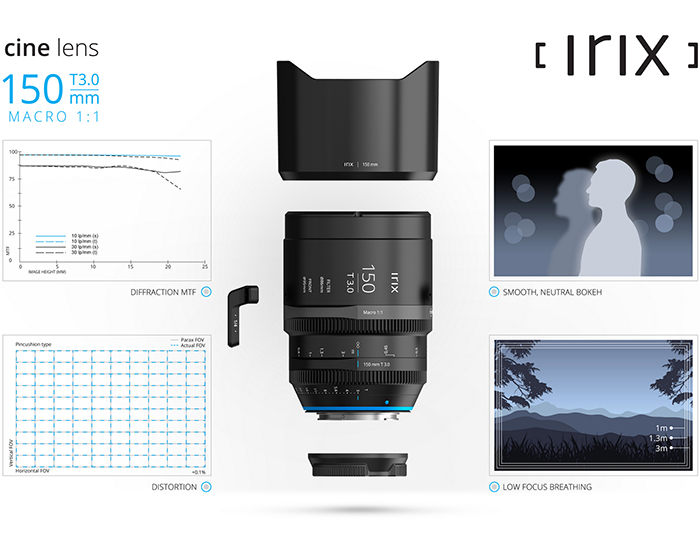
The lens is 8K ready, built on 12 optical elements construction, internal focusing and equipped with an 11 blade aperture. All to give highest possible image quality, bokeh, performance and lowest possible focus breathing. What else is needed to enjoy the Irix quality?
All features, functionalities and possibilities of the Irix Cine 150mm T3.0 Macro 1:1 are shown on the infographics below.