I know this is the future, I don’t know if this camera will be a success…but I am definitely happy it comes with MFT mount and we can bring some true innovation in the MFT world!
Camera Intelligence Unveils Caira – The World’s First Interchangeable Lens Mirrorless Camera with Google’s “Nano Banana” Onboard
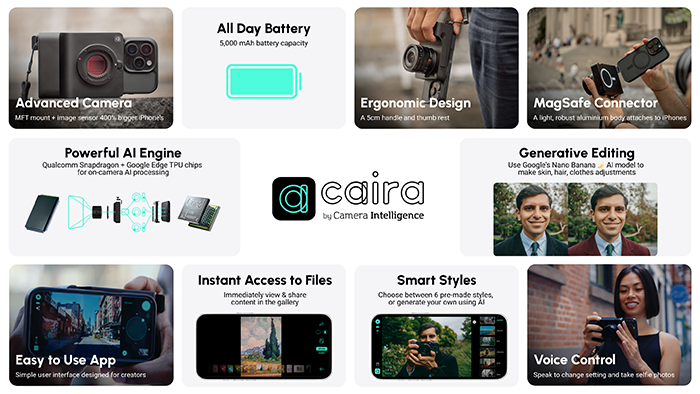
London and New York – October 6th, 2025 – Camera Intelligence today announced Caira, a new AI-native Micro Four Thirds mirrorless camera that attaches to iPhones via a MagSafe connector. Caira is the world’s first interchangeable lens mirrorless camera to feature Google’s next-generation generative AI model, ‘Nano Banana’, integrated directly into its product. This powerful fusion of professional optics and advanced on-camera intelligence empowers creators to do advanced image editing in real-time, drastically streamlining content creation workflows.
With the integration of Google’s ‘Nana Banana’ model, Caira ushers in a new era of on-camera “generative editing,” moving beyond simple capture to offer in-the-moment creation and editing, for spectacular real-time adjustments that were previously only possible through complex post-production software and workflows on laptops.
Using simple natural language prompts users can instantly change the style or colour grade of a scene, transform a bright daytime scene into a dramatic nightscape, or even make hyper-specific additions, like changing the colour of a subject’s clothing or hair, or placing jewelry on a person’s body, all directly within the Caira app after the photo has been taken.
With Caira, we are not just launching a new camera; we are introducing a new, intelligent creative partner,” said Vishal Kumar, CEO of Camera Intelligence. “Creators need more than just great image quality – they need speed, flexibility, and tools that match the pace of their imagination. By integrating Nano Banana directly into Caira, we are collapsing traditional content creation workflows; we aim to fundamentally shift how creators capture, edit, and share our world.”
Understanding the profound implications of this technology, Camera Intelligence is developing Caira with an ethics-first approach. The company is actively collaborating with a diverse group of professional photographers to establish responsible use cases. Furthermore, Camera Intelligence is designing ethical system prompts and safeguards within the AI model to prevent misuse. The technology will always adhere to Google’s Generative AI Prohibited Use Policy, and it will not permit alterations to a person’s skin tone, ethnicity, or core facial features, ensuring the tool is used to augment creative expression, not to unethically manipulate personal identity.
“We’ve put a lot of thought into this technology before offering it to our customers. Despite the skepticism surrounding generative AI, we believe photographers shouldn’t fear it. Thoughtful integration of this has the potential to be truly helpful. We chose Google’s Nano Banana because it’s the best model we’ve seen for maintaining consistent character details and seamlessly blending new edits whilst preserving the original image’s optical quality. Its one-shot editing capability is also exceptional, frequently delivering perfect results in a single attempt without unwanted hallucinations. It truly feels like magic.”
Caira is designed for creators and businesses who demand both cutting-edge quality and unparalleled creative freedom. By leveraging on-camera AI, Caira eliminates the need for laptop-based post-processing for many creative tasks, offering a seamless ‘shoot-and-share’ workflow for high-quality content creation.
Availability
Caira Camera will launch for pre-order exclusively on Kickstarter, with the campaign scheduled to go live on October 30th, 2025. Interested customers can sign up for launch notifications on the company’s website – www.cameraintelligence.com.
About Camera Intelligence:
Camera Intelligence is a pioneering company building an AI-powered camera platform that simplifies professional content creation. By integrating advanced AI directly into a mirrorless camera system that connects to smartphones, Camera Intelligence empowers creators and e-commerce businesses to produce high-quality content with ease.
TheYi M1 is perhaps one of the most underrated and forgotten cameras in the Micro Four Thirds space. Launched in 2016, it boasted a 20MP Four Thirds sensor developed by Sony (same as in the Panasonic GX8 and Olympus PEN-F).
Despite impressive specs and a Leica-inspired design, it failed miserably. Why? Poor launch timing, weak autofocus at launch, lack of features like IBIS, viewfinder, and even basic options like RAW+JPEG initially. It felt more like a smartphone with a lens mount—operated entirely via touchscreen with minimal physical controls.
Over time, firmware updates did improve many aspects including autofocus and UI, but the damage was done. Yi discontinued the camera quietly and never followed up with a successor. Tom Calton still thinks that this camera is a collector’s oddball gem—and proof that even bold entries can fail without polish.
Today deals at Amazon, BHphoto, Adorama, Amazon DE, Amazon UK, Amazon FR, Amazon IT, FotoErhardt DE, FotoKoch DE.
My 8 Micro Four Thirds FAVORITE BUDGET Lenses – Travel, Landscape, Street, Portrait (Gary W).
ProGrade Announces Digital PG10 External SSD (Explore).
What I Would Do Differently If I Were to Start Over with Macro Photography (42West).
OM-System M.Zuiko Digital ED 50-200F2,8 IS PRO – geniales Objektiv HandsOn mit Stacking-Testbildern (RingFoto).