



a bit of everything…
NiSi 9mm f/2.8 Sunstar Lens for m4/3 – Image examples with the OM System OM-1
Today deals at Amazon, BHphoto, Adorama, Amazon DE, Amazon UK, Amazon FR, Amazon IT, FotoErhardt DE, FotoKoch DE.
Micro Four Thirds Wide Portrait Using Panasonic 20mm f1.7 feat. GX85 (Gary W).
Small & Versatile Wireless Microphones – BOYA BY-XM6-S2 MINI (Robin Wong).
DJI RS 3 Mini Gimbal: An Overview (42West).
Anamorphic for All with Atlas Lens Co. Primes (Explora).
Plenty of news on the facebook OMD group, Panasonic FF and the GH5 group.
Ending soon: $50 discount on the Topaz Image AI and Video AI bundle and 20% off on Luminar

Both the Video AI and Imagq Quality AI app got a $50 discount (Click here).
And til January 31 you save 20% on Skylum Luminar Neo and all extensions (Click here).

Reminder:
The new Spinn CP is now available on Kickstarter (Click here). It’s a different way to carry your camera and an update to their previous CP version. It now comes with two different base plates and a adjustable comfort strap made in five colours. From recycled raw materials.

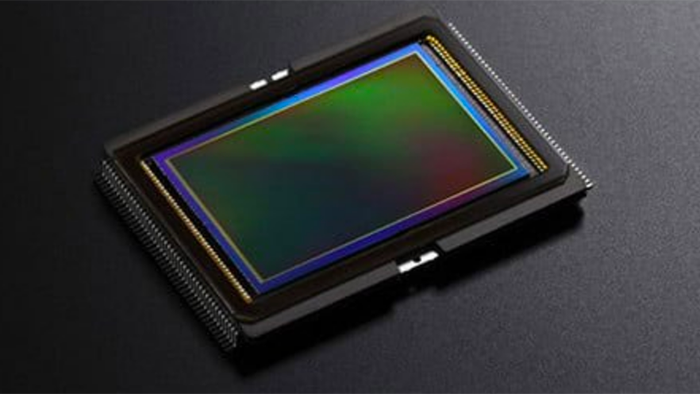
Announcement: Panasonic has developed a technology that captures hyperspectral images with the world’s highest sensitivity

Today Panasonic announced a technology that captures hyperspectral images with the world’s highest sensitivity. Panasonic writes (google translated):
In conventional hyperspectral imaging, optical elements such as prisms and filters that selectively pass light of specific wavelengths are used to detect the light of the wavelengths assigned to each pixel of the image sensor. However, these methods have physical limitations in that when looking at each pixel, light with wavelengths other than the “assigned wavelength” cannot be detected, and sensitivity decreases in inverse proportion to the number of wavelengths.
Therefore, we have developed a special filter using a structure that utilizes the wave properties of light, called a Distributed Bragg Reflector (DBR) *6 , and installed it in an image sensor (Fig. 1a,b). ). This special filter is designed to randomly change the intensity of the light emitted from the observation target for each pixel and wavelength (Fig. 1c). Changing the intensity for each pixel and for each wavelength corresponds to “decimation” of data. By properly detecting in the “thinned” state, the “before thinning” state can be restored on the software. With this technology, color separation is performed by software restoration, so the software takes on part of the color separation function, eliminating the physical limitations in sensitivity that conventional hyperspectral imaging technology had. broke through.

Using the above-mentioned special filter allows light of multiple wavelengths to pass through, increasing the amount of light detected by the image sensor and improving sensitivity. Specifically, the developed special filter passes about 45% of the incident light. This is about 10 times higher than the light utilization efficiency of conventional technology (5% or less), and the world’s highest sensitivity. In an example of an image taken with the brightness of general office lighting (550 lux), the developed technology was able to capture a clear image (Fig. 2a), but the conventional technology was only faintly visible (Fig. 2b). In this way, the developed hyperspectral imaging technology enables clear imaging without the extremely bright special lighting (over 10,000 lux) required by conventional hyperspectral cameras.
Using the developed special filter and color restoration on the software, we succeeded in capturing hyperspectral images by dividing the visible light region (wavelength 450-650 nm) into 20 wavelengths. Since the data is appropriately “thinned out” by the special filter, the colors can be accurately separated on the software, and correct spectral information can be obtained as shown in the color sample photograph (Fig. 2c). Since it can detect 20 wavelengths and an extremely large amount of color information, it improves the accuracy of image analysis and recognition compared to the naked eye and color cameras that can distinguish only three colors (red, green, and blue). later).
If I got this right this is a bit of the holy grail of photography. Something similar to the Sigma Foveon tech. Instead of having every pixel collecting the info of only one color (R or G or B) it would collect the entire color and luminosity info on one single pixel.
I only do hope this isn’t a project like the infamous organic sensor which was presented many years ago and never made it into a real production camera!
New firmware update for the Olympus 300mm PRO lens
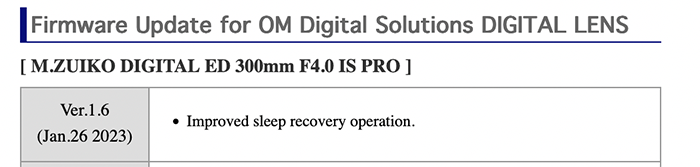
You can now download the new firmware update for the 300mm lens: cs.olympus-imaging.jp/en/support/imsg/digicamera/download/software/firm/e1/
This is likely the first image taken with the new OM 90mm f/3.5 macro lens

OM System posted a new macro video teaser (see below). And it’s highly likely that the image you see has been shot with the upcoming 90mm macro lens!
via DClife
a bit of everything…
Improve Photography Without Upgrading Gear – With @sulantoblogvlog & @ForsgardPeter
Today deals at Amazon, BHphoto, Adorama, Amazon DE, Amazon UK, Amazon FR, Amazon IT, FotoErhardt DE, FotoKoch DE.
Bosma Enters 8K Market with G1 Pro Cinema Camera (Explora).
Best Carbon Fiber Tripods (42West).
DPReview Readers‘ Choice Awards 2022: Product of the Year
Ask Me Anything: The Focus Episode (OM Youtube).
Plenty of news on the facebook OMD group, Panasonic FF and the GH5 group.