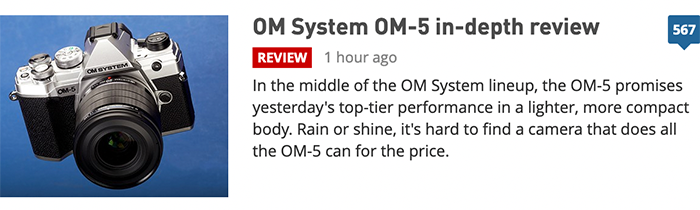
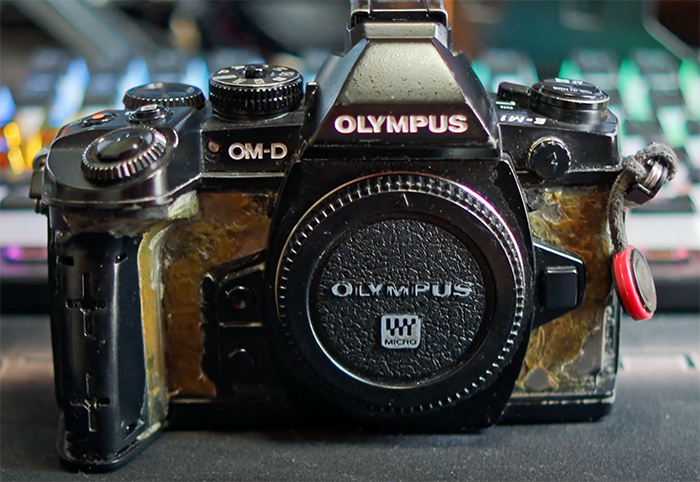
The OM-5’s balance between durability, capability, and portability is hard to match anywhere in the photography world. Although it lacks bleeding-edge performance, for the money this model gives beginners a lot of bang for the buck. It can take great-looking stills, has some of OM System’s famed computational photography features, and can shoot good enough video in a pinch, all while snapping away in snow and rain.
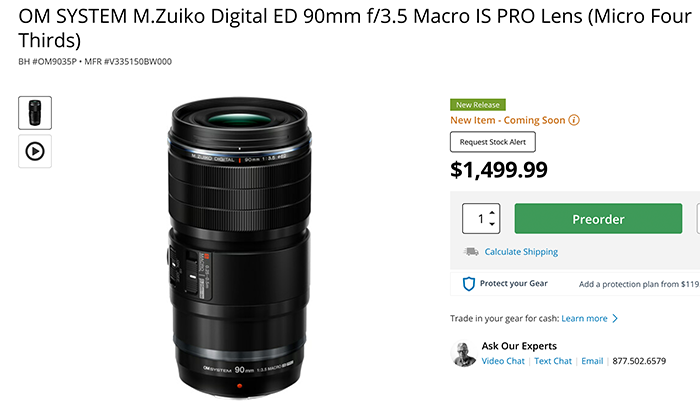
Our resolution test showed clearly that the lens has to be closed down by 1-1.5 EV to reach the peak of its performance. It means that the macro scale and the maximum performance needs an effective aperture f/8-11 so you will have to tolerate just decent resolution values near 55-65 lpmm at most. They are very far from record values amounting to 95-100 lpmm that are possible to achieve in the Micro 4/3 system.
In other words, the decision of using the f/3.5 aperture means potential users will profit from only a bit over a half of resolution that can be offered by this system.
Another misconception is a recommendation for photographers to attach the OM System M.Zuiko Digital ED 90 mm f/3.5 Macro IS PRO to a teleconverter. We are tempted by an impressive 4:1 mapping scale but nobody mentions the fact that working in its proximity you can count on the maximum effective aperture of f/16. By f/16 the Micro 4/3 system is simply useless because it provides resolution on a level of just 40-42 lpmm. Indeed, even such values are unattainable because it’s a diffraction limit for this aperture. Meanwhile for this set it constitutes the maximum relative aperture which has to be closed down by 1-3 EV in order to achieve the peak of the performance. It means in turn you would have to employ f/22-45 apertures which are completely useless in the case of the Micro 4/3 system.
I don’t doubt that a macro lens, designed for the Micro 4/3 system, that is supposed to offer better mappings than 1:1 should be faster than its full frame equivalents. Unfortunately OM Digital Solutions copy mistakes of Olympus and consequently offer slower lenses, destroying all possible assets of the use of a smaller sensor. I fail to understand such a policy…
When it comes to the tested model, so the OM System M.Zuiko Digital ED 90 mm f/3.5 Macro IS PRO, it performed exactly as we expected, delivering good quality images up from the maximum relative aperture, very good on slight stopping down. Its parameters didn’t allow it to do more but we’ve already covered that topic…
Lenstip is disappointed that OM Digital didn’t make the lens faster. I know it would have been an even bigger lens but maybe this would have made more sense?
Micro Four Thirds Panasonic 20mm f1.7 Portrait and 35-100mm Landscape feat. GX85
Lumix GM1 Takes Over –Goodbye Ricoh GR3
Olympus 12-40 f2.8 first impression
Panasonic Lumix 35-100mm f/4-5.6 – The BEST COMPACT Telephoto Lens for Micro Four Thirds
The man behind the Olympus OM camera: Yoshihisa Maitani (DigitalCameraWorld).
Finally, I Have The OM-1 (Robin Wong).
The medium format camera ma.rket is expected to grow further til 2027 (Reserch and Markets).
A Guide to Using Vanishing Point in Photography (42West).
Enjoy Outdoor Shooting with the Protective PhotoPod and MyPod (Explora). LUMIX GH6 | 3 Shooting Tips in Low Light Situation
New Adventures with the OM-5 (Adrien Sutter).
A Guide to Car Photography (42West). LUMIX GH6 | New expression with Dynamic Rage Boost mode
Lav vs. Shotgun Mics for Interviews: Which is For You? (Explora).
Go Wide! A look at four top ultra-wide primes for Micro Four Thirds (Dpreview).