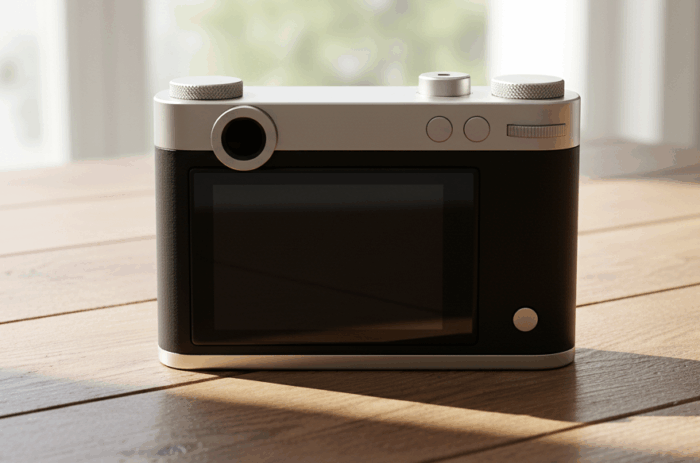
Lats week Photographer Côme Courteault has launched the new Esquisse Camera project (check out the website). A 20MP MFT camera with built-in 256GB storage, EVF in a high quality aluminum unibody. I used the one official image and the official sketches to create a more realistic rendering of the camera. It gives you an idea of how it will look in real life:
According to George Holden, when it comes to street photography, two brands often stand out for their vintage aesthetics and practical usability: Fujifilm and Olympus (now OM System).
While neither Fujifilm nor Olympus use full-frame sensors, both bring unique advantages to the table. Fujifilm relies on APS-C sensors, while Olympus uses Micro Four Thirds. Surprisingly, for street photography, these smaller sensors can actually be a benefit—offering greater depth of field and compact lenses, perfect for everyday shooting on the go.
Fujifilm’s strength lies in its digital implementation of zone focusing, first introduced with the Fujifilm X-T2. This allows photographers to pre-set a focus distance and use depth of field for faster, more reliable shooting without depending on autofocus. Holden praises this feature for its precision and efficiency in fast-paced street environments.
Olympus (OM System), on the other hand, benefits from its two-times crop factor. Lenses like the Olympus 45mm f/1.8 deliver a 90mm equivalent field of view in a tiny, lightweight body. This makes it easy to achieve telephoto reach without carrying heavy glass. The deeper depth of field from Micro Four Thirds sensors also helps keep scenes sharp from foreground to background, which can be ideal for storytelling in street photography.
Price is another factor. Fujifilm cameras like the X-T1, X-E1, and X-Pro1 still hold value, but bargains can be found. The X-T2 in particular remains a great option thanks to its zone focus interface. Olympus bodies such as the OM-D E-M5, PEN E-PL10, or the compact OM-D E-M10 series offer affordable entry points into the Micro Four Thirds ecosystem.
Ultimately, Holden highlights that the choice between Fujifilm and Olympus depends on your style. If you value film-like shooting with advanced focus tools, Fujifilm delivers. If you want lightweight telephoto reach and consistent sharpness, Olympus has the edge. Both brands, however, give street photographers a vintage-inspired experience that encourages getting out and shooting more often.
The Nikkei Industry Map Financial Yearbook includes detailed shipment data for Japanese mirrorless camera manufacturers, offering an exact breakdown of the global camera market:
Mirrorless Market Trends (2021–2025)
The figures discussed here refer specifically to mirrorless camera shipments, excluding DSLRs and compact digital cameras. From 2021 through 2025, the data shows a clear upward trend in the mirrorless market. Nikon, in particular, has steadily increased its shipments—gaining roughly 100,000 units each year.
According to the Nikkei Industry Map, Canon reclaimed the top spot from Sony in 2022. By 2024, Canon’s mirrorless shipments alone surpassed 2 million units, solidifying its dominance. Sony remains stable but hasn’t shown much aggressive growth recently. Perhaps it’s time for Sony to move beyond incremental updates and introduce more innovative, cutting-edge models.
Fujifilm rebounded past 400,000 units in 2024, while Panasonic and OM Digital continue to trail behind the top four manufacturers.
Canon Stays Strong — Compact Digital Cameras Update
Canon not only led in mirrorless and DSLR shipments in 2024, but it’s also gearing up to take the lead in the compact digital camera segment. Currently, Sony holds the top position with 470,000 units shipped, followed closely by Canon at 430,000 units.
Canon has announced plans to boost production of compact digital cameras starting January 2025, and its new PowerShot V1 model is already on the way. This could enable Canon to overtake Sony in the compact segment and achieve a “triple crown”: leading in mirrorless, DSLR, and compact digital camera shipments.
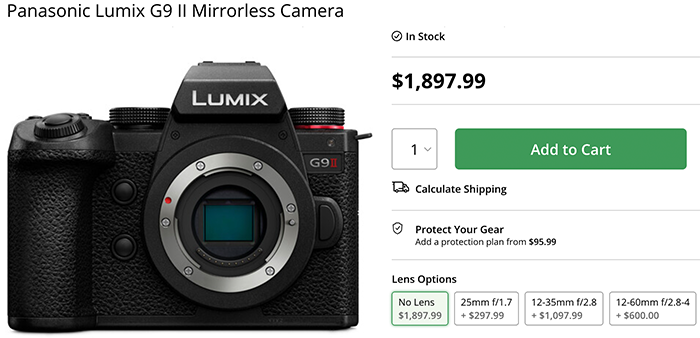
Micro Four Nerds published the long term review of the now two year old Lumix G9II. Her conclusion is that the Lumix G9II proves itself as one of Panasonic’s best Micro Four Thirds hybrids — with excellent autofocus, great stabilization, strong burst modes, and impressive low-light performance. It’s not the smallest body, but for photographers and videographers who want a rugged, versatile, and reliable tool, the G9II still stands out as a flagship that deserves more recognition.