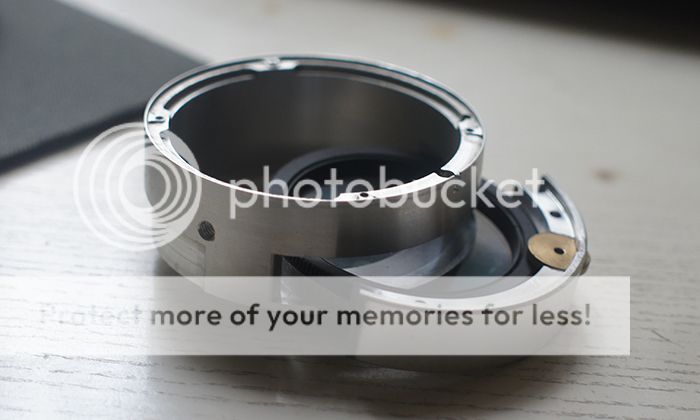
New image of the OWL drop in filter adapter.

Share

This is an image of the new Micro Four Thirds OWL drop in filter adapter devleoped by MXcamera.

The advantages you get with that drop in filter are:
1. for ultra wide angle or fish eye lens, no way to install the filter. Rear drop filter is the only way to solve the problem.
2. For Cine lens, like Canon CP / Zeiss CT lens, the filter is thread is 95mm, very expensive filter, a rear drop in filter can reduce the cost
3. easy to change drop in filter and will not affect the setting, front lens filter may change your setting when un-installing, especially the lens is not internal focus….
4. The setting of rear drop in filter will not change while you change the lens, more efficient
5. For telephone lens, the lens body is too long, when you attached the lens on tripod, this is difficult change the filter.
using rear drop in filter, you can change the filter and keep an eye in the viewfinder.
6. MX is now developing the tele-converter lens for this adapter, so you can upgrade this adapter to tele-converter easily.

The filter will go on sale early 2014. And they will sell it on their eBay Store.

Share

New GX7/GH3 kit deals at Amazon. Leica 25mm for $499.

Share

Panasonic launched new kit deals at Amazon US (Click here). As you can see you save up to $200 on the GH3-GX7 with 20mm or X lens combo.

And Panasonic approved dealer MZgamers has two new deals too:
Panasonic-Leica 25mm f/1.4 for $499.99 on [shoplink 42914 ebay]eBay (Click here)[/shoplink].
Silver GX7 body for $979.99 on [shoplink 42912 ebay]eBay (Click here)[/shoplink].

Share

a little bit of everything…

Share

another video by Jamie MacDonald about the opportunity to provide feedback to Olympus engineers in Japan.

The GX7 vs the OM-D E-M5, battle for my affection, Round 3 – IQ, Interface, Features and the Final Decision (tysonrobichaudphotography)
Voigtlander 42.5mm f/0.95 Nokton Lens Review at ePhotozine.
Olympus 17mm f/1.8 lens review at Soundimagesplus.
GF6 review at Der Spiegel.
Olympus PEN E-P5 Offer (ePhotozine).
Panasonic GM1 image samples by Mapcamera.
E-M1 vs E-M5 image stabilziation test by Pekka Potka.
Olympus Stylus 1 Hands-On Preview (ePhotozine).
Olympus stand in Paris by OpenPn.
Win An Olympus Camera With Olympus Impressions (ePhotozine).
Photo Ninja – Some comments from Jim Christian, the developer at Soundimagesplus.
GX7 review at Neocamera.
The top 10 cameras of 2013 by Photographytalk.
GM1 test by DCfever.
2013 Rueckblick by SystemKameraForum.


Share

Shooting wedding with cheap stuff: E-P2 with Toy Lens (Guest post by Elisabeth Busani)

Share

We know well how much expensive stuff you usually have to buy to do serious Wedding photo work. But how would it look like if you would take these pictures with a Toy lens and a cheap MFT camera? Elisabeth Busani (Flickr) shared his experience shooting a wedding with that stuff:
[shoplink 42873 ebay]$290 for the E-P2 at BigValue[/shoplink] [shoplink 42872 ebay]$100 for the 26mm f/1.4 Toy Lens on eBay[/shoplink]

—–
“A special guest”

September, a wedding, an Olympus EP-2 and a f1.4, 26mm Toy Lens from SLR Magic. This is what brings me to this blog, telling you about pictures I’ve shot during a friend’s wedding.
The Toy Lens, as you certainly know, is a very peculiar lens. It’s called “Toy” for a reason, but after having used it extensively for over a year, it’s become much more than that, so I decided to use it as my primary lens for the wedding.
Please note that I was not the official photographer (actually there was no such thing as an official photographer) since my friends preferred to collect the pictures, made by friends and family.
The Toy Lens has a very strong character of its own, the focus is concentrated in the center and moving towards the borders the picture gets gradually blurred. On one hand this “vignette” effect is perfect for portraits and details, since it enables you to focus on one element by blurring the rest, but usually at a wedding you might want to use something more flexible. On the other hand though, you can always use so called technical limitations to your advantage.

The Toy Lens can yield some surprising results also for long and medium shots and if you’re lucky you’ll also be able to capture a spontaneous outburst of joy.
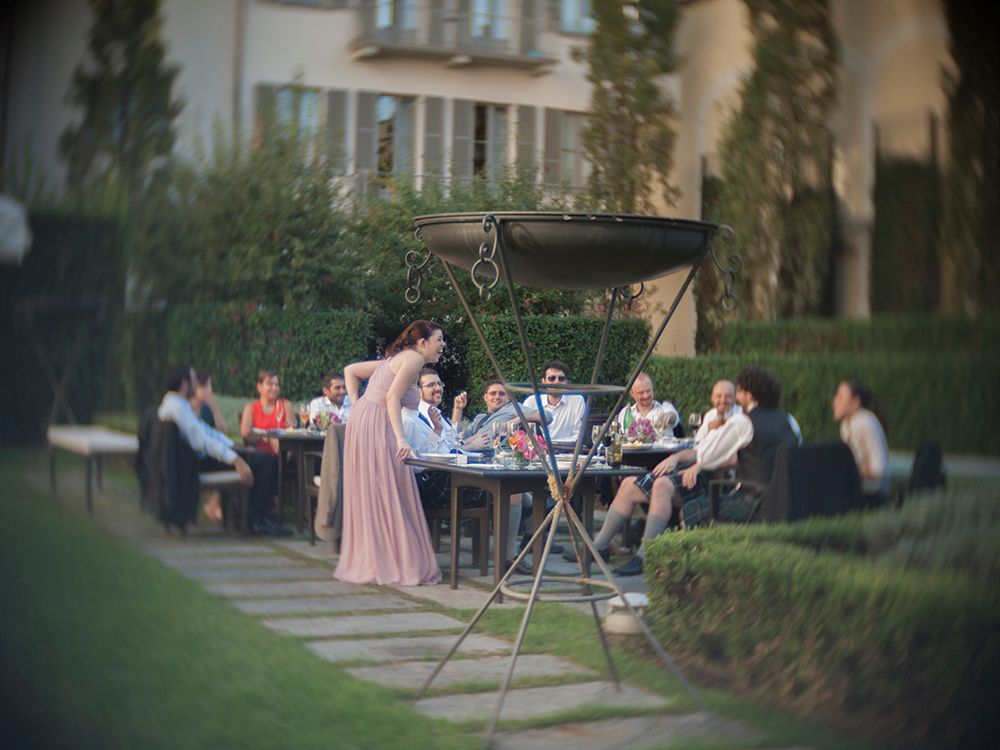
Another one of this lens’ technical defects, which I find very fascinating, is the way direct light get’s diffracted in certain situations. If you use it well it can create interesting effects that underline the sense of airiness and peace of the moment.


I found the lens to be very fitting for situations like these:

and these:

And finally, the lens has a pretty good aperture, so it works quite well in low-light situations (I didn’t use a flash for this shooting).

 

I am very satisfied with this lens: it saturates the colours and its low-fi character gives my photos a certain peculiar personality. I find it very fitting with my style of photography, which has its root in visual arts (I’m mainly an illustrator by trade).
When you shoot photos at a wedding you need to be quick, always ready to capture that one moment. Using a Toy Lens with a fixed focal length and manual focus makes things more complicated, but I can only recommend you to try that at least once, it’s an interesting challenge, and it’s also a lot of fun!

………Elisabeth Busani………
portfolio: http://www.flickr.com/photos/elisabethbusani/

Share

Triple review: E-M1 (Luminous Landscape), GM1 and GX7.

Share

Panasonic GM1 review by Digital Camera World.

Here is a triple MFT camera review roundup. And great to read that all reviewers liked all three cameras! Luminous Landscape (Click here) focus is on the great FT Lenses coupled with the new E-M1:

Olympus ended up creating a line of zoom lenses that remains unsurpassed from a single manufacturer. A few L series and Gold ring lenses from Canon and Nikon may be comparable, but likely none are better. Ironically, now that they have a world-class camera in the E-M1, and sensor size is no longer the issue that it was a decade ago, together with their Pro series lenses from a decade ago Olympus has a stealth combination that will appeal to any Pro and advanced amateur who knows that this combo exists.

The new GM1 got tested at Expertreviews (Click here):

The GM1 represents a major milestone with its genuinely pocketable dimensions. The fact that image quality, video quality and performance show no signs of compromise is even more impressive.

GX7 review at Imaging Resource (Click here):

The Panasonic GX7 handles virtually everything an advanced photographer would it expect it to, and handles it rather well. It’s a great value, too, offering most of the features and functionality of high-end, flagship Micro Four Thirds models, but without any pro-level overkill. There’s no question: The Panasonic GX7 is a clear Dave’s Pick.


Share