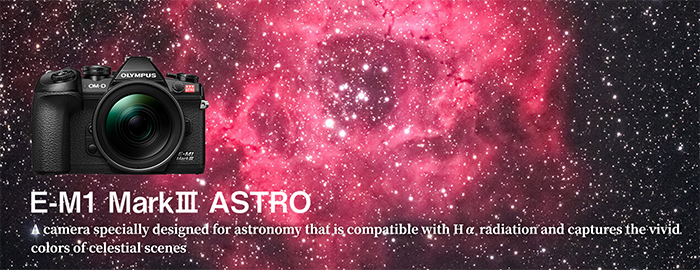
Olympus Japan just announced a special “Astro” version of the E-M1III. Doesn’t look like this camera will be available outside of Japan…at least for now. The camera will be released on July 25, 2024 for ¥ 327,800. This is the google translated press text:
The OM SYSTEM E-M1 MarkIII ASTRO is a dedicated camera for astrophotography that optimizes the IR cut filter located in front of the image sensor of the mirrorless single-lens camera E-M1 MarkIII for astrophotography, allowing you to capture colorful red nebulae that are popular among astrophotography enthusiasts.In
addition, the filters included with this product, OM SYSTEM’s computational photography, and M.ZUIKO DIGITAL lenses enable a wide range of expression from starry sky photography to full-scale astrophotography such as constellations and nebulae.
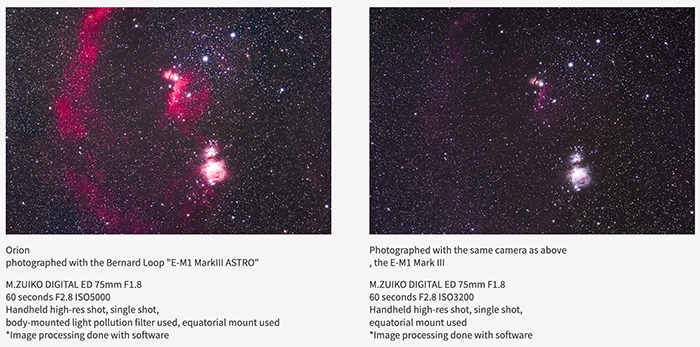
Captures Hα radiation and captures beautiful red diffuse nebulae in vivid, high-resolution images that cannot be seen with the naked eye
The OM SYSTEM E-M1 MarkIII ASTRO has an IR cut filter in front of the image sensor that has been optimized for optical characteristics to achieve approximately 100% transmittance of Hα rays, which are important for astronomical photography. This allows you to vividly capture the beautiful shapes and colors of nebulae that emit light from Hα rays, which are difficult to capture with ordinary digital cameras.
Covers a wide range of photography scenes, from starry sky photography to astrophotography
By combining a wide variety of M.ZUIKO DIGITAL lenses, from wide-angle to telephoto, which can be selected according to the subject, you can capture beautiful images of various celestial objects, from magnificent starry skies to specific constellations and distant nebulae. In addition, by using a commercially available Micro Four Thirds compatible adapter, you can attach it to an astronomical telescope and take pictures.
The stacking process of the High Res Shot function enables shooting in higher quality and with greater detail.
High Res Shot is a computational photography function unique to the OM SYSTEM that realizes high-resolution photography using ultra-high-density pixel information obtained by shooting multiple images. Normally, “Handheld High Res Shot” is used when shooting handheld, but by using it with the camera fixed to a tripod or equatorial mount, the “stacking process” often used in astrophotography can be performed in the body in one shot.
This not only results in high definition, but also reduces noise.
The “Handheld High Res Shot” function on the E-M1 Mark III uses the slight misalignment that occurs during shooting to generate a high-resolution photo of approximately 50 megapixels from 16 shots. Since the images are aligned one by one when compositing, the camera is fixed to a tripod when taking “Handheld High Res Shot” shots to generate a composite image in which the movement of the stars due to their diurnal motion has been corrected. In addition, when using an equatorial mount, the composite image is generated in which the misalignment of the stars caused by tracking errors has been corrected.
Useful support functions for astrophotography
Custom mode includes convenient settings for starry sky photography
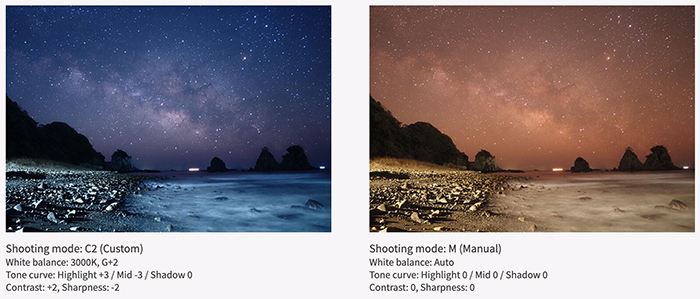
To make it easy to use for those just starting out in astrophotography, the camera is equipped with convenient camera settings for starry sky photography in the custom modes C1 and C2 (mode dial). In addition to the initial settings such as setting AF mode to Starry Sky AF and LV Boost to On2, frequently used functions in the astrophotography workflow are assigned to buttons so that they can be called up quickly. In addition, while it is common to finish astrophotography by adjusting the color tone etc. in the post-shooting development process, the custom modes C1 and C2 also have settings suitable for astrophotography, such as white balance and tone curve, so that natural images can be obtained even when output from the camera.
C1 setting: This mode uses Handheld High Res Shot to capture high-resolution astronomical photographs. Use a tripod or equatorial mount to take photos.
C2 setting: Drive mode is set to Single Shot. Image stabilization is set to S-IS AUTO to support handheld shooting.
*Each setting can be changed/overwritten to suit the subject and photographer’s preferences.
A convenient body-mounted filter for astrophotography
The OM SYSTEM E-M1 MarkIII ASTRO comes with two types of body-mounted filters that are convenient for astrophotography. They are attached inside the camera body (between the mount and the image sensor), so you can still get the same effect even if you change lenses. They can also be used with fisheye and wide-angle lenses, where it is difficult to attach a filter to the front of the lens.
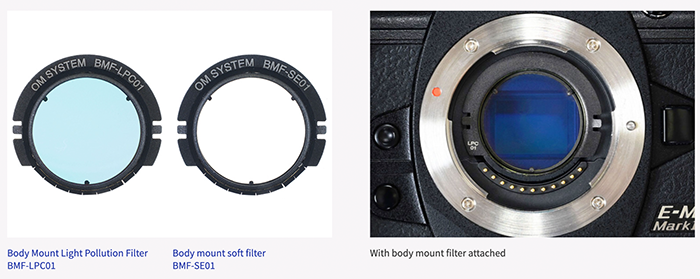
Body mount light pollution cut filter BMF-LPC01
(included in the body mount filter set, sold separately)
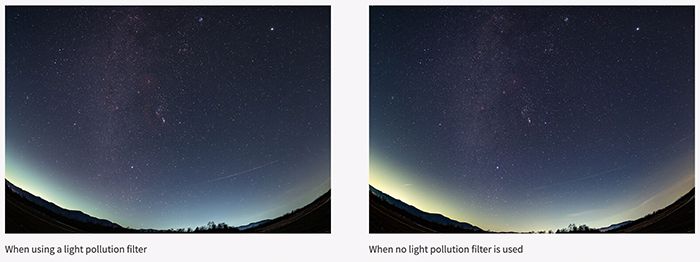
Light pollution filters cut out light from artificial light sources such as city lights and street lamps. This prevents color casts in the night sky, allowing you to capture the natural beauty of nebulae and constellations more vividly. In addition, since the area near the horizon is most susceptible to light pollution, light pollution filters are also effective when photographing constellations rising in the eastern sky or setting in the western sky.
Body mount soft filter BMF-SE01
(included in the body mount filter set, sold separately)
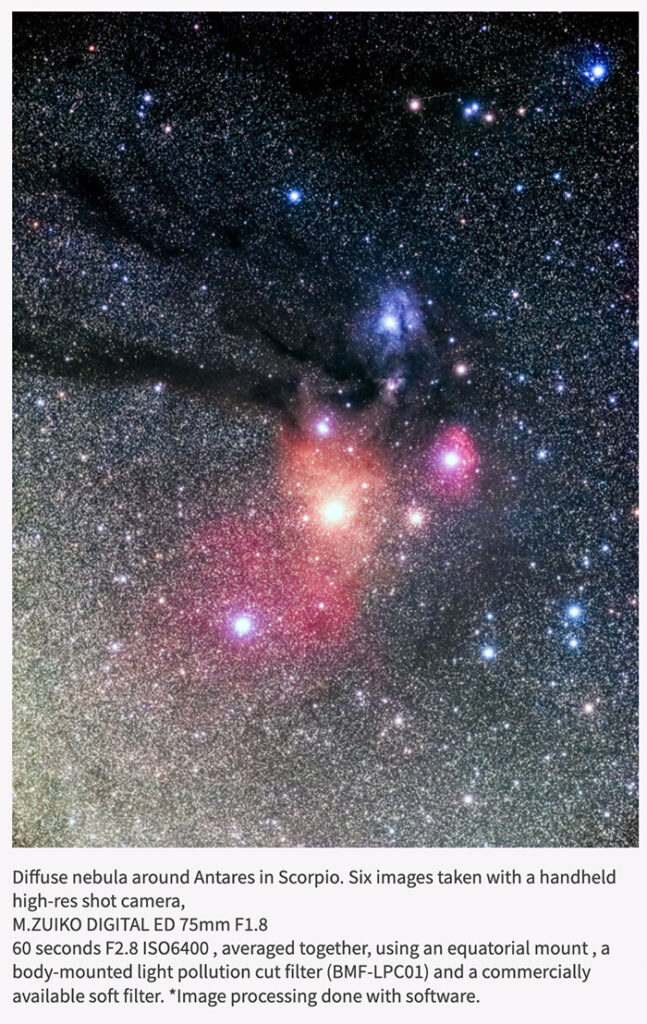
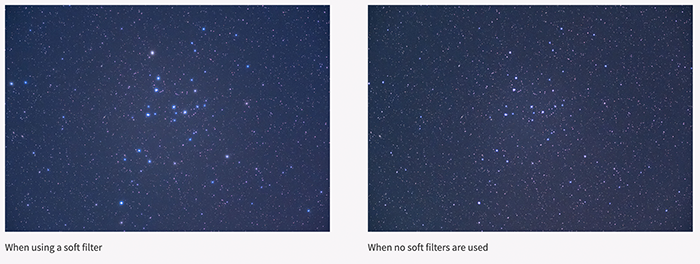
The high-resolution M.ZUIKO DIGITAL lens forms a clear point image of stars, which are ideal light sources. On the other hand, because many stars are recorded as point images, representative stars may not look impressive. By using this soft filter, you can achieve the effect of blurring and emphasizing point light sources, making brighter stars appear larger and more blurred, and the colors of the stars are also emphasized, making the stars and constellations stand out.
Other useful features
Like the E-M1 Mark III, it is equipped with a variety of functions that are ideal for starry sky photography.
Starry Sky AF: Focus on the stars
Live Composite function ideal for shooting star trails
Digital level for easy leveling even in dark environments
Convenient for long-term shooting, USB power supply from USB/PD compatible devices