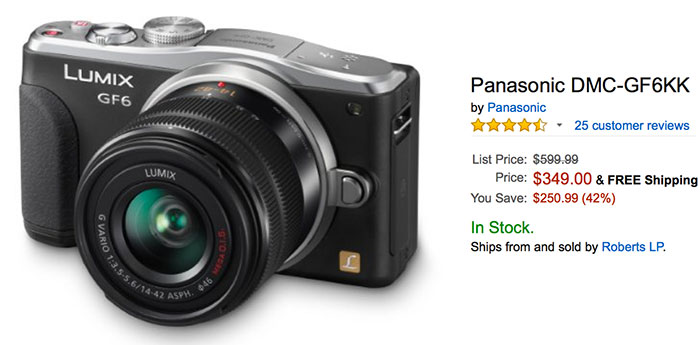

That’s really a great deal: The Panasonic GF6 with kit lens sells for $349 only at Amazon US (Click here). And here is the full Olympus rebates reminder:
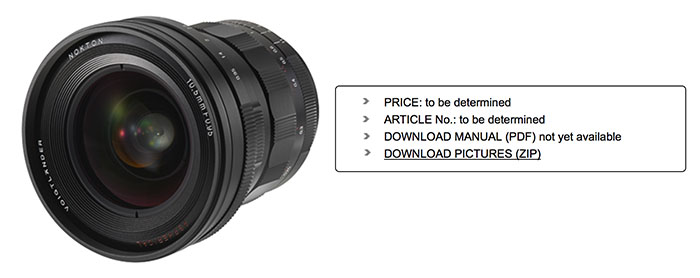
So far on Voigtlanders site you can only read the specs and download two pictures of the lens. And still no preorder option at BHphoto where the lens is listed with unknown price and availability.
The following is a guets post written by Chris Corradino. The article appeared first on his website www.christography.com. All images and text are copyrighted and used with permission.
—-
Side by Side Image Comparison: Full Frame DSLR vs Micro Four-Thirds Mirrorless
January 06, 2015 in Gadgets and Gear
Yesterday, I posted this side by side comparison to Facebook as a simple test. One image was captured with a full frame DSLR and a professional quality lens totaling approximately $2400. The other was shot with a small mirrorless camera with a micro 4/3 sensor and a prime lens totaling $899. Both were captured in RAW on a tripod with the exact same camera settings and auto white balance. They were imported into Lightroom and were not sharpened or adjusted in any way, only saved for the web.
As you can see, the results were quite similar, making it quite challenging to determine which is which. This was further proven by the variety of guesses from the Twitter and FB communities. Some were able to see the difference, while others couldn’t. Now, I’ll reveal the camera types.
Do the results surprise you?
Here’s a larger view of each image.
Canon 6D with 17-40mm LensOlympus OMD EM-10 with 17mm lens
My take on it
Considering that an entry level Olympus with a micro 4/3 sensor can actually compete with a full frame DSLR on image quality, I believe a major shift is coming to the industry sooner rather than later. Yes there will definitely be pixel-peepers who dispute that. This is not for them, but rather to help YOU find the best tool for your specific needs. Do you want to spend an extra $1500 and carry more weight or would you be better off with this alternative?
The images out of the mirrorless have more than enough resolution for publication, web, and print enlargements. Granted, the 6D definitely offers better detail at larger print sizes. Still, at a fraction of the weight and price, one has to really determine what their priorities are. For travel, scenic, everyday work, the OMD EM-10 has repeatedly proven its worth. In addition to the excellent files one can capture with it, the functionality is actually superior in my opinion with more focus points, EVF, to name a few. Having said that, I still reach for the DSLR for sports, wildlife, and aviation. I feel the AI Servo and instantaneous response are more conducive for high-speed situations. Yet with advances in mirrorless technology and a wider selection of available lenses, I do wonder how much longer that will be the case.
The GX7 has been officially marked as discontinued at BHphoto (Click here). Easy to guess the GX8 will come soon. Likely at CP+ in February. And also the Panasonic G6 is marked as discontinued at BHphoto (Click here). Let’s hope Panasonic will bring us a new G7 too!
Reminder:
Follow the announcement today live here on 43rumors (streaming via panasonicces2015.com) at:
10am Las Vegas time
1pm New York time
18:00 London time
19:00 Berlin time
03:00 (January 6) Tokyo time.
The only Micro Four Thirds “related” news from today’s announcement is that Panasonic has a new 4K card for your GH4 :)
Here is the full press text:
Panasonic Announces SDXC/SDHC UHS-I Memory Cards Compliant with UHS Speed Class 3 for Reliable 4K Video Recording Featuring Maximum Read Speed 95MB/s and Maximum Write Speed 90 MB/s
LAS VEGAS, NV (January 5, 2015) – Panasonic is introducing the new lineup of UHS-I type SDXC/SDHC memory cards by upgrading to the latest “SDUD” that boasts maximum read speed of 95MB/s and maximum write speed of 90MB/s, in addition to compatibility of UHS Speed Class 3 (U3)*1. In addition, the lineup includes a maximum capacity upgraded to from SDXC 64GB to 128GB.
In recent years, the standard of video content has become larger and even consumer products are capable of recording motion picture in 4K. The footage bitrate is also higher, for products such as the Panasonic Camcorder HC-X1000 and the DMC-GH4 which record full-HD All-Intra at approximately 200Mbps. To make the most of these cutting-edge imaging tools, the recording media also needs to function so there are no dropped frames and all content data is recorded without error. By crystallizing the technology long fostered through the development of digital camcorders and cameras, Panasonic is proud to produce the high quality memory cards that excel not only in the data transfer speed but also in the stability and durability under wide usage conditions to keep the data safe for the long term.
Major Features
Specifications
*1 Under UHS-I bus interface. The speed shown in the table above is not possible with a non-compliant UHS-I device. In that case, high speed mode or default mode is implemented. The actual speed depends on devices and conditions.
Panasonic announced at CES that it will now sell the CM1 1 inch sensor smartphone camera in USA too (price $1,000). If you are interested to learn more about the camera read the CM1 review by Pier-Yves Menkhoff on 43rumors, Hands-on by Cameras.reviewed, Interview from DC.watch on 43rumors.