Phototrend had a talk with Foucauld Prové, Managing Director at Sigma France. He said the following about MFT:
We no longer manufacture lenses for micro 4/3, so I imagine our management no longer anticipates huge growth for this format. But, having attended quite a few wildlife photography festivals and shows, we realize that micro 4/3 still has certain advantages.
Of course, due to the size of the sensors and their limited definition, this will not be the best choice for making incredible enlargements. Nevertheless, the compactness of the lenses remains very relevant for nature photography enthusiasts.
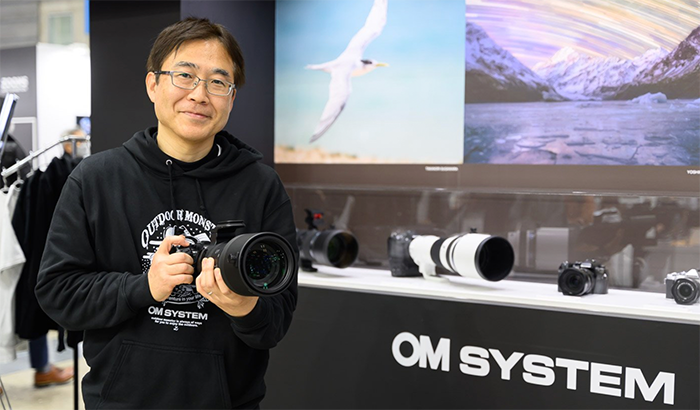
We see this clearly with OM System, which is focusing – rightly – on the outdoor and wildlife photography market.
The video dives deep into whether Micro Four Thirds systems can truly compete with full-frame setups in sharpness, depth of field, and low-light performance. The new OM System 50-200mm f/2.8 offers an equivalent field of view of 100-400mm f/2.8, weighs just 2.4 lb, features IP53 weather sealing, in-lens stabilization, and an integrated Arca-Swiss tripod foot. When paired with the OM-1 body, users can achieve up to seven stops of image stabilization.
Comparing it to the Sony full-frame setup, the reviewer notes that while the full-frame camera still delivers slightly better image quality and creamier bokeh, the Micro Four Thirds system remains far more compact and enjoyable to use, especially for travel and handheld sports or wildlife photography. In field tests covering wildlife, golf, tennis, and even night pickleball, the OM-1 Mark II delivered excellent autofocus, light weight, and remarkable stabilization performance — all while costing about 40 percent less than the Sony and Sigma combination.
Ultimately, the video concludes that full-frame systems still produce marginally superior images, but Micro Four Thirds cameras like the OM-1 Mark II offer a more versatile and enjoyable shooting experience for most photographers, achieving 80–90 percent of the image quality at a fraction of the size, weight, and cost.
The Lumix GX7 may be old (released in 2013), but it still delivers a surprisingly enjoyable shooting experience — especially for budget-conscious photographers. It’s compact, well-designed, and packed with features like dual control dials, a tilting EVF, touchscreen, and even built-in Wi-Fi.
While its 2-axis IBIS is very limited (and doesn’t work in video), and the mechanical shutter is loud, the GX7 still shines in still photography with good image quality when handled properly. Low light performance isn’t its strength, but with the right technique, it’s absolutely usable — even impressive in some cases.
It lacks modern video capabilities (no 4K, no IBIS in video), but for under £300, it remains a fantastic, fun, vintage-style tool for photographers who appreciate great ergonomics, a retro rangefinder aesthetic, and don’t mind working within its limits.
In short: If you know its quirks and shoot accordingly, the GX7 is still a charming bargain gem.
We will be closing our LUMIX PRO service on 30 November 2025. This step allows us to refocus on new activities designed to better support our customers and creators.
Current members will be able to log in and manage their accounts, including securing any data, until 31st December 2025. New registrations are no longer available after 18th September 2025.
To continue to receive updates and benefits from LUMIX, please sign up to My Panasonic.
For more information and Terms and Conditions visit Terms & Conditions.