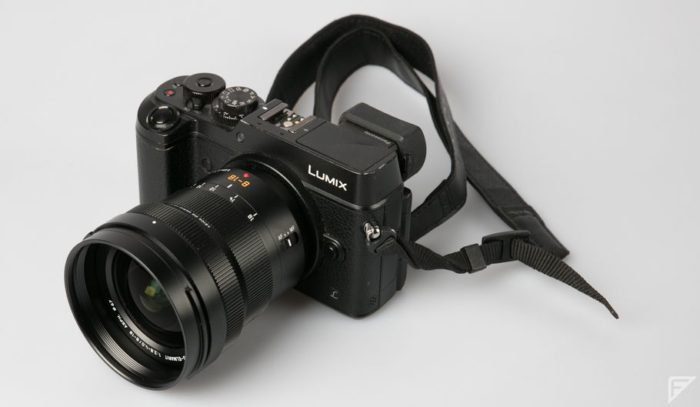
Leica 8-18mm review at Focus Numerique

Share

The French version of Dpreview is Focus Numerique. And they just tested the new Leica 8-18mm lens. Here is the google translated text:

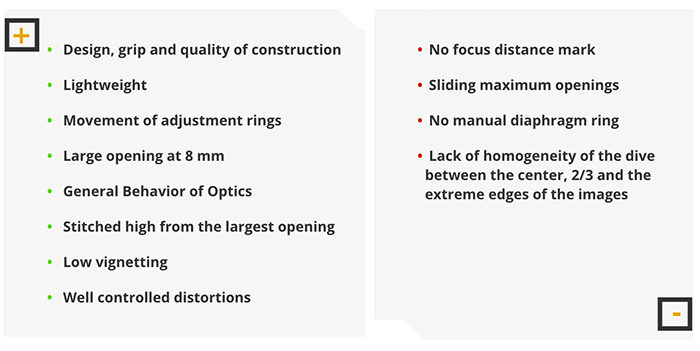
Impossible not to recommend this ultra wide-angle zoom that combines qualities in all points of view.
The weight is very contained, the grip is excellent, as are the adjusting rings. We would have liked a third to manually adjust the diaphragm. The quality of construction is perfect and the design, very successful.
Finally, on the optical quality side, it is very good. The lens delivers rich images in fine detail at all focal lengths, from the largest openings. In addition, the objective has a beautiful homogeneous behavior. It suffers however from a lack of homogeneity between the center, two thirds and the extreme edges of the images.

Leica 8-18mm lens at  Adorama, BHphoto, Panasonic and Amazon. In Europe at Amazon.de.
Share

a bit of everything…

Share


Aurora Aperture PowerUV and PowerCPL Filters Review (available here on eBay).

You’re Going to Fail at Photography? (Podcast by that1cameraguy)
These Portraits Were Shot with a Water Drop as a Lens (PetaPixel).
3 Quick Tips for Shooting Close-ups with Extreme Wide-Angle Lenses (Explora).
Meet A Pro: Cradoc Bagshaw on Why Photography is a Feeling, Not a Thought (Adorama Learning Center)
E-M1II tested by Dkamera.de.
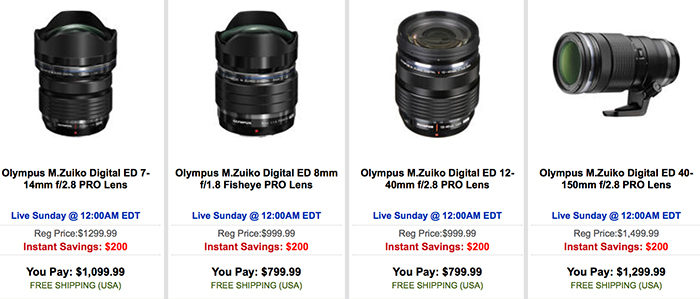
Italian 7-14mm PRO lens review by Ugofoto.

Plenty of news on the facebook E-M1II group and the GH5 group.


Share

Dpreview says “The Olympus TG-5 is the best rugged compact you can buy right now”

Share

DPreview tested the new TG-5 and concluded:

The Olympus Tough TG-5 stands alone in its ability to stand up to the elements and get you photos in situations where no other camera could (or situations where you simply wouldn’t be willing to bring a dedicated camera at all).
And the TG-5 doesn’t feel like just a tool to use because you need it; it’s genuinely fun. It’s responsive, handles great, has a decent amount of controls and a reliable ‘auto’ mode for when you hand the camera off to your friends. It’s practical in that it also offers USB charging, so you can use any USB power bank to charge it up off the grid, and then you can Wi-Fi transfer images to your phone for easy sharing without lugging a laptop along.

Get the camera at at Amazon, Getolympus, BHphoto, Adorama and ParkCameras.

Share

Weekly 43rumors readers pictures roundup…

Share


Aurel Manea
E-m1 mark 2, 12-40mm 2.8 pro, handheld
facebook

1) You can share your pics by using posting on our 43rumors Facebook page (Click here).
2) All 43rumors readers pictures can be seen here: facebook.com/43rumors/photos. Like the pictures you like and chat with the authors if you want to know how they took the shot!
3) The most liked pictures and some pics selected by myself will be posted weekly on 43rumors

This is the weekly selection:

Share
Read more

The Supersonic Wave Filter (SSWF) from 2003

Share

Olympus posted that new article about the very first Olympus camera with SSWF:

What you see here is rare, actual, slow-motion footage of a prototype Supersonic Wave Filter (SSWF) dust reduction system being tested a year or so before the debut of the Olympus E-1 DSLR camera in 2003. Each OM-D is equipped with a much more advanced SSWF dust reduction system, which vibrates over 30,000 times per second to remove dust particles from the image sensor every time you turn the camera on. But realizing this system wasn’t so easy.

By applying a conductive coating to the glass protecting the sensor, Olympus engineers were able to remove dust that stuck to the sensor by static electricity. Being able to remove the dust adhered to the sensor by intermolecular forces was a much larger challenge, and for this the Supersonic Wave Filter was invented.

However, the first SSWF only generated around 100g of acceleration, and the dust didn’t even budge. Many rounds of trial and error were carried out, and Olympus engineers utilized resonance to amplify the vibrations so that an acceleration of thousands of g was achieved. Still, not all dust fell from the sensor. Only the dust located at the vibration crests fell, and the dust located at the nodes of the vibrations stayed put. Finally, the engineers managed to generate the vibrations so they peaked uniformly across the sensor, removing all dust particles.

The SSWF dust reduction system has since been providing Olympus interchangeable lens camera users with clean, crisp images, receiving various accolades and high praise around the world.

Share