
Olympus 40-150mm f2.8 vs. 50-200mm f2.8-3.5 [Is an OLD lens a match to a NEW lens?]
Peter Forsgård wonders if a 13-year-old lens can be a match to a new lens…

Peter Forsgård wonders if a 13-year-old lens can be a match to a new lens…
As usual to take with a dose of fun! Camera Conspiracies writes:
Panasonic is ending the G9 lineup. There will be no G9 mark II. They are going for a super hybrid Panasonic GH6 with 8k 60p with high megapixels for photos. Wrong direction in my opinion. Panasonic is very confused.
Peter Forsgård tested the SLR Magic 25mm T0.95 MFT lens you get for $379 at BHphoto.
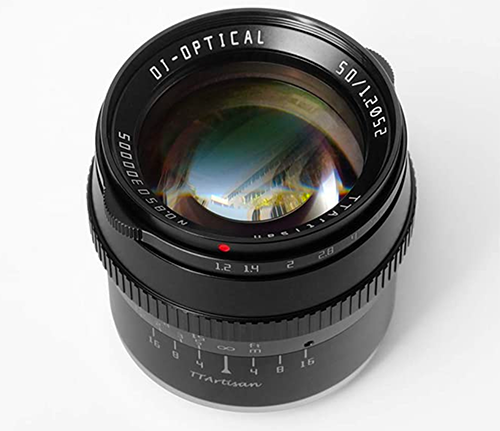 Use the code “08YZE72X” to save 8% on the newly announced TTartisan 50mm f/1.2 MFT lens sold on Amazon US.
Robin Wong:
The camera shown in video was E-M10 Mark II, but all sample images were taken during my review with E-M10 Mark III several years ago. Hope this clarifies some confusion, if any.
Malaysia is still under lockdown, and I could not go find friends who have E-M10 Mark III. The E-M10 Mark II was borrowed from another friend. I did own an E-M10 Mark II myself several years ago, for about almost 2 years.
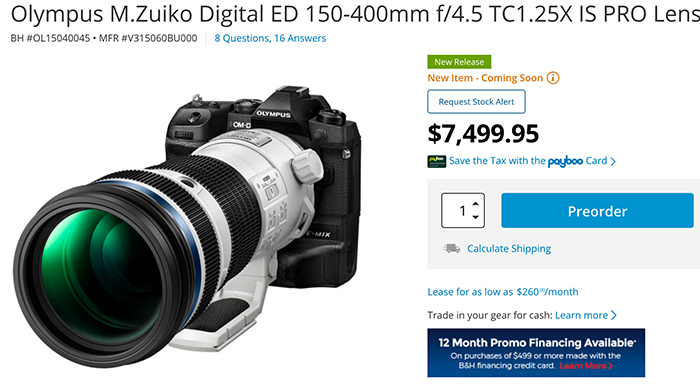
Preorders: Olympus 150-400mm lens at BHphoto, GetOlympus, Adorama.
Joan from the Dpreview Forum shared the first unboxing pics of the new Olympus 150-400 that shipped out in the USA. Chech them out!
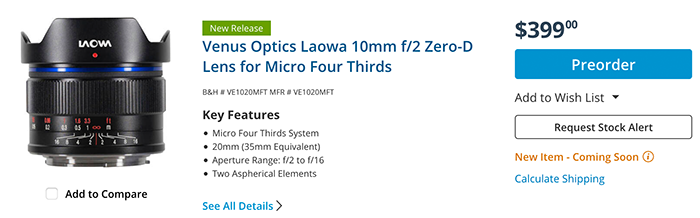
You can preorder the new Laowa 10mm f/2 ZERO-D MFT lens at BHphoto and Venuslens worldwide store.
Opticallimits tested the new lens and concluded:
The Laowa 10mm f/2 Zero-D MFT is a fun lens that also has the capability of delivering some serious results. In terms of optical performance is shines with a very high resolution straight from f/2 and it’s darn sharp at f/4. As the name implies, it is a fully distortion-corrected lens – which is a rare quality in mirrorless land. And this raises the question of why Olympus/Panasonic can’t do the same here. The high corner quality can also be contributed to the fact that distortion correction isn’t necessary at all. That being said, auto-correction DOES help when it comes to vignetting. The raw vignetting is on the extreme side at f/2 so unless you are after a keyhole effect you should keep it activated. Even so – some obvious vignetting remains at f/2. Lateral CAs are pretty low and nothing to worry about. Flare can be an issue in extreme lighting situations. If you are after sun stars – yes, the lens can give you these in qualifying scenes when stopping down and the quality is good. We haven’t executed a formal analysis of the bokeh but as you can see in the sample image section, the out-of-focus blur is pretty smooth. This is a rather rare quality in an ultra-wide lens.
The Laowa 10mm f/2 Zero-D MFT is a tiny and super-lightweight lens. This doesn’t mean that the build quality is suffering – on the contrary, it is actually very good. The lens body is made of metal and the focusing is smooth. There is no weather-sealing though. Unlike early Laowa offerings, the lens is fully coupled thus you can select the aperture on the camera rather than on the lens. EXIF data is also provided. However, you still have to live with manual focusing only. Given the ultra-wide nature of the lens, this shouldn’t be a big deal for most users at least.
We quite enjoyed our time with this little marvel also because it highlights what’s cool about the Micro-Four-Thirds system – a nice size factor combined with low weight. It may not be perfect in every optical aspect but if you are after a fast ultra-wide lens that doesn’t go bonkers in terms of field-of-view, you should have a deeper look.