George Holden says the PEN-F is the Only Camera They Ever Made That Shoots Like Film

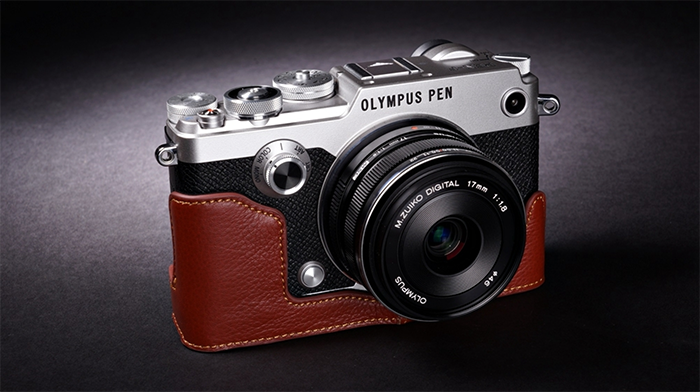
George Holden believes the Olympus PEN-F is the only digital camera that truly shoots like film. Released in 2016, it was inspired by the classic half-frame PEN film cameras and designed with a strong focus on creating film-like results straight out of camera.

The PEN-F stood out thanks to its unique “Creative Dial,” which allowed photographers to instantly apply monochrome and color profile controls, mimicking the look of traditional film stocks. Features like the dedicated exposure compensation dial, intuitive controls, and strong in-body image stabilization gave it a tactile, analog-like shooting experience that most digital cameras lack.

Holden points out that what makes the PEN-F special is not just its design but its ability to deliver images that feel authentic, organic, and filmic—without heavy editing. Even today, it remains a rare gem in Olympus’ lineup, cherished by street and travel photographers who want both digital convenience and the timeless feel of film.

M.Zuiko 100-400 f/5.0-6.3 Mark II: The Professional’s Verdict by Thomas Eisl

Thomas Eisl tested the new lens and concluded:

The OM System 100–400mm II is an impressively versatile super telephoto zoom lens that delivers professional results in a compact Micro Four Thirds package. Ideal for wildlife, sports, and macro, it combines excellent optical quality, stabilization, and autofocus in a weather-sealed body.

Pros:
✔️ Sharp across the zoom range
✔️ Excellent image stabilization (up to 7EV with Sync IS)
✔️ Great autofocus performance, up to 25fps
✔️ Compact and weather-sealed design
✔️ Macro-capable and teleconverter-compatible

Cons:
❌ Zoom is not fully parfocal (when zoomed quickly)
❌ Minor vignetting at 400mm
❌ Slight aspherical bokeh artifacts in lab tests

The new lens is at Amazon US&CA&EU, Bhphoto, Adorama, OM Digital.


Jake Sloan tested the new OM 50-200 f/2.8 Lens in Alaska

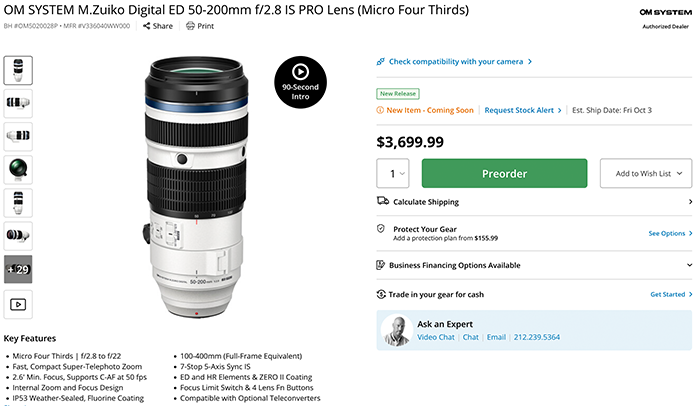
After days of testing across Alaska — from the Arctic Circle to ice caves and salmon runs — Jake Sloan concludes that the OM System 50–200mm f/2.8 is an incredibly versatile lens. Its constant f/2.8 aperture, compact size, internal zoom, and excellent stabilization make it stand out from typical 100–400mm equivalents that usually compromise with variable apertures.

He highlights how sharp and fast the autofocus is, how smooth the focus fall-off looks, and how well the lens compresses subjects against dramatic backgrounds. For wildlife, landscapes, and even detailed shots of vast environments, this lens proves itself as a do-it-all companion that fits easily into a travel bag.

Jake’s bottom line: the OM 50–200mm f/2.8 is a rare combination of portability, speed, and image quality. Whether you’re chasing wildlife or capturing sweeping landscapes, it’s a lens designed to deliver stunning results in nearly any situation.

OM 50-200mm f/2.8 PRO preorder links at BHphoto, Amazon, Adorama, OM US store, Fotokoch, Foto Erhardt, Calumet, WexUK, Clifton, OM European stores.

New OM 50-200mm f/2.8 PRO lens reviews: Joins the hall of fame of best wildlife lenses!

OM 50-200mm f/2.8 PRO preorder links at BHphoto, Amazon, Adorama, OM US store, Fotokoch, Foto Erhardt, Calumet, WexUK, Clifton, OM European stores.

Techradar conclusion:

OM System has further served its mission to be a leading outdoor photography brand with its outstanding new 50-200mm F2.8 zoom. With an equivalent 100-400mm focal length and bright maximum aperture, it’s a highly versatile wildlife and sports optic, and you can further extend that reach with the 1.4x teleconverter to create a 560mm F4. Build quality is top drawer, the internal zoom is a welcome bonus, and paired with a current OM System camera you get a lightweight, IP-rated weather resistant system, complete with smart subject-detection autofocus, rapid burst shooting and incredible image stabilization. Optical quality impresses, even if bokeh can be a little fussy at times. It’s an expensive lens, and quite the leap price-wise from the 40-150mm F2.8, but if you invest in the 50-200mm F2.8 won’t be disappointed. For me, it joins my best wildlife lenses hall of fame, and impressive macro photography skills add extra shine.

PetaPixel conclusion:

Should You Buy It? Yes. With the OM System M.Zuiko 50-200mm f/2.8 IS Pro, you pay a professional price, but you get professional quality. This lens has versatility in spades to help offset its high cost.

DigitalCameraWorld conclusion:

The OM System M.Zuiko 50-200mm f/2.8 IS Pro isn’t officially a replacement for the trusty 40-150mm f/2.8, but it is absolutely the new sheriff in town. While the 40-150mm has made me a lot of money over the years, the 50-200mm outclasses it in every way, from its extended reach and improved IS to the superior sharpness. And the supercharged performance is particularly noticeable with top-tier cameras like the OM-1 Mark II, as the lens supports blazing fast 50fps continuous AF, as well as Pro Capture and focus stacking – all of which will make this an essential professional tool for my kitbag.

DigitalKamera.de conclusion (google translated):

The OM System M.Zuiko Digital 50-200 mm F2.8 ED IS Pro is a powerhouse. It combines high light intensity and a generous zoom with a comprehensive range of features in a reasonably compact body that’s very robust thanks to its IP53 rating. From wildlife and action to sports, to landscapes and close-ups, it’s suitable for a wide variety of subjects and is easier to take far from civilization than a corresponding 35mm setup. The autofocus is fast, the bokeh and even the sun star are beautiful. The image quality from wide open is beyond reproach. Only the not-so-affordable price of just under €3,500 might be a hindrance to the purchase. But this zoom lens is by no means overpriced or unaffordable.

Phototrend conclusion (google translated):

With this 50-200mm f/2.8 IS PRO, OM System has created a lens that ticks all the boxes: brightness, versatility, compactness, and robustness. A true “Swiss Army knife” of the Micro4/3 range, it is aimed at both demanding wildlife photographers and traveling naturalists looking to limit their equipment without sacrificing quality. It now remains to be seen whether its promises in terms of speed and image quality can be confirmed in the field. But one thing is certain: this 50-200mm could well become one of the new pillars of OM System’s M.Zuiko PRO range.

Mapcamera conclusion (google translated):

If the M.ZUIKO DIGITAL ED 150-400mm F4.5 TC1.25x IS PRO is a lens with ultimate super-telephoto performance, then the OM SYSTEM M.ZUIKO DIGITAL ED 50-200mm F2.8 IS PRO truly is the ultimate telephoto lens. The shooting style that combines the rendering quality of a 400mm F2.8 with mobility is undoubtedly unique. Personally, I was pleased with the detachable tripod mount. All of the shots in this article were taken handheld. I was also surprised that I could store it horizontally in my 30-liter backpack instead of vertically. I wanted a lens that could cover the super-telephoto range, had a fast aperture, and was lightweight. The OM SYSTEM M.ZUIKO DIGITAL ED 50-200mm F2.8 IS PRO is the lens that will fulfill that desire. I highly recommend you try it out for yourself.


Eric Jannigs: OM-3 vs Nikon ZF … My Thoughts

Eric Jannigs says that after spending a couple of weeks with both the Nikon Zf and the OM System OM-3, the differences between these two retro-styled cameras become very clear.

The Nikon Zf impresses with its premium build touches such as brass top dials and a metal shutter button, paired with a well-thought-out mix of classic dials and modern control wheels. The fully articulating screen, excellent EVF, and robust manual focus assist (with eye tracking and magnification) make it a capable hybrid shooter. Under the hood, its 24MP full-frame sensor and strong autofocus performance shine, and it offers the flexibility to adapt F-mount lenses and use Nikon flashes. On the downside, it’s chunky and not pocketable, most Nikon Z lenses don’t match the retro styling unless you pair it with manual focus options like Voigtländer lenses, and the dual card slots (SD + microSD) are awkwardly placed in the battery compartment.

The OM System OM-3 is physically closer to a classic film camera in size and feel. It sports high-quality metal dials with satisfying tactile feedback, a more convenient side card slot, and a better battery door/tripod plate layout. A unique color/mono switch and easily customizable profiles add to the fun factor. Most importantly, the Micro Four Thirds lenses like the Olympus M.Zuiko 12mm f/2 and Olympus M.Zuiko 25mm f/1.8 are compact, premium-feeling, and visually match the OM-3 perfectly. However, the 20MP Micro Four Thirds sensor can’t match the Zf’s full-frame image quality, its EVF and manual focus aids lag behind, it only has a single card slot, and the on/off switch is less ideally placed.

In the end, the Nikon Zf delivers better image quality, EVF, and full-frame performance, while the OM System OM-3 wins in ergonomics, retro charm, compactness, and lens system cohesion. For pure shooting enjoyment, the OM-3 comes out ahead, but for maximum technical performance, the Zf remains the stronger choice.