The LX100 is now shipping in Asia (Digitalrev) and Europe (Wex Germany and WexUK). And first 43rumors readers sent me their test videos.
Pier: “Long time before the GH3 and GH4, I had Panasonic several LX series. This week, I offered the DMC-LX100 to my girl friend. I’ve borrowed it for an evening, for a video test > https://vimeo.com/109446766. Filmed only in 1080p. Sorry, I have not the use of 4K… You can compare this video with the other one on the same place, shot a few minutes after, with the GH4 > http://vimeo.com/109473731. However, the first two shots came from the LX100.”
Hallelujah – Puddles Pity Party at the SF Regency Lodge Ballroom
—–
The following article is a guest post from Gary Yost. If you want to write on 43rumors contact me at 43rumors@gmail.com. Thanks!
—–
Matching four Micro43 cameras and a Sony A7s for a live shoot of a 7’-tall singing clown.
Due to different project requirements, I’ve collected a variety of camera bodies over the years. Nikon DSLRs, a Black Magic Pocket Cinema Camera, Panasonic GH4 (and GX7) and the Sony A7s. Each has its own strengths (and weaknesses). When I began production on a new video for a 7’ tall singing clown named Puddles at a recent live show in San Francisco, I decided to use four Micro 43 cameras and the Sony A7s to capture a 5-camera multicam recording for Puddles’ cover of Leonard Cohen’s legendary song “Hallelujah.” (The fifth camera was a borrowed GH4 belonging to my friend Mark Spencer, giving us two GH4s for shooting in 4K, providing the ability to punch into those shots in post.) I recently had a great experience shooting a 4K trailer for the Mill Valley Film Festival with the GH4, but I also wanted to put the A7s to the test, especially in the dressing room of the theater where I’d be very close to the subject, sometimes in fairly low light.
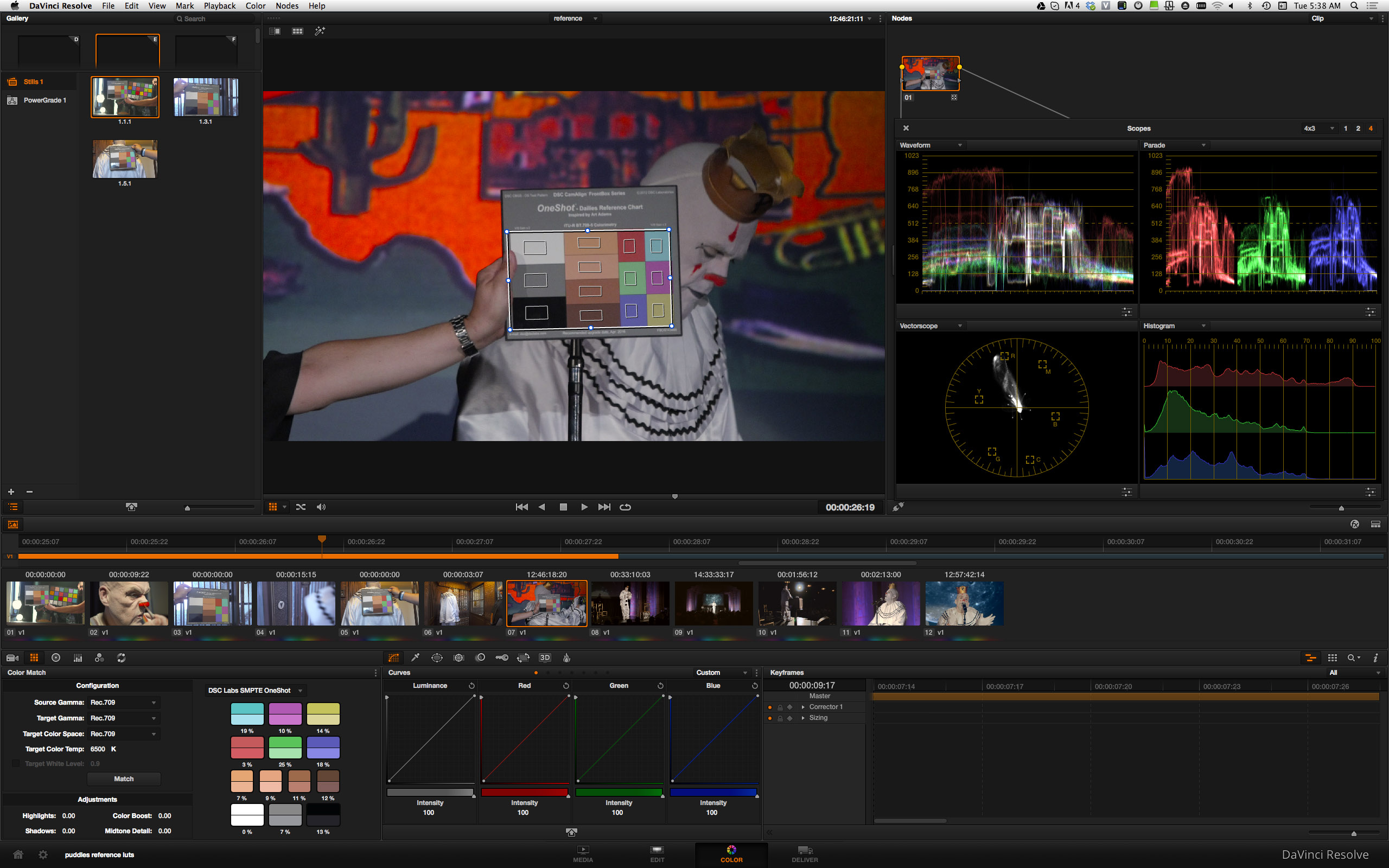
The big question for me was how to match these four different sensors so that the final piece would have strong visual continuity. I had recently read a great article by Michael Garber about using the DSC Labs One Shot color chart with the Davinci Resolve Lite grading software that was already my favorite color finishing tool. In the article, Michael describes how to bring each camera’s footage into Resolve version 11 and apply their new “color match” control to the DSC Labs target. This is what that looks like in the Resolve UI:
Click on image to enlarge
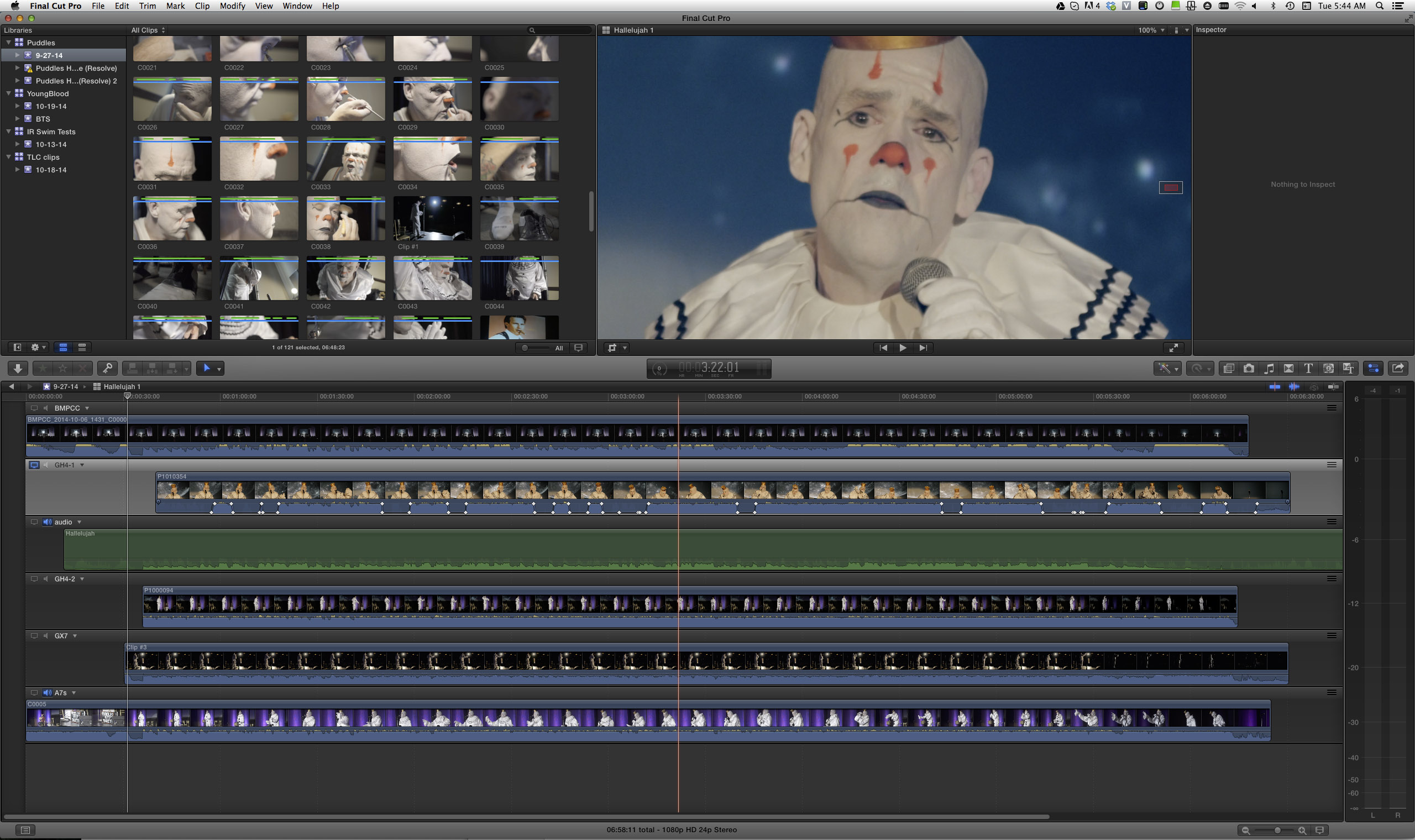
Once matched, with a right-click you can save the color LookUp Table (LUT) and then, using the $29 Final Cut Pro X LUT Utility from Color Grading Central, those LUTs can be applied to the video clip in FCPX. I did this with each of the five cameras we used on the shoot and voila… my multicam clip had five matched cameras even before I started editing! This allowed me to edit the piece with good visual continuity well before I started the final color grading process. Here’s what the multicam clip looks like in FCPX:
Click on image to enlarge
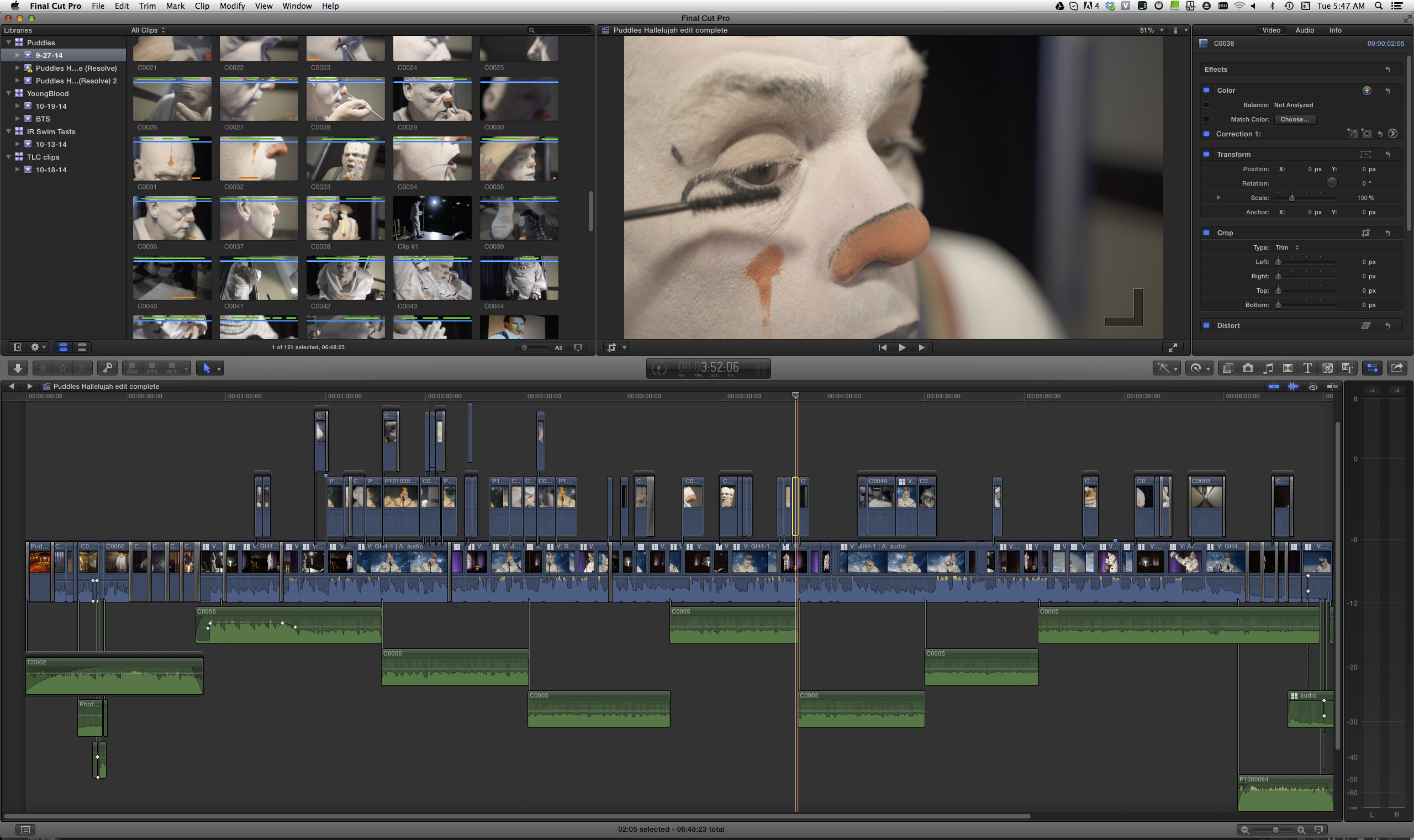
Editing among five cameras along with b-roll from the dressing room preparations for the show was easy and straightforward. All of the b-roll was cut into the timeline as connected clips.
Click on image to enlarge
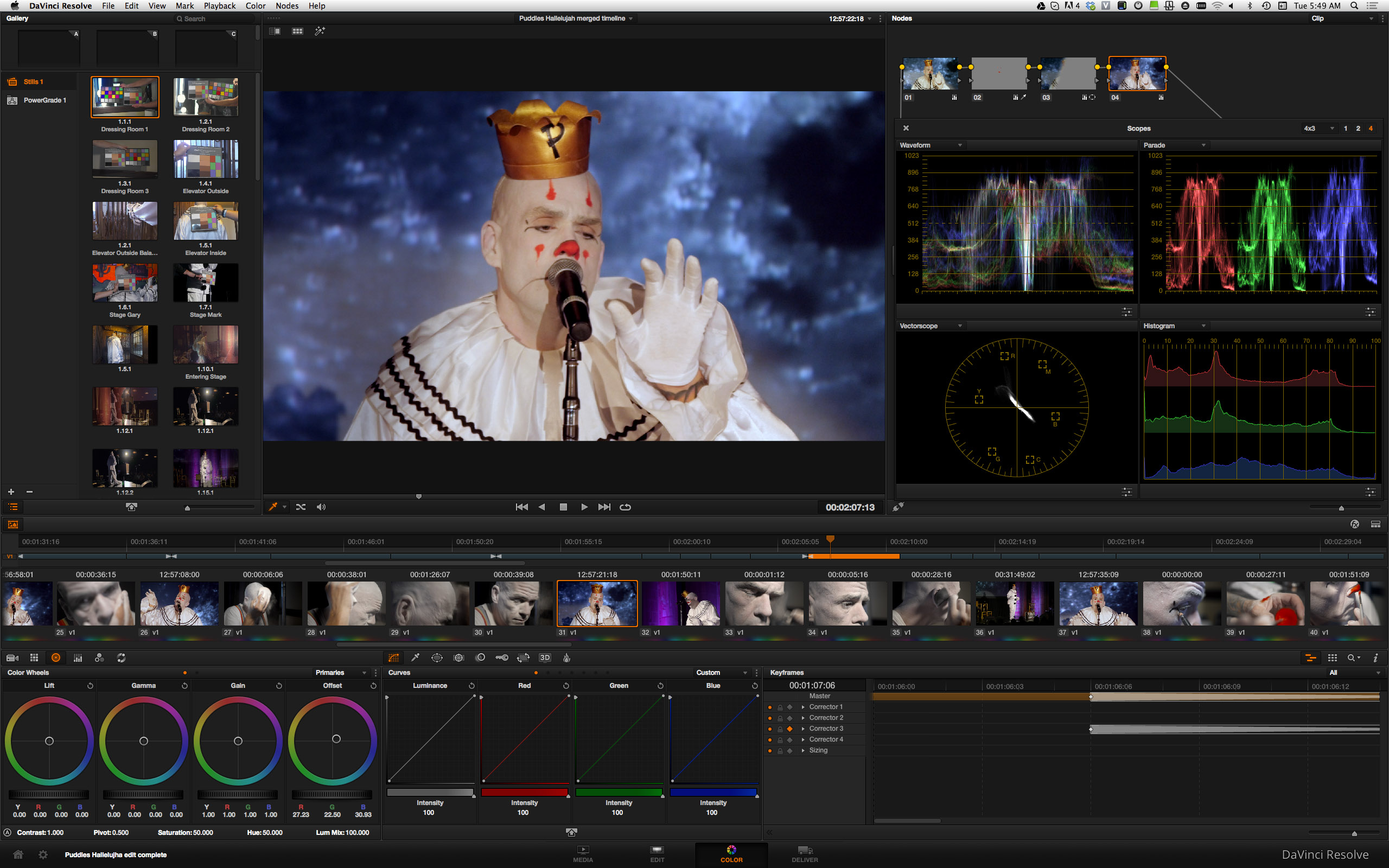
Once I was completely satisfied with the edit, I deleted the LUTs from the five master clips and then used the Overwrite to Primary Storyline function to put the entire show into one storyline before exporting it as an fcpxml file for Davinci Resolve. This provided the cleanest way of getting a single timeline into Resolve.
Click on image to enlarge
I then reapplied the LUTs to the clips in Resolve and added secondary qualifiers to tweak various aspects of Puddles’ makeup, along with animated custom vignettes to direct the viewers’ eye to exactly where in the frame I wanted them to be looking. The color grading process in Resolve is incredibly fun and creative and I always look forward to getting to this stage. (I still can’t believe that Black Magic Design gives this software away for free.) I consider Resolve to essentially be Photoshop for video and would never finish a project without it. One of my favorite Resolve features is the ability to animate any aspect of the grading process, but most importantly it also provides the ability to grade clips in context with any other set of clips simultaneously, allowing for the type of visual continuity that defines a professionally-finished production.
I hope you enjoy the final piece. I had a terrific time shooting, editing and grading it. The Huffington Post feature on it drove over 250,000 people to watch it on Youtube, and that is always satisfying.
Bio: Gary Yost is a filmmaker and photographer living in the San Francisco Bay Area who focuses on telling stories about the interesting people and places where he lives. Yost has been using technology to tell complex stories for a long time. As the leader of the team that created Autodesk 3DS Max he gave millions of people 3D modeling and animation tools, enabling them to use computers to visualize anything they could think of… and a lot of those things were too large, too small, too fast or too slow to show with conventional video. These days, Yost refers to nature as “his grand animation stand” and spends much of his time on Mt. Tamalpais in Marin County. You can view his work at www.garyyost.com
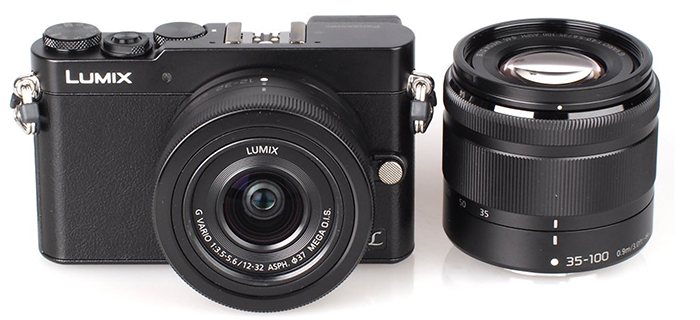
ePhotozine (click here) posted the full Panasonic GM5 review. The camera got a a full 5 star score:
Despite being one of the smallest Micro Four Thirds cameras available with built in EVF, and also being smaller than most other mirrorless cameras, the Panasonic Lumix GM5 doesn’t compromise on image quality or features, and delivers advanced options in a camera small enough to fit in your pocket, even with the lens attached! The camera has a good 3 inch touch screen which makes it easy to use in combination with Panasonic’s clear and logical menu system. Built in Wi-Fi makes sharing photos or using the camera remotely easy and fun. There are a few negatives, including the short battery life, and the kit lens doesn’t offer as good macro performance as other kit lenses available, but for those that want excellent image quality, the ability to change lenses, and one of the smallest compact system cameras possible with a built in electronic viewfinder the Panasonic Lumix GM5 is our Editor’s Choice!
Panasonic published the third party of their LX100 development story with focus on the extremely compact lens design. And there is also a new LX100 review by at Cameras.Reviewed:
Panasonic’s camera chefs added their own secret herbs and spices to the mix—fast burst shooting, a Four Thirds image sensor, 4K video with tons of control, and even a callback to the fan-favorite Lumix LX3 with a multi-aspect ratio sensor. It’s a camera that evokes the best qualities of Panasonic while borrowing from some of the most successful fixed-lens cameras around.
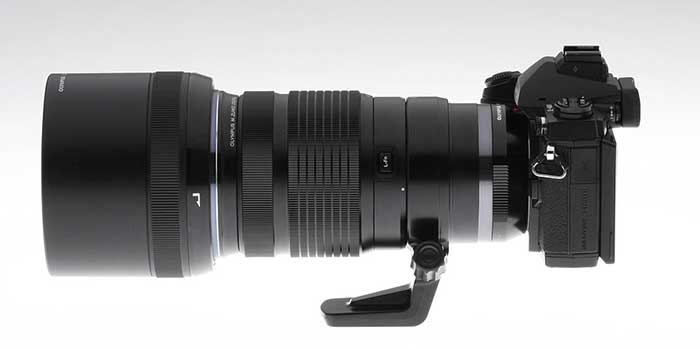
Olympus is making a big splash with the new Olympus 40-150mm ƒ/2.8 Pro lens. No longer are professional and enthusiast photographers beholden to their large, heavy DSLR telephoto zooms if they want a tele lens with bright apertures, rugged weather-sealed build quality and compatibility with teleconverters. Not only are images tack sharp and the build quality outstanding, but the size and weight is also refreshingly light for such a lens. The Olympus lens measures up at around 6.3 long and weighs just a bit over 2 lbs (with hood and tripod collar attached), whereas a comparable 70-200mm ƒ/2.8 DSLR lens, such as the Canon 70-200mm ƒ/2.8 Non-IS lens is 7.6 inches long and weighs almost 3 lbs. (for the IS Mk II version, you tip the scales at about 3.3 lbs.).
For Micro Four Thirds shooters, the 80-300mm-equivalent focal length range on the 40-150mm ƒ/2.8 is tremendously versatile, and when you factor in the addition of a 1.4x TC, it makes this lens quite a powerful and flexible, shoot-almost-anything lens. From portraits with nice, out of focus backgrounds, to sports and even wildlife, the 40-150mm ƒ/2.8 is able to “reach” all of these subjects, for the most part. And the fact that it’s a fixed ƒ/2.8 lens makes it great not only in lower light shooting but also for increased subject isolation (and we found the bokeh on this lens to be very nice as well). In short, if you want the best, premium telephoto zoom lens for Micro Four Thirds currently available, this is the one.
The M.Zuiko 40-150mm is the more interesting option in terms of image quality and performance. The 50mm of extra reach can prove very useful in different situations such as event work or portraiture. The MC-14 teleconverter is also an extra accessory that makes this lens even more interesting. I also prefer its bokeh rendering.
In truth though there may be little that is truly revolutionary compared to previous recent iterations of the Pen series, this is another solid entry that looks the part and performs well. So, if you are seeking a lighter alternative to a DSLR that is still capable of taking some stunning pictures on occasion, then the 16.1 effective megapixel Olympus E-PL7 will be worthy of a place on your wish list.
Most people coming to this camera as newcomers to Olympus will get a great machine. However, for those who have been following the Micro Four Thirds world closely, there’s nothing terribly exciting about the E-PL7 other than some reshuffled technology. Personally, I would hold out for Olympus to introduce a camera with an all new sensor after so many years.