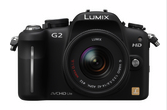



Panasonic G2 reviewed on Imaging Resource

The newly announced Panasonic G2 has been reviewed on Imaging Resource.
And they compared the camera with the Panasonic G1, Olympus E-P1
, Samsung NX10
, Canon T1i
, and Nikon D5000
Check out their review to read their conclusions: http://www.imaging-resource.com/PRODS/DMCG2/DMCG2A.HTM


kesztió
2 years ago |Essentially the same image quality the G1 has. SHAME!
Forget it!
Thanks a lot, Panasonic, and waiting for GH2, no matter how pricey it will be.
panka
2 years ago |Essentially the same image quality the G1.
No it has a worst image quality .. tha g1 render the yellow color better! … it’s better to buy a used gh1!
So what’s the meaning of this model? I think pana had some problem developing the new sensor ….
panka
at
2 years ago |G2 has less chroma noise and in-camera JPEG-NR (retain the same level of details of RAW), as compared with G1 and GF1, from the test sample images.
fuujin
2 years ago |No manual controls for video?! WTF!?
I’ll buy a camera this summer, it seems it will be a Sony EVIL, Canon 550D, or even a GH1 (if the hack enhaces IQ for video) and not a G2 as I was thinking…
Shame on you pana!!!
at
2 years ago |It is obvious the fact is, G2 is a successor of G1, not GH1. It is nothing to be shame on pana. If you concentrate on taking photos more than video, G2 is one the best option at a reasonable price. GH-series is more hybrid type of camera which you would like to have both photo and video in an integrated form (DSLR form), so you need to pay more. If you need the most advanced features biased on video only, camcorder will be the best option.
fuujin
2 years ago |@at
I’m more focused on video
Canon 550D gives me more video options for the same price. But I want an EVIL one, that’s why I’ll wait until Sony release. If Sony’s cameras also don’t have what I what, I’ll buy a Canon 550D.
kesztió
2 years ago |@at: “It is nothing to be shame on pana. If you concentrate on taking photos more than video, G2 is one the best option at a reasonable price.“
NO, No and definitely NO.
G2 would be the best option if it had the sensor of GH1. But – unfortunately G2 still has the sensor form G1.
“Concentrating on taking photos more than video” should mean the exigency for high image quality. In this case still GH1 is the best option…
at
2 years ago |@kesztió
I think Panasonic secures your investment much better than other companies, remember the successor of LX3, GF1 and GH1 are still not officially announced yet, and G1 takes more than 1.5 year before discontinued. Of course, someone may want to get the latest technology as soon as possible. However, not everyone is happy with the value of their asset to drop rapidly, and it is not always new technologies are better.
spanky
2 years ago |@kesztió
What would possibly motivate Panasonic to release a G2 with the same sensor as the GH1 while the GH1 is still being produced and marketed as their premium line? The answer is absolutely nothing. They’re not that stupid. The higher quality video in the GH1 by itself isn’t enough to justify the price premium above the G2, so they have to keep the better sensor on the GH1 as well for now. At some point once the GH2 comes out they’ll migrate the GH1 sensor to the G2/G3/GF2 cameras with the improved Venus processor. Until then, not a chance.
Tyson
2 years ago |I think what is most concerning to me, is that Panasonic is trying to compete with the entry level APS-C dSLRs where it is obvious that the micro 4/3 system runs into it’s limitations and is bested by the T1i, T2i, D90, D3000/5000, etc and not really offering much of a benefit size wise. All the while, they are continuing to produce large, bulky, slow plastic mount zoom lenses that really do nothing that the cheaper kit lenses can’t do on the Penikanon cameras (and these systems already have a large collection of dedicated, AF compatible lenses). I think that this round may be the wake up for Panasonic having watched Olympus go the “smaller” route while they maintained the dSLR-lite style camera. Sony and Samsung are starting to challenge (although, I must say, I am not impressed with the NX10 at all). I am hoping to see the next release from Panasonic start to play to the benefits of the micro 4/3 system with a nice, fully loaded GF2 coupled with an add on EVF with quality like the current Oly EVF. That and, please, for the love of all that is holy Panolympus, start giving us smaller lenses! I want a good camera/lens combo that can fit in my pocket, not a good camera/lens combo that is worse than an entry level dSLR and more or less the same size I already have other big cameras for that!
pdc
2 years ago |Oh dear, oh dear …, thanks but no thanks – I’m going to skip the G2.
Such a disappointment – and to top it off, this G2/G10 move has set
back the lens program – it has been a year since the much wanted
100-300 tele was a solid rumor. If you want to do video, and want better stills than the G2/G10 can deliver, get a GH1, unless Sony or
Samsung do even better. This surely will put some smiles on Nikon and Canon executives.
CR102
2 years ago |@Tyson
You’re 100% correct. Despite Panasonic’s edge in electronics, the one who got it right is Olympus. 90 years of experience in photo-gear R&D must account for something.
at
2 years ago |@Tyson
Regarding different EVIL systems, I really think Sony and Samsung are going to wrong directions using APS-C sensor to compete with DSLR, unless they are making some traditional-looking cameras with good lenses, because the lenses are still too large even the body is smaller.
M4/3 is in between, but the lenses will still be too large for large aperture or zoom lenses, not readily as a replacement of compact DC.
I think the best option is to use a even smaller sensor of 1-inch or 2/3-inch type, which have better quality than the 1/1.8-inch or 1/2.3-inch type sensors, while easier for making smaller lenses with fast aperture. Nikon seems to be working on a 1-inch type EVIL with crop factor of 2.5-2.7x. 2/3-inch type sensor, on the other hand, is also great because it will be truely compatible with the image circle of many C-mount lenses or video primes, and the camera will be even smaller.
The tradeoff between quality and size is difficult to decide. However, I think other manufacturers may find a new way to earn more with a more compact EVIL system that can easily outperform the quality of tiny-sensor inside a DC.
Tyson
2 years ago |@at
I agree, although I am impressed with the size of the initial Samsung pancake lens. It is impressive. I think for any interchangeable, large sensor camera, small lenses will have to = prime lenses. I’m okay with that, but I know many are not. That is cool, but I would like to see Panolympus cater to both by creating both zooms and primes at the same time.
I think that a 1″ or 2/3″ sensor is going to start to have the same issues that many compacts and video cams are having in low light. The only answer currently is through a processor which, at least with current noise reduction algorithms, softens an image to the point where it isn’t very useful for any semi-serious application. I think that a smaller sensor EVIL camera like that will get it’s piece of the consumer pie, but I think that where the micro 4/3 system CAN win, is by playing to its strong points. When there weren’t other EVIL cams out there, they didn’t have to worry, but now, it’s a new game and I think that they have the two things that they can play up to, being small size for relative quality, and system compatibility. If I were involved in the development of micro 4/3, I would be trying to get the camera body as small as possible, (while keeping it metal for a nice solid heft) and focusing on developing at least a couple more high quality, fast, pancake prime lenses. There is just something amazingly sexy about a GF1 or EP1/2 with the 20/1.7 on the front. Also, the somewhat untapped demographic of old schoolers let’s say the “poor man’s leicaphiles,” could have a digital rangefinder-like love fest if they were to develop an integrated EVF in a small(ish) body. Panasonic’s relationship with Leica should really be exploited. They have the next potential cult classic on their hands and they seem to continue to try and foil that with the dSLR-lite bodies (which are great in their own right, I mean no disrespect) I just feel that the system’s true knockout blow needs to offer something unique as opposed to trying to compete with larger sensor, yet similarly sized cameras where they are not going to be able to compete pixel for pixel and with proprietary lenses (currently anyway). That’s all. Whether that is where the money is or not, I do not know.
at
2 years ago |@Tyson
Your vision of the future of M4/3 is great. However, Panasonic and Leica have very different marketing strategy towards digital cameras. Panasonic is a Japanese digital AV company having long history in the DC market targeted for novice users with modern design, quite different from Olympus either. Its M4/3 lines are surely a copy of their DC and DSLR products, from their design, user interfaces and features. It is quite difficult to imagine that an AV company like Panasonic will ever produce a classic-looking camera designed for the minority rangefinder or traditional users. Everyone wants a dream product at a competitive price, but I cannot imagine how the two companies from Japan and Germany having totally different traditions and cultures, business nature, vision and history will ever think in the same way.
Tyson
2 years ago |@at
Not the same, no. A game changer. Regardless of Panasonic’s history, they’ve decided to enter this new game. If they don’t contiune writing the rules (which they’ve done pretty well with up to this point), they will be forced to follow whatever rules are written. They do have a relationship with Leica and really should be doing more to foster that, in my opinion. I think that there is a BIG market for folks that already have M mount lenses for instance that don’t have (or want to spend) $7000usd budgeted for a digital rangefinder and are happy occasionally shooting on an old M mount film camera (or are more or less happy with a current m4/3 cam, but will only go so far without a compact with EVF or will only deal with the current accessory EVF for so long). Not only would it provide the rangefinder fans with a new exciting camera, but the rest of us could enjoy it as well. It would be different than anything else on the market and I think that a certain level of ‘different’ is going to be necessary for the micro 4/3 system to continue to grow, otherwise it quickly bumps up against its limitations and becomes another flash in the pan. I’m just waiting to see the next move as I think it will tell us quite a bit about the future of the format. Are enough folks invested in the system for them to play it safe, or will they try to again redefine digital interchangeable lens cameras? That to me is the big question and one I hope they answer correctly. We all win when the envelope is pushed, and I don’t see the G2 or G10 having come close to doing that.
pdc
2 years ago |Although I was very much hoping for some refinement in the G2 sensor (over the G1), and probably am going to wait out the model upgrades
until this happens, we must not forget that it is Panasonic who we must credit with the game changing development of a very effective mirrorless
interchangeable lens camera system, and the G1 set a high standard of play when it started shipping in October 2008. So, on the positive side the
G2 should appeal to those who don’t yet own a G1 or GH1, and the G10 may produce a significant volume of sales, generating profits that Panasonic
can put into MFT R&D, particularly in the sensor, processor, and shutter designs. Now that I am spending a lot of time shooting my G1 with Nikon, Canon
and Leica fixed focal length lenses, and getting superb results when scene dynamic range is small, but finding out more and more about the DR limitations
of the present G1/G2 sensor, it is crucial for Panasonic to emphasize the “prosumer” virtues of the G camera system – OK to have a cheapened G10 version
to build profit, but if Panasonic truly wants to be in the Top Three it must advance the techological performance of the Prosumer G2/GH1/(GF1?) line, and
probably also start a Professional line, especially in the line-up of fast single focal length lenses, including macro, wide, portrait, long telephoto, and perspective
control types.