




(Colorfoto.de) Olympus E-5 test results explained

Two days ago we posted the Olympus E-5 review from the german magazine colorfoto.de (click here to read the google english translation). There were a lot of discussions because the E-5 had a better performance than the Nikon D7000 and the Canon 60D. I learned the measuring was done by one of (if not the) the most renowned laboratories in Germany: Image engineneering. They are engaged in DIN an ISO-Standards and do of lots of testing for manufacturers with pre-production-samples, too. See: http://www.image-engineering.de/index.php?option=com_content&view=article&id=53&Itemid=102
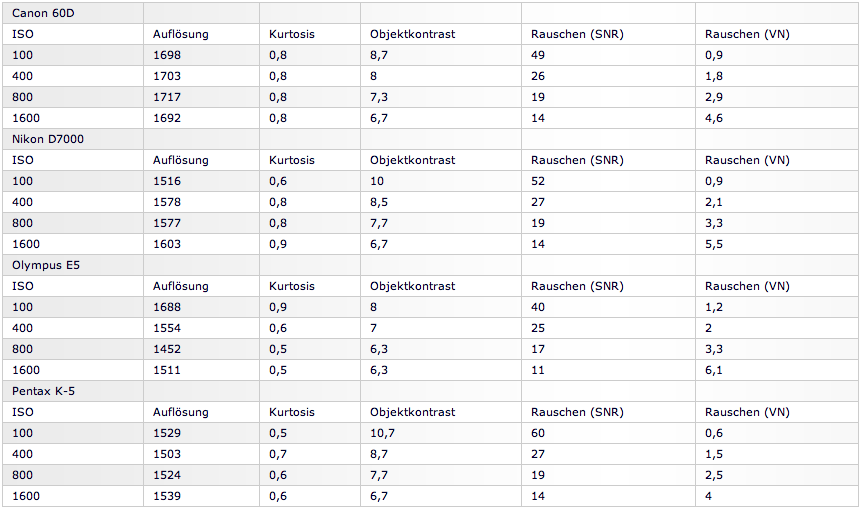
You can see the the detailed results on the screenshot on top. Interesting, at 100 ISO the Olympus E-5 has more resolution than the Nikon D7000 and Pentax K-5.

Sylvain
2 years ago |They are engadget in DIN an ISO-Standards
Engadget is a website, you meant engaged or even better, involved?
admin
2 years ago |And there is still people out there that says Freud is no modern anymore
a bunch of malarkey, these tests
2 years ago |i will miss you oly,
oh well i’ll still be holding onto my 8080, vintage pen, om and zuiko lenses with a kung-fu grip
only in death will this grip yield
Reza
2 years ago |I don’t get it, how come the Nikon D7000′s resolution increases with increasing ISO?! the other see typically decreasing resolutions with increasing ISO, which is what one would expect.
Voldenuit
2 years ago |I’m surprised that they tested at ISO100 instead of ISO200 (Olympus’ recommended nominal ISO for the camera), and didn’t even include the ISO200 tests (they jumped straight to 400). While this shouldn’t affect the resolution test much, it would definitely have an impact on DR and colour accuracy.
While the D7000 is not significantly ahead of the 60D in synthetic noise tests (and in fact colorfoto shows it as lagging), real world tests tell a different story – there is significantly less shadow noise when lifted, giving the photographer much more latitude in post, and making the D7000 the current king of low-light/high ISO in the APS-C world.
Also, resolution is a function of dot pitch, so it’s no surprise that the E-5 gets a high number, when in reality the figures for different sensor sizes are not directly comparable. It is also telling that the resolution figures start to fall on the E-5 as ISO increases, dramatically so, whereas the other cameras in the test hold steady.
I don’t think anyone is debating the low ISO performance of the E-5, which is brilliant, but it can’t keep up with the best of the APS-C and FF crowd once the light fails, and the colorfoto results confirm this.
azos
2 years ago |is normal that at high ISO, the E5 is left behind. we have an older(2 yaers) senzor and a smaller one. if a 2 year senzor can compete against with the top today’s APS-C, is great. if Oly will get the latest 4/3 sensor i think the problems will desepear.
Voldenuit
2 years ago |Dxomark (take grain of salt now) didn’t like the sensor on the GH2* all that much either, so I think (m)43 is in a bit of a bind if it wants to compete in the pro space. The DX sensor on the D7000 is only 63% bigger by area than m43, but it’s still far ahead of the best m43 sensors in low light at the moment. ISO1600 isn’t even considered ‘high ISO’ on high end bodies these days, and the E-5 has already lost 15% of its resolution at this stage, effectively becoming a 10 MP camera as far as resolving power goes.
We need better sensors than what Panny can supply (and is willing to sell to its partners). The exclusivity agreement between Oly and Panny is due to end (or may have ended already), and I can’t help but hope that this will be a good thing. If Oly can cajole Sigma, Kodak or some other sensor supplier to develop for m43, the increased competition should spur Panasonic to speed up its sensor program.
* Don’t get me wrong, I’m seriously considering a GH2 as a second body, but I don’t make money off my art, so my needs are not as exacting.
gabs
2 years ago |There is huge difference between RAW and JPEG. Dxo measures raws. For me the results in the german website seems to be from jpegs (vith dsp treatments). So…
david bateman
2 years ago |Note the signal to noise measurements. The E5 is low at ISO 100 only 40 to the others hitting 60. But at ISO 400 the E5 is 25 with the others at 26 and max 27. I would say not significantly different. That would imply to me that the best shooting comparison for the E5 to others is ISO 400, where the E5 holds its own.
Gabriel
2 years ago |For what i understand, they test a camera+couple lenses. The e5 with the all mighty 50mm f2.8
So it’s hard for other camera to win against that.
Dana Curtis Kincaid
2 years ago |“is normal that at high ISO, the E5 is left behind. we have an older(2 yaers) senzor and a smaller one. if a 2 year senzor can compete against with the top today’s APS-C, is great. if Oly will get the latest 4/3 sensor i think the problems will desepear.”
There are no problems. The camera takes great pix, the lenses are terrific. What else do you want?
I EXPECT 1600 and 3200 to have some noise. It bothers me not.
Per
2 years ago |I do not trust this kind of measuring a camera quality: It all depends what and how you measure. This example contradicts the DXO measures.
Look at the results from cameras and lenses instead! Of course it is easy for testers to do “objective”(!) measurement to establish a ranking. In many cases wellknown photographers glasly use lenses that do not come out on top. These are very quality-senisitive. The conclusion: Measurent can be interesting but do never regard them as the truth!