




(FT4) The Olympus modular system will be different than the Ricoh GRX system.

All our most important sources confirmed that Olympus is working on a completely new modular camera system. Some of them told us that Olympus original plan was to first release the
$loc = $_SESSION['geoip'];
if ($loc == 'GB' OR $loc == 'UK')
{ $sel = "1"; ?>Olympus E-3 }
if ($loc == 'ES')
{ $sel = "1"; ?>Olympus E-3 }
if ($loc == 'IT')
{ $sel = "1"; ?>Olympus E-3 }
if ($loc == 'AT')
{ $sel = "1"; ?>Olympus E-3 }
if ($loc == 'DE')
{ $sel = "1"; ?>Olympus E-3 }
if ($loc == 'BE')
{ $sel = "1"; ?>Olympus E-3 }
if ($loc == 'AU')
{ $sel = "1"; ?>Olympus E-3 }
if ($loc == 'FR' OR $loc == 'FX')
{ $sel = "1"; ?>Olympus E-3 }
if ($loc == 'JA' OR $loc == 'JP')
{ $sel = "1"; ?>Olympus E-3 }
if ($loc == 'NL')
{ $sel = "1"; ?>Olympus E-3 }
if ($loc == 'CA')
{ $sel = "1"; ?>Olympus E-3 }
if ($sel != '1')
{?>Olympus E-3 } ?> successor and after that the first modular camera. But now Olympus is forcing the modular camera development and there are three possible scenarios:
1) They release the Olympus E-5 at Photokina and the first modular camera by end 2010-early 2011.
2) They will skip the Olympus E-5 release and announce a semi modular camera (it means with not all the planned features)
3) Olympus makes the miracle and the modular camera should come with all the new features.
What kind of features will the modular camera have?
1) New sensor with a small increse of total Megapixels (14-15 MP)
2) You will be able to use both m4/3 and 4/3 lenses
3) faster autofocus
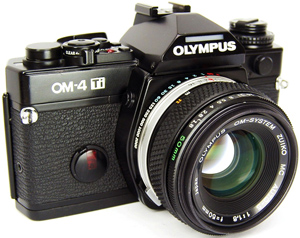
4) completely new design (based on the
$loc = $_SESSION['geoip'];
if ($loc == 'GB' OR $loc == 'UK')
{ $sel = "1"; ?>Olympus OM4ti }
if ($loc == 'ES')
{ $sel = "1"; ?>Olympus OM4ti }
if ($loc == 'IT')
{ $sel = "1"; ?>Olympus OM4ti }
if ($loc == 'AT')
{ $sel = "1"; ?>Olympus OM4ti }
if ($loc == 'DE')
{ $sel = "1"; ?>Olympus OM4ti }
if ($loc == 'BE')
{ $sel = "1"; ?>Olympus OM4ti }
if ($loc == 'AU')
{ $sel = "1"; ?>Olympus OM4ti }
if ($loc == 'FR' OR $loc == 'FX')
{ $sel = "1"; ?>Olympus OM4ti }
if ($loc == 'NL')
{ $sel = "1"; ?>Olympus OM4ti }
if ($loc == 'CA')
{ $sel = "1"; ?>Olympus OM4ti }
if ($sel != '1')
{?>Olympus OM4ti } ?>)
5) easy-intuitive and fast controls
6) The mount should be modular but separated from the sensor module. Olympus will probably not take the path of the one piece lens-sensor modul from Ricoh GXR (and that’s good news!)
We are currently receiving some rumors about the modular camera but we are still not certain how exactly the real camera will look like. Contact us at 43rumors@gmail.com if you can and want tell us more!
Thanks!
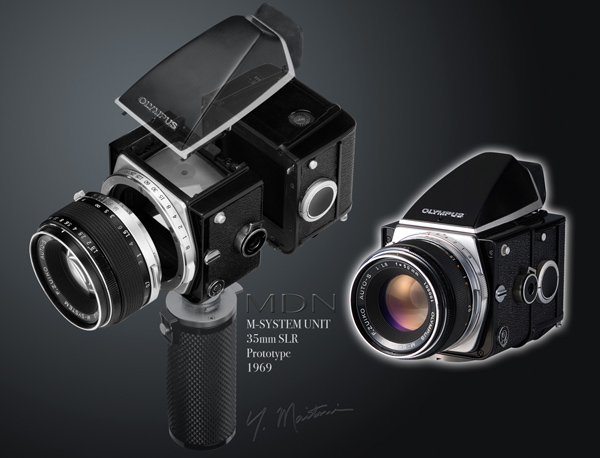
Oh, and one more picture of the original Maitani modular system:

Fan^2
2 years ago |“based on the Olympus OM4ti”
The dream of many Oly fans!!!
Om4 Digital !!!!
Archer
2 years ago |Finally, a camera company that might be listening to the enthusiast! I don’t know how many times I’ve heard the words “I just with someone would make a camera that’s just like (insert favorite manual camera here)!” Looks like we might finally be getting it.
kesztió
2 years ago |“2) You will be able to use both m4/3 and 4/3 lenses”
This certainly means NO MIRROR, no optical viewfinder, no phase detection. Am I Right?
kaine
2 years ago |any idea if it will have the option of full frame with old oly lenses?
efix
2 years ago |kesztió, if they are doing this right (and I surely hope they are), the only reasonable solution would be something like the Maitani prototype on the picture, with modules for 1) lens mount, including or excluding mirror, viewfinder, either optical (via mirror) or electronic, back with sensor, display etc. The mount modules would be available for Micro Four Thirds, Four Thirds (including mirror for ovf) and legacy OM lenses (also with mirror for ovf), two attachable viewfinder modules – one optical that is coupled to the mirror modules, and one electronical for use with the MFT module. As concernc backs, they could offer different entry-, advanced- and pro-level backs with different sensors, monitors, handling etc. And maybe even a film back.
That would be one ultimately versatile 35mm modular camera that could appeal to *all* photographers out there, whether hobbyists or professionals, whether coming from film, MFT or FT.
Archer
2 years ago |I think that “modular” may mean that it can use different mirror-box (or lack thereof) and autofocus mechanisms. We’ll see what comes in a few months.
Nathan
2 years ago |I figured the sensor would not be on the same module as the mount. It would seem pointless to make the sensor interchangeable.
I doubt it will have a “back” analogue. Maybe a modular mount, but unless they do something radical with sensor design, I just can’t see why you’d want to swap out the sensor. Maybe, if they made a 5MP+ sensor module that could do ISO 12800 cleanly, I’d see the purpose for a swappable sensor module.
You know, or a 16 bit monochrome sensor with 15 stops of dynamic range. Something really boutique. But, Olympus doesn’t MAKE sensors, so it seems kinda silly.
Chris
2 years ago |I think it’d be interesting if they had a “full frame” sensor module. Something 2x the size but with the 4:3 ratio (instead of 2:3).
It’s just a pipe dream, though.
samo
2 years ago |i still want an e5! Is it just me?
NDI
2 years ago |Damn. if it looks like this I’ll buy one in a heartbeat. Although I don’t own an OM4 Ti, I do have a Minolta X-700 which looks similar and would love to have a digital equivalent that I can use my Zuikos on!!
I am interested in the engineering of a modular system, more parts = more complexity and usually more bulk so the form factor of the final result may not be taking advantage of the ‘smaller sensor = smaller system’ approach.
May be that the m4/3 will be the small model and the rumored modular will in fact offer a larger sensor to justify a larger form factor.
Bring on more rumors!!
Darkened
2 years ago |@samo
No, you are not alone. I want a solid continuation for my E-3 also, and with no major changes to the body size. My hands are quite large and I don’t want anything resembling a toy when I’m dealing with bigger lenses as I tend to hand-hold them. The battery handle could do with a bit of refining, but other than that, the E-3 is quite nice fit for my hands.
If I would vote for a scenario, it would be number 1, because that would give me an option to upgrade my E-3 to the new E-5 or if I can wait that long, maybe the modular or semi-modular camera which would be out at the end of the year or Q1 2011.
If I can wait long enough, I can then see what reviews have to say about both bodies and decide after that. Then again, if neither option is any good, I’m hoping that Nikon gets the D400 out or the successor to the D700, what ever that would entail. Something which is certain is that I’m moving on from the E-3, but in which direction, that’s something we’ll have to see.
Darkened
peroni
2 years ago |QUOTE: “i still want an e5! Is it just me?”
I surely can’t be bothered by an E5 if they make a prof camera as small as the OM-4 Ti
Miroslav
2 years ago |I’m starting to like that modular camera idea … Although, I see little sense in E-5 being a separate product, except for weatherproofing. Photokina can’t come soon enough for me.
kesztió
2 years ago |Well,
If efix is right I also have to admit that it’s a really bright idea.
Developing a modular camera which is essentially a MFT but can be easily “upgraded” to a “classic” FT using just two additional modules – Yes, It really makes a sense!
kesztió
2 years ago |@Miroslav:
Cannot see any matter of principle in making a modular camera waterproof.
napalm
2 years ago |“I surely can’t be bothered by an E5 if they make a prof camera as small as the OM-4 Ti”
I agree with you on that!
spanky
2 years ago |So…. what’s the market share of something that’s completely modular anyway? Why would I pay twice as much for one camera system as I would for a single camera system that already allows me to do the same (m4/3). Is it just for people who have sold their Oly 4/3 cameras in favor of m4/3 cameras and would like something that allows them to use their 4/3 lenses a bit better? Sorry, I don’t see it. On top of that, more parts means more chances of failure and damage (which benefits the company, of course – more stuff to sell).
Bad idea, IMO. Seems like it’s a way to appease both the 4/3 and the m4/3 crowd within Olympus because someone at the top doesn’t want to make an executive decision on a company direction, so they’re coming up with this turd (although I’m sure it’ll take fine pictures).
Darkened
2 years ago |““I surely can’t be bothered by an E5 if they make a prof camera as small as the OM-4 Ti”
I agree with you on that!”
I really don’t get this “small professional camera” concept at all. Look at 1D series and D3 series from Canon and Nikon. There must be a reason why they are big and sturdy.
I can’t even use the E-3 without the vertical grip, because there is no space for my pinky when it’s off. With the handle I can get a decent grip of the camera, which is very important to me.
Modularity here could be beneficial though, if and only if there is a way to make a smaller (m4/3 or Leica’ish) body to have a decent 1×1 ratio “outer shell” with weather proofing (and also be as solid as an unibody camera). With that I could get on board with, since I’m not necessarily always happy to lug around a huge camera, but off with the Olympus it will be if I don’t have a chance to get a decent size camera which will fit in my hands.
I honestly think that the only small sized body used by professionals is the Leica system and even that is for a specific purpose and not an all around camera system by any means.
Darkened
Russ
2 years ago |“1) They release the Olympus E-5 at Photokina and the first modular camera by end 2010-early 2011.
2) They will skip the Olympus E-5 release and announce a semi modular camera (it means with not all the planned features)”
I’m not sure if I understand what was written here. Does this mean that the E-5 will be a new model that is different from the modular model? What is the semi-modular camera? Is that a third model, the E-5, the modular model, or are all three the same model?
Anyway, I look forward to a modular model. It won’t be for everyone, but it will have an enormously positive impact for Olympus. There will be a lot of buzz that will get many people to look at the brand. For people who purchase it, they’ll have a body that is more flexible, and a bit more resistant to obsolescence.
Gianca
2 years ago |This rumor may be not as far fetched as it first sounds.
There are already existing modular systems, including the upcoming Red Scarlet system (not out yet):
http://www.red.com/epic_scarlet/
Oly may just jump on this bandwagon because so far being on the edge of innovation it payed off for them: their bet on a redesigned system based on a 4/3rds sensor led them to the market position where they are now with the m4/3rds. Not a bad place to be.
Being just stuck on a 35mm system it is not a safe position anymore, and the m4/3rds success proved that.
I would not be surprised to see a system where the sensor and the mount are available as completely different modules, allowing for either a full 4/3rds mount module with a choice of an electronic finder or a mirror finder module (destined to become obsolete soon or later), and/or a m4/3rds mount module with only a choice of an electronic finder module.
Why going modular? To give choices to the photographer. Right now the only choices we have is changing lenses and entire bodies: what if we would instead have the choice of keeping the body/mount module and upgrade only the sensor module? That would be the equivalent of keeping a E3 but getting a new sensor: it will shorten the cycle of upgrades, which is good for Oly and it’s good for us.
And we would be able to reconfigure the camera based our task needs on the fly, like shooting in a light controlled studio versus wildlife: we could opt for a full/heavy configuration or a silent/light one, depends on what’s needed and without having to swap entire bodies with limited options. That’s what the Red/Scarlet offers: a completely customizable system.
Russ
2 years ago |Never mind, I was thrown off by the formatting. I see the three possible scenarios.
don
2 years ago |If the new E5 is to be a modular digital OM4, then I can see a high probability of a new digital OM body style as the new m4/3 DSLR replacement from Oly as their version of the G2 & replacement for the E400 & E600 series & E30? Only make this gem in similar small all metal body (probably also with cheaper plastic version) as the OMs. With appropriate converter they would be able to use either 4/3 lenses or legacy OM ones. Just what many have been hoping and asking for.
napalm
2 years ago |well if this is true, i think they will set at different kits. like a starter kit for m4/3 or 4/3. then a dual module kit.
as for parts breaking, we can think of it this way, if something breaks, you just need to replace that part. you dont have to buy a new body. it works both ways.
Mistral75
2 years ago |Just imagine:
- a μ4/3 body with contrast detection AF and detachable electronic viewfinder (or no EVF at all but the rear screen)
- plus an additional module comprising mirror box, phase detection AF and optical viewfinder, whose thickness (viewfinder excepted) would be equal to the difference in registration distance between 4/3 and μ4/3, to be placed in front and on top (viewfinder) of said body,
and you should be close to what is alluded to here.
misu
2 years ago |I can’t really see the advantage of a modular m43/43 system. the problem with olympus cameras is the image quality.
a modular camera might also mean a video/still camera, and that I would like to see. (by video I mean professional video, without moire, solid codec, etc, that would be compatible with 43 system).
even so, I think the nex system, with the announced video camera, will be better in terms of image quality and codec options.
Monty Leman
2 years ago |The one problem I foresee is that this might actually make me (and others) LESS likely to buy a new model. This makes it sound like they’re planning an E-5 and a modular camera, and they might not be one and the same, so if they release one camera and it’s not a “modular E-5″, I might just wait to see what the next one’s going to be, instead of settling for an interim camera.
Nathan
2 years ago |I still maintain that the ONLY scenario that makes any sort of sense is for the “new” system, if any, to have a larger image circle, and for the 0.5x SWD adapter from the Olympus patent to be used with a whole new set of simplified fast lenses.
I can’t see why the ability to use micro four thirds and four thirds lenses would make a camera revolutionary, since the E-P series can already do so.
Marcel
2 years ago |Please pinch me! Based on the OM 4ti … this is excellent, excellent news!
Brandon
2 years ago |Darkened: 1D and D3 series are big, but medium-format is bigger. It’s the sensor, and beyond that: the vertical grip and added componentry… the very things a modular camera would allow to be added only as needed.
Spanky: Where are you getting “twice as much” from? Oly bodies have historically been priced below competition (though with good reason) and the only fundamental change to cost that modularity brings is increased surfaces for enclosures, and increased shipping and packaging, all of which are amongst the least expensive aspects of a camera. I would expect a marginal increase for the individual who wants to ‘have-it-all’ but that said: (A) such an individual would be the very person most benefited by the versatility of the total system and all its interchangeable parts and (B) anyone who doesn’t need every function pro-level cameras provide would (possibly) now only have to pay for those functions they actually use and want (or at least, would not pay for as many functions they do not use or want) which makes this system effectively cheaper for them.
Regarding the increase in product failure: modularity does not increase componentry, it only alters how they connect. The number of moving and/or complicated or delicate parts is not increased, in fact (as just mentioned) one may select a scaled-down system with potentially fewer such parts. Regarding the connections: separate enclosures increases reliability, not the other way around. Additionally problem-components are easier for the company to correct when isolated (no issue with revamping the entire camera. In fact one could imagine sending in a particular component for repair and still having ‘enough camera’ left-over to manage without halting work-flow (or at worst having to rent/buy only a single component while repairs are made should an important job demand it). Now…some modular parts may not have such individualized enclosures, and this not only increases seals, etc. but may expose parts (when not coupled) that are normally relatively protected. This is exactly the kind of concern that cannot be estimated at this point, so while it’s good to be aware, we have every reason not to assume this camera would be more vulnerable.
Regarding an unwillingness to make an executive decision: look again at the recent postings: they are making rather bold decisions, and in particular are evolving beyond 4/3 as it has existed. Whatever this is, it’s not a conservative or derivative move made simply for compromise or appeasement.
shatteredsky
2 years ago |>I really don’t get this “small professional camera” concept at all. Look at 1D series and D3 series from Canon and Nikon. There must be a reason why they are big and sturdy.
I can’t even use the E-3 without the vertical grip, because there is no space for my pinky when it’s off. With the handle I can get a decent grip of the camera, which is very important to me.<
Hmmm, I don't get the "there must be a reason why they are big sturdy" argument. Finally Olympus made a small body (E-400 – E-620), but no sturdy small one. And to those arguing that they hold their lens by the body, you may do it but I never understood why it is so difficult for many to hold the lens (with the body). For weight I don't care, but everything that shaves off a few millimeters is good.
Cheers
Neonart
2 years ago |I think this is going to be great if it comes to fruition. Don’t think some of you are understanding how great this can be.
One of the appeals of m43 is smaller bodies. (Sorry to those who do have larger hands and prefer a bigger body, but the market is not in your favor. In electronics smaller & lighter sells.) Yes, alot of the pro equipment is large, but it doesn’t have to be. Lot’s of pros shot with 35mm bodies like the OMs for decades. Others shot with MF. At this point I don’t think Oly is after the D3 class.
If they can produce an OM sized body that has a smaller hump with EVF and shorter mount for m43 with a great new sensor they’ll have tons of people who can upgrade from their original m43 bodies, and give the option to upgrade to 43 if needed.
But if you have 43 lenses and buy the same sealed body with the sealed 43 mount (surely they can seal the module) and real mirror-box with OVF you now have a pro body for 43 lenses. Add a battery grip and there is an e3 replacement. Still hefty and weather sealed, but works with two markets. Lighter and smaller with m43 mount and larger, heftier and completely sealed for 43.
The industry is changing. We can’t just think of how we like it now, but what’s on the horizon. Imagine how many people were reluctant to digital. If the industry listened to only them we’d still be worried about our 24 exposures…
Brandon
2 years ago |PS: Modularity also gets cheaper over time as only certain components need be upgraded. Indeed cost-savings is perhaps the single-greatest advantage of modularity.
I’ve only been on this site for a few weeks, but I’m constantly disappointed by the sheer lack of insight or intelligent contribution by the majority of posters. Why are you chirping in if you haven’t thought it through? Isn’t the only point of such a forum to get our collective brains together? If you’re simply going to declare your feelings, either in the sense that you simply proclaim what you like/dislike or in the sense that you speak your mind–complete with predictions and judgments–yet unfettered by consistent and objective analysis–then aren’t you just wasting our time?
There’s maybe one in twenty posters here that have something to add worth reading.
Brandon
2 years ago |And here’s another cost-saver: modular components not only may be swapped between bodies, but for some components one might be all that is ever needed fro any number of bodies. For example: a GPS -tracker that can communicate with multiple bodies, or a flash-to-camera module that can communicate with multiple flashes, or a WiFi system that can communicate downloads (two methods here: download one camera at a time when a shoot is completed, or for real-time downloading you can use an Eye-fi or similar to communicate with a the single WiFi base-station). And those are simply the more or less conventional examples…
The best thing about modularity is it evolves… and with it increases the pace of evolution itself. It’s dynamic; Think about how quickly PCs have evolved since they went modular (and forget all the Mac vs. PC stuff: that’s all about usability, which is not a modular-component issue but an open-platform, multi-manufacturer issue involving market-share, product eco-systems and developer-control).
Brandon
2 years ago |Here’s another cost-saver: With modularity you purchase low, then grow. Not only are you not forced into as large an initial investment, but you can evolve your system with your needs and abilities. We’ve been talking about the person who has a library of 43 lenses and doesn’t want to lose their use. What about the person who has no lenses, is thinking about investing but unsure the format? This way no investment is left to rot. You buy a D90 and then upgrade to FX… and your lenses are crippled in use, plus your D90 is an extra body you maybe don’t need. You buy a non-FF EOS camera with non-FF lenses and upgrade to FF and your lenses don’t work at all on the FF, plus you have that extra body.
With this camera everything retains value, and you only buy an extra body when you actually want two bodies.
napalm
2 years ago |well you can always attach a grip to make a small cam bigger. buy you cannot saw off the bulk of a bigger camera
)
napalm
2 years ago |i still feel this “modularity” will be limited to interchangeable mounts. and probably an introduction of a totally new mount and lenses (as hinted by a previous rumor) if not upon launch, maybe at a later date.
i think Oly wants to upgrade their system but do not want their old user base to be left off, so having modular mounts solves this dillemma.
Russ
2 years ago |I wouldn’t bet on a new mount. 135 sized sensors use glass that can transmit only so much resolution. If someone really needs a lot of resolution, and 43 can’t provide it (once 43 gets to its limits), 135 is probably not enough either. The next step should be medium format.
JNMPhoto
2 years ago |For many years I used, exclusively, OM-1 & OM-2 cameras, and when the time came to adopt digital I went with Olympus.
Compared to the OM system, my E-1 is large, but not exactly a giant. It has served me well, but it is due for an upgrade. I have no interest in the m4/3 range, although I do think it is a good system and deserved to do well. I have no interest in a modular system either. I just want (like many others here) a pro grade E-3 replacement.
If it is the same size as the OM then good, but if it is the same size as an E-1/E-3 then also good. It does not need any “scene” modes, just APSM, it does not need any Art filters. No video, even better, no pop up flash, better still. Just make it weather sealed, with the same focus assist light as the E-1, same Single-Constant-Manual focus switch, and a real optical viewfinder and (almost) indestructible and I will buy one.
If, on the other hand, Olympus decide that the E-5 will not be released or it is a “pro” m4/3 or a “stop gap” system (modular or otherwise) designed to allow 4/3 users to migrate to m4/3 then my next camera (and lens collection & flash) will not be Olympus.
PS I still use the OM cameras, and with a 250 frame back & motor drive fitted, they are not exactly small……
Miroslav
2 years ago |@kesztió
What I meant is that the E-5 and this new modular camera should be the same thing. It’s not good to make two separate products, although this rumor states that there will be separate. The only thing modular camera cannot ( easily ) be is weatherproof.
I also believe that the modular system will be based on smaller m4/3 body ( contrast detect AF ), which would operate in the same way as all current, with two add ons: m/3 lens mount with mirror and OVF and OM lens mount with mirror and OVF, both with phase detect AF. One advantage of this modular approach nobody mentioned is that by making this Olympus, Panasonic, Leica and Sigma do not need to make m4/3 versions of their 4/3 lenses. They can continue making old lenses ( some of which are excellent ) while all those complaining about m4/3 needing more lens choice can shut up. Price wise it is also better, because R&D costs are much smaller and old lenses can only be cheaper. The only ones who loose out of all this are those wanting smaller lenses than 4/3 are.
The real potential of the system is if some independent company makes mount-mirror-phase detect AF module for Canon/Nikon/Pentax/Zeiss etc. lenses. It would allow people to use the absolute best glass ever made on a single camera.
I hope they make the body compact enough.
Michael
2 years ago |New digital camera based on professional OM system is really good news. Olympus has always been different from competition – that’s why smaller pro camera. I don’t know for D3 sized upcoming DSLR as some writing, I think E-System is more at D300s or 7D level, however it may sense if you are using SHG Zuikos. If Olympus really wants to go pro they have to consider image quality compared to best in class (high-end DSLRs with 135mm sensor), developing new 4/3 sensor we never seen before or switch to new mount (current E-System costumers may feel abandoned). Stick with 4/3 development is more realistic rather than developing whole new system (lenses, mount etc.) This new camera may be a solutions for professional backup camera for pros or just one camera to go (street shooters etc.).
Neville
2 years ago |Neonart:
There is a limit to smaller is better and in recent times things are getting bigger. Think of the Smart Phone, I carry a much larger iPhone compared to my older phones, iPhone 4 is larger than iPhone3GS from the photos/then there’s iPad.
JNPhoto:
I agree that ART etc is a waste of time. But think of this. You decide that you want to take your indestructible camera on a tour and you don’t want to take everything with you. I can pack my E-620 (which is not weather-proof and I need a E3 replacement), My 70-200mm with 1.4, my 12-60, a graphite tripod into a lowpro and of I go for a days hiking. I have just finished a stint in Alaska. There were alot of Nikon/Canon guys (including two professionals) who were VERY jealous of the quality of a handheld equivalent 600mm lens) and did not get the shots.
So in your case it seems like you are a professional photographer (I am not) who does studio work (I am not). You change your mind and go for a modular camera system.
You buy one body, with a back and tethered capture, but its modular system. You can then take components on a 20km mountain hike in search of wildlife. THAT appeals to me.
Regarding video. That is a MUST for me.
I took 20 photos of a glacier carving say an apartment block at 2km on a lightweight tripod. (which none of the Nikon/Canon guys could get as they couldn’t lug their gear), 18 of them are 5 star rated Imagine if I could flick a switch and HD video. Surely that must appeal to you.
Granted there are some very nice telephoto lens out from these guys there but they are not hitting the length I am with the 2x factor
Regards
Neville
Neville
2 years ago |Error 50-200mm
Brandon
2 years ago |Miroslav is right-on in pointing out one of the two greatest advantages. I say “two” because I feel equally game-changing would be the end of current-level ‘digital-rot’… Replace the sensor, maybe the processor, but keep the body… We may again see the day that pro bodies last a decade or more. How would Canikon even compete with that? If Oly doesn’t waste this opportunity, they will come from the back to take-over the field, as Nikon did in just 18 months to Canon with merely evolutionary change in their product line. This is revolutionary. Who would spend $3,500 for their next upgrade when $400-$900 (depending on sensor size) will do? This approach even allows still-better bodies to be developed–because the body is again a major investment. We can eventually expect customized options and just general attention paid to what is, after all, going to be in your hands as a treasured possession for a long time to come (think Leica-build). This approach also forces Camera-makers to constantly refine their user-interface (like Leica must do with their largely unchanging bodies) instead of endlessly tweaking the controls on the body (which disrupts the work-flow of an experienced shooter). It’s a better approach from a real-world usability stand-point.
Brandon
2 years ago |PS: With only the sensor to upgrade, upgrades can come down the pipe at blistering speed: Oly doesn’t have to design a whole-new camera after-all. Eventually there may even be third-party sensors. The whole enterprise just opens-up like a PC’s internals. I think it’s inevitable, actually: just not sure how far ahead. In the meantime we’d still have Oly able to concentrate on a ‘single’ modular pro body (not several pro bodies for different needs) and able to push out constant upgrade paths (so that if you wait a year to jump you get another year’s better sensor-tech, instead of just joining the bandwagon late, and so (of course) you can just upgrade even more regularly (if you really want to spend what you’ve always spent–there’s always a way to spend that money saved).
Darkened
2 years ago |As I stated before, I’m not saying that the “pro” camera must be huge mammoth which only few people can hold up. But there is in fact a reason for the bigger size of the so called “pro” – models.
I compared the hopefully coming E-5 to Canons 1D – line and Nikons D3 – line, which was only to demonstrate the size, feel and the physical format of the body, not to compare it with their technical differences. I’m aware that the E-3 never went against these pro models from Canon or Nikon, but rather the “advanced photographer” – models like the D200/300 and 40D and so on.
Also I know that part of the bigger size is due to the bigger sensor in these cameras, but for example even though Canons latest pro model doesn’t have a full size sensor, the body stayed the same (ok, maybe if the sensor would have been smaller still, they would have had the opportunity to make the body smaller). The question is that if it would have been say APS-C sized sensor, would they have changed the body to match? I for one don’t think so.
So back to the topic. I’d be more than happy to buy a system which would entail a smaller (leica-like) body, but which could be brought to a true “pro” size camera with an add-on. I’m just concerned about the weather sealing of the body if it was done this way, also the body should be as rigid as a traditional “unibody” – system (I wouldn’t like it if one of my heavier lenses ripped the smaller body or the bayonet mount off the camera when hiking). And finally since I’m quite fond of the optical viewfinder, I’d like that to exist on the camera and if it is a modular piece, then so be it, but again, I want my weather sealing.
The point I’m trying to make here (let’s put the body size and even weather sealing aside) is that I’m really happy for myself and Olympus if they can pull this off. I’m all for modularity, but if it comes with a cost, then I’m switching camps.
Darkened
dMS
2 years ago |I have nothing against the modularity, as long as I can continue to have a mirror a pentaprism and a big OVF, keeping the general appearance of an SLR. I don’t want/need the colorful look of GH(s) or worse. I am not fundamentalist about the size, if I can have at once two bodies the size of the E3 and E410 so much better although I think small is impossible with so many joints. Do it with more MP, APS-C sensors have already exceeded the pixel density of a 4/3 sensor. Yes I absolutely need a film mode, it was the main reason for not having bought the E30 or E620.
Some of you might say why not purchase the Canon 7D and I answer you in advance: because I’ve spent more money on glass than many of you in lenses and bodies.
Newsed1
2 years ago |A few weeks ago I came on here after the first modular mount rumors broke and made a suggestion along these lines.
If you have a compact body with switchable M43/43 mounts and a separate, chunky, battery grip you could built two camera systems with one body.
Use the body, M43 mount and M43 lenses for a light, high quality travel kit.
Or use the body with the grip and the 43 mount to go with your 50-200mm et al for serious action shooting.
Olympus has said before it wants to sell more accessories and more lenses. This concept could achieve just that….
Ross
2 years ago |I can see a great potential for this modular concept & hope it all comes to a successful fruition, but with it, I like the sure grip of the E30 (E3) & even the E520 where you can carry the body with a large lens on it without feeling like it might slip out of your hand. So I hope there is an option for that sizeable grip which could end up being a chioce between 2 bodies. One, an E3/E30 styled main body or two, a cheaper E600 style instead. The possible scenarios for this year might stiil be the E5 appearing from September followed by the modelar series later in the year or early next year. I hope that is what happens, but we will see.
Neonart
2 years ago |“Error 50-200mm”
Why must it be an error? Maybe he’s got a Sigma 70-200.
—-
“There is a limit to smaller is better and in recent times things are getting bigger. Think of the Smart Phone, I carry a much larger iPhone compared to my older phones, iPhone 4 is larger than iPhone3GS from the photos/then there’s iPad.”
The iphone cannot be compared to a Nokia phone that has no screen and does nothing else. But as far as technology shrinking, the iPhone 4 is actually 24% thiner than IPhone 3G/S. (See keynote @ 32:16) The iPad is one of the thinest and lightest laptop replacements (it’s not a phone.)
I’m just saying that in technology smaller is seen as new and more advanced. I agree there’s a limit. However, I don’t think something sized like a 35mm OM4 is “too small” to be pro grade.
Neonart
2 years ago |Got it mixed up. Thought previous post mentioned the 70-200. Sorry.
“Error 50-200mm”
Why must it be an error? Maybe he’s got a Sigma 70-200.
mortmain
2 years ago |This sounds very exciting and innovative, but the problem seems to be that a modular system is geared towards providing different options for different users, but I am guessing the one thing we can say for sure is that the system, as a whole, will be e-x-p-e-n-s-i-v-e, thereby relegating its appeal to professionals and amateurs with disposable income. Unfortunately, in this market, its difficult to imagine such a system appealing to the masses.
spam
2 years ago |“The Olympus modular system will be different than the Ricoh GRX system.”
You could make that FT5, the chances that Olympus would license the Ricoh system is nonexistent.
Anonymous
2 years ago |[...] [...]