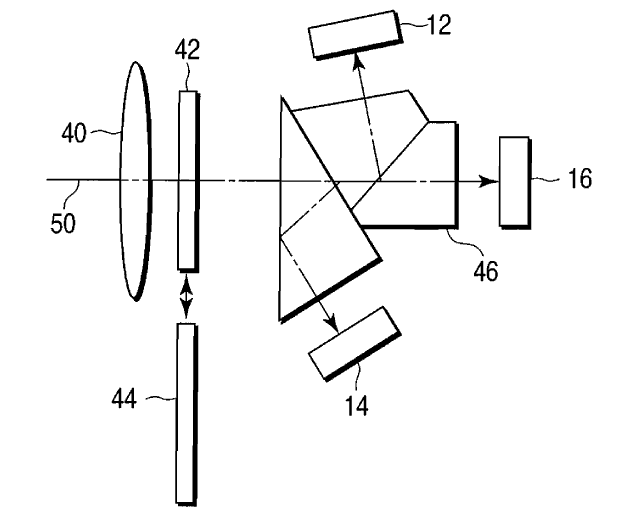





(a long term rumor) Olympus is working on a completely new simultaneus HDR System.

UPDATE: Sorry guys we posted the wrong patent link and wrong text before! Here you have the right one: http://www.google.com/patents/about?id=dwS_AAAAEBAJ&dq=Olympus+camera
This is the famous TrineCCD. Olympus designed a camera system which uses 3 CCD sensor and can archieve true color and MAYBE simultaneus HDR.
A old false leak shows the E-5(?) using Trine CCD:



zzz
October 4, 2009 |It won’t happen. You can’t for example build sensor IS into that thing.
Duarte Bruno
October 4, 2009 |Sure you can. You just need to triple the IS modules.
Interesting idea, the possibilities are endless: HDR, FULL COLOR capture, SUPER-RESOLUTION, NOISE-REDUCTION, etc…
Duarte Bruno
October 4, 2009 |A shame though that this would never benefit m4/3.
David Bateman
October 4, 2009 |This is almost exactly the layout of the three sensors in my Panasonic GS200 bought in 2004!
Panasonic uses it for green, red, blue and this is a video camera.
So due to the olympus panasonic partnership, I think this tech is further than you think. But will only be a consumer, lens fixed (IS in lens) camera.
achiinto
October 4, 2009 |How do you know that this patent is from Olympus? When I read it, there is no mentioning of Olympus but two instances which Nikon and others are mentioned along side.
admin
October 4, 2009 |Achiint we posted the wrong link! Sorry!
snk
October 4, 2009 |No, this is impossible.
SirSeth
October 4, 2009 |I especially like the multi angel touch LCD. I think I’d only need one angel to touch my LCD to make it high rez. What can we expect if multiple angels touch the LCD? Will it sing?
We’ve knocked around this idea for years. Maybe Oly will make it happen, but I’m dubious and will be happily surprised if it does happen.
It would take a while to research, but I wonder how many patents have been filed that never come even remotely close to materializing on the market?
Cheerio,
Seth
David Bateman
October 4, 2009 |Now this picture is more like it!
This is possible and already done today in there Confocal microscopes that I have used. Each image dichroic mirror will cut the light response down, thus giving you the Exposure bracketing. Three “Filters” depending on strength to bounce the light will cut your exposure down. In microscopy you do this with filter at the angles to get you specific filters blue for DAPI (See nucleus), green for GFP (a label) and red for something else. This is possible done today and may not be used in cameras for consumers but there spinning disc confocal microscopes that use Super High frame rate CCD cameras.
If this did go into a camer for consumers it would give you amazing dynamic range.
David Bateman
October 4, 2009 |Now that I have read the patent ignor my last comment!
This is just as in my fist comment, HDR will not work in colour only if shooting BW.
But this can work in a m4/3 body the size of G1, and will need IS in lenses. So really an argument against buying a sigma DP camera.
Chris Polis
October 4, 2009 |Just a few comments to clarify.
1. This only _just_ fits into a regular 4/3 camera. It won’t fit µ4/3. But a lot of the componentry that are going into making µ4/3 work are necessary for this as well.
2. IS is possible, but as mentioned would require three IS systems.
3. The effect of doing this is the equivalent of increasing the sensor size approximately threefold. So about the same area as APS-H. It puts the output a solid step above APS-C, but not quite to the level of full frame cameras. Still, the lenses would still work exactly the same as they do now.
4. This is not at all like Foveon, so we wouldn’t get the compromises in colour inherant to that system.
achiinto
October 4, 2009 |Sound like this is going to make the 43 pro-system a great step forward in performance, size and price. :O
zigi_S
October 5, 2009 |“3. The effect of doing this is the equivalent of increasing the sensor size approximately threefold. So about the same area as APS-H. It puts the output a solid step above APS-C, but not quite to the level of full frame cameras. Still, the lenses would still work exactly the same as they do now.”
What about the light gathered by the lens. IT would still be the same. I don’t see any noise advantage with this setup.
snk
October 5, 2009 |This is possible onli for m4/3?, not for 4/3 … And then camera will be huge ]:->
Chris Polis
October 5, 2009 |The reason their is a light increase is that the dichroic filters split the light into red, green and blue portions, rather than the bayer filter which absorbs the unwanted colours. So instead of 2/3rds of the light being absorbed, it is all directed to the appropriate sensor.
And again, this is not for µ4/3.