



An analysis about the present and future of Panasonic and Olympus (by Thom Hogan)

I want to focus your attention on the latest article from Thom Hogan (Click here to visit the website). He starts with the following statement: “Welcome to the beginning of the end of the digital SLR era.” The “DSLR unit sales have been flat and appear about to fall. Revenue per unit has fallen. Household penetration for DSLRs peaked some time ago, and much of the market now is replacement, not new sales.”
He described the situation of all non Nikon and non Canon camera companies. I am going to copy the Panasonic/Olympus part only. Please read his article to read the full text at bythom.com.
“Olympus/Panasonic: made a big bet on m4/3 taking the DSLR initiative away at the low end. Both pretty much neglected or abandoned any traditional DSLR approach to do so, which on Olympus’ side has alienated customers. Both increased their overall interchangeable lens camera sales significantly with their strategy, but at a lower price point. Still, they haven’t really blunted the low-end Canon and Nikon DSLR sales, they augmented them. Status: tenuous foothold at the low end, very tenuous above that. Forecast: continued tough road ahead.”
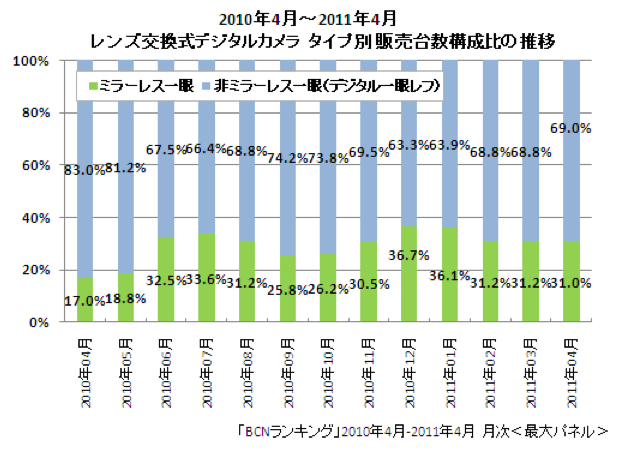
What do you think about his opinion? I added the latest sales analysis graph made by BCNranking about the Japanese system camera market shares. As you can see on the graph (see image on top of the post) 69% of all sold system cameras are DSLR’s and 31% are Mirrorless. Mirrorless market share reached the top in December 2011 with 36,7%. But my guess is that market share has fallen because there wasn’t any real new product (only the slightly upgraded E-PL2). And the lens repertory from all current mirrorless system is still “immature”. I predict a further advancement of the Mirrorless market after the June announcements (Panasonic, Olympus, Sony and Samsung will release new cameras and lenses).
P.S.: You can see on Amazon that most cameras in the TOP 20 are compacts and DSLR cameras. Mirrorless is still not so popular as in Japan:
Amazon US rankings (Click here)
Amazon DE rankings (Click here)
Amazon UK rankings (Click here)
Amazon FR rankings (Click here)
Amazon IT rankings (Click here)

amalric
12 months ago |Interesting. Might there be market saturation in mirrorlless too? In Japan I mean.
Seriously, Oly at least is opening new marketing depts. In China and India. They have stated recently that it is were their sales drive will be.
Hybrid ILS cameras are very well suited to those expanding markets, which so far were mostly made of P&S users.
West might catch up later, Panny has been selling well in America.
Clearly to be a dSLR replacement mirrorless needs mid to upper tier models, but they already are due to come. IMHO there is a technological advantage, apart from smaller size/weight. You see what the sensor sees, WYSIWYG. No dSLR can give you the clarity of an EVF.
With that you can PP your image /before/ you shoot. No dSLR can give you that. So the jump from dSLR to mirrorless is as big as the old one from Leica to film SLR.
It’s a photographic advantage, wider success will come – Oly predicted that mirroless would be the dominant system by the end of the decade. We still have time
Ahem
12 months ago |“No dSLR can give you the clarity of an EVF.”
While I agree with you on others, above is BS. DSLR OVFs are superior to MFT EVFs, and all modern DSLR LCD screens are superior to most MFT LCD screens. Most also have Live View, with the notable exception of Sony cameras.
Archer Sully
12 months ago |Not all OVF’s are created equal. Since I use 135, 127, and 120 format (why is it that the higher numbered formats are smaller?) and frankly by comparison anything short of a D3 or 5D is kinda sucky. APS and smaller OVF’s are very difficult to use, IMHO. Give me a good EVF (GH or VF2) any day.
marsupial2go
12 months ago |I shoot video with sound, or do sound for shooters. The Canon 5DM2 seems to have a very long life, perhaps the longest in recent years. In 2006, the Panasonic HVX200 was all the rage. People invested big bucks for big systems and for two years most of my sound work was with HVX200 DPs. Those days are over and selling an HVX200 is kinda tough, unless it’s dirt cheap.
I didn’t buy a 5DM2 because of the expense and I was concerned about its longevity, as well as its limitations for video. It remains quite popular but it’s not suitable for shooter/sound work I do. Although my gigs are usually non-camera-specific, with the GH2 I can shoot long form AND in low-light with interchangeable lenses. My GH2 was affordable, my sound gear is not GH2-specific, so if the GH2/M43 dissolves in two years I’m ok with it. But it won’t dissolve. That’s rapture talk.
Don Pope
12 months ago |Indeed, no EVF can give you the immediacy and real time accuracy of an OVF.
Archer Sully
12 months ago |+1 Rapture Talk. I’m going to use that from now on.
Thom Hogan
12 months ago |I think the 5DII’s life as “large sensor choice” for video is now over. Too many dps I talk to are doing what I just did, and buying one of the dedicated large sensor dedicated video cameras as their main production machine. Once you see what you get by using the full sensor for video instead of subsampling behind an AA filter designed for high resolution stills, you don’t want to go back.
Miroslav
12 months ago |Oh hell, even HD SpyCam is more popular than any mirrorless camera
.
Inge-M.
12 months ago |You mean, on You-tube, Miroslav
Miroslav
12 months ago |On Amazon Germany as well. No wonder Panasonic is making even smaller GF model – they want to outsell HD SpyCam
Akon Ikon Nikon
12 months ago |There have been several blanket statements, from Thom Hogan and others, about the Japanese, regarding design and marketing. They’re somewhat in poor taste. In many areas, I see several Asian companies whipping Americans when it comes to design and marketing. That’s right, huge American corporations getting beaten at their own game, in their own country, in their own language (re:marketing, in English), by Asian corps. And they could crush the lone remainder (Leica) any day, if they really wanted to.
Panasonic and Olympus do have problems with their product focus and marketing, but the problems aren’t due to Japanese business sense inferiority, as you imply.
As for your reference to the American automobile triopoly (in the GF2 poor sales thread), what happened to them? Oh yeah, the Japanese came and ate their lunch! So enough with the Euro-snobbery. They designed the G-series to accommodate your big noses, why are you still complaining? They are not so foolish to design what you Euro-supremistically refer to as “Japanese girl”-only cameras. Euro girls like them too. Maybe American girls are not as photo-savvy, and prefer lame phone cams, perhaps that explains slower CSC sales in the US?
gulabiguy
12 months ago |“There have been several blanket statements… They’re somewhat in poor taste.”
Your whole post is laced with blanket statements that are poor in taste. Quite hypocritical IMO. So don’t attack a certain ethnic group (so called “Euro-snobs”) if you are trying to be taken seriously. Also, jingoism isn’t to help the m43 movement. The m43 movement will need input from western/eastern consumers in order for the system to be globally accepted and successful.
Ahem
12 months ago |Don’t feed the troll.
Thom Hogan
12 months ago |+1
43RC
12 months ago |problem #1: Nikon and Canon are entrenched, with strong dealer/photographer relationships. This is changing somewhat, with Mighty Sony making biggest inroads, micro4/3 also.
problem #2: Mirrorless neither compact nor DSLR (not bad, necessarily).
problem #3: Many people are hopelessly conservative in their thinking.
You can’t teach old dogs and old farts new tricks.
Thom Hogan
12 months ago |#1: yes, they’re entrenched. Right now Nikon is vulnerable, as they were short on inventory already and the quake has made that even worse. They are also the only company that is dependent on cameras (66% of sales), so if someone can elbow them aside now, it would be very bad news for them.
#2: not a problem, it’s an opportunity (which Panasonic correctly foresaw)
#3: are you talking about customers or companies? Thing is, traditional SLR/DSLR users are 50+ years old and getting older fast. They won’t drive sales for much longer.
DonTom
12 months ago |The field is wide open for Apple, they must be thinking of going there. If I could buy a CSC with an iPod touch built in, would I? I’d have a damn good think about it, and I’m a slow adopter. Sure, HD is great, but where’s my massive built in hard drive? I can fill an 8GB SD too fast, I want 500GB on-board, and wifi, and PP, and …..basically, I don’t want to take my laptop and hard drive with me on holidays, but I do want to post pics and video to family and friends while I’m traveling.
If Apple don’t get it, some Chinese or Russian whizkids will. Sure as eggs the Japanese won’t, because their companies are too hieracacal(sp?) for fast innovation.
Thom Hogan
12 months ago |You don’t need a CSC with a Touch built in. You need a CSC that communicates with a phone/WiFi system.
Gato
12 months ago |In most businesses going from nothing to 1/3 of the market in 3 years would be a phenomenal success. I think long-term the future is mirrorless. There are just too many potential advantages over moving-mirror DSLRs — more accurate and flexible focus, vari-angle or remote viewing, integration with video, extreme high frame rates and so on.
Short term mirrorless may stall temporarily for lack of semi-pro and pro cameras (including full frame mirrorless) and lack of lens selection, but long term I am convinced the DSLR and moving mirror are on the way out and mirroless is the most likely thing to replace it.
43RC
12 months ago |32% market share in less than two years is impressive, IMHO.
Digital didn’t overtake film in 2 years, DVD didn’t overtake VHS…
Half the people I know aren’t even aware of the new CSC category.
I agree with Admin that mirrorless will make big gains June-December 2011!
amalric
12 months ago |The problem with Hogan and other watchers is that they are hopelessly both dSLR centric *and* American-centric.
Even if they conceive success of mirrorless, it will always be a small thing, since the US have always been the main market fo dSLR, with the lifestyle attached. Big zooms, big teles, big bag, to carry in a car of course.
Mirrorless compact is the negation of that. I remember one of the first Oly ads: very aptly it was in a train station, where most of the Japanese population commute. Small pens are ideally suited for that lifestyle, of for Bombay or Shangai.
These are enormous markets with very little photographic competence. Pens are designed to shorten the learning curve, contrary to top dSLR. Their price might quickly decrease too, due to simpler assembly.
Even if mkt penetration is very slow in the US and Europe (5-7%) Oly said it expected to reach 40% in the rest of Asia, and growing. It’s not by chance that Samsung is betting all on mirrorless – a non Japanese company, or that NEX sales have skyrocketed.
I think that old Japanese cameras watchers from the US cannot really accept that the main market from cameras is shifting from the US to Asia. And yet it is the main factor for explaining why the type of camera and ergonomics are changing.
This has happened other times in the history of photography. I am old enough to remember a time when Europeans swore only by German cameras, and would despise ‘Japanese cheap stuff ‘
radix
12 months ago |or Jakarta
here in Indonesia, Oly is gaining some reputation too thanks to the PENs. We even got a thread that goes to 186 pages in one of our biggest photgraphy portal
http://www.fotografer.net/isi/forum/kategori.php?id=33
and oly distributor here actively marketing with ads, gathering, training & session with a well known pro pothographer. I guess it works.
Thom Hogan
12 months ago |> The problem with Hogan and other watchers is that they are hopelessly both dSLR centric *and* American-centric.
Guilty to the second, innocent of the first.
I am not DSLR-centric. I would estimate that I shot more with mirrorless cameras in the last 18 months than DSLRs, and that’s measured in tens of thousands of images. You are misconstruing my criticism of bad early design decisions with dislike of the product. Go back and read what I wrote about DSLRs when they first came to market. They sucked.
As for Ameri-centric, yes, I am. We represent over a third of all camera sales. What Americans want in a camera barely registers in the Japan design centers, and what does get there goes through translation. The Japanese auto manufacturers figured out that they needed to change their Japan-centric design system over 30 years ago. You’d think that the camera makers would have figured out that they might need to do a bit of the same thing, too ;~).
Thom Hogan
12 months ago |I studied New Technology Economics and Management as my PhD major. Adoption curves are highly predictive. Basically, you can often get a reasonable forecast for several years into the future by what happens in the first years and the moving slope of the curve. That’s actually how I predicted in 2003 that the peak DSLR sales would be sometime around 2010. Mirrorless isn’t penetrating fast enough yet to suggest that it will reach DSLR-type levels. It’s still very early, so there could be two reasons for that: (1) we’re still seeing the foot of the slope; or (2) the slope hasn’t and will never hit the level needed.
YeahYeah
12 months ago |We know Hogan doesn’t like Olympus. Why are you still advertising for him admin? he doesn’t deserve to be read!
admin
12 months ago |He shoots m43, I don’t know why you say he doesn’t like Olympus. Why? Please try to argument. Otherwise this is just baby criticism
Akon Ikon Nikon
12 months ago |Olympus is doing quite well, considering the huge investments needed to make a completely new type of camera, and the lack of resources compared to Sony and Samsung, not to mention Canon and Nikon.
I don’t see Kodak, Polaroid, or HP doing any better! How’s that GE mirrorless coming along?
Archer Sully
12 months ago |Considering that Thom uses (or used) Olympus, that statement is kinda hard to support. Thom likes all good cameras regardless of vendor, and simply calls the market as he sees it, without regard to brand. You should read some of the things he says about Nikon, and his blog is officially about Nikon!
cL
12 months ago |Yes, what you’re saying it’s true and a good rebuttal. Thom did use Olympus and he didn’t really hate Olympus per se. In fact, if you go to his website, he is actually a Nikon user. That should say much.
But here is one thing though (not necessarily a bad thing). He judges a camera’s merit based on its sales report rather than the camera’s quality. Consumers don’t always know what they want, and that’s the main issue…. Because of that, sales report doesn’t always tell the whole story and is retrospective in nature (i.e., after the fact). Consumers may have bought into a system because of various issue: style, lifestyle, reputation, friends are using them, availability, salespeople’s push, etc., etc.. Actual quality of the item has smaller significance in purchase decision than before. It is the perceived quality that has growing in weight in that regard. However, I do not question Thom’s methodology in this particular subject. Projecting past result into the future is usually the most “objective” assessment (just not always the accurate indicator of future), as it has solid “on paper” support for the argument.
The report on the top of this thread indeed shows a plateau in the DSLR sales but we don’t know if the trend is going up or down for sure later. All we know is plateau indicates there will be a shift in direction, and indeed, going downhill is the most likely trend, but given the current economy, it could simply be a function of consumers’ spending cut, as DSLRs are generally more expensive or saturated market (could be anything). Finding out what that rationale behind people’s mind will give a more accurate forecast. Everything now is preliminary (which is not a bad assessment, but too early to call it a final answer is all I am saying).
Thom’s assessment is American-centric no doubt. I admit I am somewhat American-centric as well (hard not to, if you’ve lived in this country most of your life). That’s why hearing people from other parts of the planet is very important in understanding the overall global market. American market no long has the largest weight in global economy (still very significant, but you can’t simply project US result to the world as you could in the good ol’ days).
Olympus has lost in touch with the general consumers long times ago. Knowing a little bit of the company’s history, you know they went by the professional’s route and totally ignored that amateur market is the largest piece of the pie. (digital) Pen’s success is a wake up call for Olympus, hopefully it’s not too late (unlike what happened to OM). Canon started to make its name in camera’s world when it focused on auto-focus performance, a feature Olympus snubbed it as being amateurish, as indeed, AF was neither fast nor more accurate than MF to suit professional’s need (that is still true, but the gap has narrowed). That’s how Olympus began to lose its place to the “amateurish” Canon which never was quite “legendary” in their products but they were very good at mass marketing. As great as the quality of Olympus’s lenses is, it is not the only thing that sells….
I agree with Thom with product differentiation (which really is the modern marketing dogma), though our direction on how to achieve it would be very different indeed. I am not all for mass marketing for the sake of profit margin. We still need some companies that still care about quality to suit professionals’ needs while still making money from their mass market end to support their pro-centric products. Given Olympus’s root as professionals’ choice (Minolta is devoured by Sony now) among Japanese camera makers, pulling away from pro segment isn’t what I believe the smartest move as their largest loyal constituents will feel betrayed, despite there isn’t a lot of money to be made in that segment… (but there is no loyalty in money). In end, money is important, but not the most important thing if it cannot spark passion. That is from an artist’s POV.
Thom Hogan
12 months ago |> Thom did use Olympus and he didn’t really hate Olympus per se. In fact, if you go to his website, he is actually a Nikon user. That should say much.
I am a CAMERA user. Period. I happen to make a modest living describing how Nikon cameras work. Those two things overlap but are not the same.
cL
12 months ago |I am not exactly sure if you got my drift right, or maybe you did. Anyways, I mean you’re a Nikon user, but you’re trying your best to do an impartial judgement.
Agrivar
12 months ago |Oh yeah.. MILCs are now in best buy.. so most soccer moms would soon hear of CSCs…
E-PL 1
NEX 5
GF 2
NX 10/11
sneye
12 months ago |M4/3 has to establish itself as the reference mount among mirrorless systems before trying to beat the SLR. It has a fair chance of securing this position due to the widest and deepest lens lineup currently available. However, Olympus and Panasonic can’t wait for much longer. They have to introduce cameras which are tailored to the wants of enthusiast stills shooters (resilient and sealed bodies with built-in viewfinders, intuitive mechanical controls and thoughtful ergonomics). The small / high IQ system will always have its place in the market, so moving from 4/3 to m4/3 was a clever thing to do in 2008/9. It’s time for the manufacturers to demonstrate the full abilities of this system.
BTW, if I were in charge I would commission a new Nokton every year from Cosina-Voigtlander.
Akon Ikon Nikon
12 months ago |No hypocrisy, just 100% facts, observations and a few jokes (whereas Thom and others were dead serious, DonTom being the latest case in point).
Yes I should say American-centric, don’t want to give Euros unfair blame.
DonTom
12 months ago |Actually, most of my post was tongue -in-cheek. This is where a cross-cultural forum can break down I guess. Have to say to you @Akon etc: not fair if you call Thom Hogan “American-centric” without revealing your own origin/bias, also, I don’t recall Thom ever saying that his analyses are aimed at any other than the American market!
As for big Euro noses..well, my Asian wife has some camera/nose issues of a different type. Perhaps “big” is the wrong word, long and slender vs. cute and wide might suit the mix of cultures here better?
Oh dear, digging myself a hole. Guilty of my own accusations…Back to fixing my Italian espresso machine with the help of American wrenches, a Californian/Chinese iPhone and various internet help-groups……how handy is an iPhone camera for recording which wire/tube goes where?
By the way, better to reveal my own bias; New Zealand Irish/Spanish living in a South East Asian/Chinese household in the Middle East….for now.
More4/3
12 months ago |I find the whole DSLR/mirrorless classification misleading. For me the real point about m4/3 is the smaller lenses, which keep weight and size down for any given quality. But none of m4/3 cameras have yet addressed the Achilles heels of poor dynamic range and noise handling compared with APS. I suspect that a fair number of people who own entry level APS cameras would be very interested in switching to m4/3 if these two issues were solved. That would provide the increased volume required to generate some decent profit, despite the lower margins at this end. And more profit means more money to build out the lens range etc. I don’t know, maybe if Fuji with their HDR sensor tech, and Sigma with Foveon tech get together they can produce the sensor that finally breaks this barrier and can compete with the APS (especially Sony) sensors.
Ranma13
12 months ago |Does dynamic range REALLY matter that much though? I don’t think I’ve ever seen a photograph and said “If only this photo had more dynamic range, that would make the shot!” Sure, it helps, but I think that the ‘advantage’ of more dynamic range and slightly less noise is not all that significant in the end. Personally, I believe that the lack of brighter lenses is the only thing that’s holding MFT from becoming a strong contender.
Ahem
12 months ago |That’s what drives new camera sales: “if I could just have THAT camera I could make better photos.” Unfortunately most people don’t realize or don’t want to admit that quality of photos is rarely determined by the camera (or lens).
cL
12 months ago |I agree with your assessment. Just a little tweak. The quality of photo can be determined by the lens depends on what type of photo shoot you do. I do all sorts of photos but landscape is my core. That is one example where lens do have decisive outcome to the end result because of various aspects like flare, CA, and edge-to-edge sharpness and geometric distortion (if you do architecture photos). Yes, you can use a Holga with its crap lens and still get good landscape photos (if you’re shooting for the feel, not technical perfection), but they could be improved if there is no artifact.
Alan
12 months ago |Yes! Dynamic Range matters a lot to me, I’ve actually just bought up a vast supply of Fuji Pro 800Z 35mm film for the situations where my GH1 cannot hack it on DR (As soon as the ISO moves above 100 basically), Sure the GH1 image would be a lot sharper and smoother, (although at 800 and above it does take on a film like softness) but it ain’t much use use if half the image is blown to white.
If we could get another stop of DR out of m4/3 and smidge better noise performance then I’d be very happy indeed.
cL
12 months ago |Actually you can “hack” the DR with digital. You use Adobe Lightroom instead of darkroom, but the idea behind it is exactly the same. Since Fuji Pro series of films are negatives and digital format is positively, you do everything in reverse and there is your solution to DR hack. You shoot to preserve shadow instead of highlight (spot meter highlight instead of shadow) that is, then go to Lightroom and pull it back up (darken exposure when shooting, but bring it back up with brightness slider). Use histogram as your guideline.
Archer Sully
12 months ago |So, are you 1/6 less than Ranma 1/2?
.
cL
12 months ago |Ranma13: “Does dynamic range REALLY matter that much though?”
Yes and no. Depend on what you’re shooting. DR problem can often be solved with photographer’s skill and post-processing (i.e., if you shot it right in the first place, which means always underexpose it slightly when shooting in high DR situation). Most casual photographers nowadays aren’t interested in knowing the technical insight on how to make their photos better, so sensor’s DR performance is really important in making the sales and it can be a deal breaker for them. Most of them don’t even know it is DR problem that kills their photos, but they do know the photos looked bad.
That said, better DR is always welcome. There is time when no amount of skill could fix a situation where better dynamic range is the only solution. People now can shoot photos any time they want because of DR performance, but in the film days, you have to shoot at certain time of the day (i.e., early morning, late afternoon), or your film will rebel against you. Though everything must be checked in moderation. 4/3 sensors already have good enough sensor DR than most films, but better technology is always welcome as it gives you more flexibility and room for creativity.
Ahem
12 months ago |“But none of m4/3 cameras have yet addressed the Achilles heels of poor dynamic range and noise handling compared with APS.”
It is a matter of physics that MFTs will always be behind APS-C cameras, but that doesn’t mean they are poor performers. MFT cameras are on par or superior to APS-C cameras from two-three years ago on DR and noise, and we were perfectly happy with those cameras then.
cL
12 months ago |+1
Technology advance is the driving force of capitalism…, because it makes us feel discontent.
joe
12 months ago |He’s so right.
I am currently abandoning my Pentax APSC system with many top quality lenses,
pre-ordered a G3 kit, already bought a 20mm and looking for a FF camera in near future.
Ahem
12 months ago |Very good commentary from Mr Hogan.
I would go farther than him, though: Canon and Nikon are in a serious risk of getting overpowered by Panasonic/Olympus and Sony. Canon and Nikon haven’t even announced mirrorless “serious” cameras, and there are only very vague rumors about Nikon entering the fray. This is a huge strategic oversight, one which has gone on for inexcusably long.
Mirrors (and OVFs) will be a thing of the past in just a few years (5 tops), and unless Canon and Nikon get their act together, their market shares will drop precipitously as more and more prosumer and even pro cameras and lenses come out from the three-four mirrorless manufacturers.
Arne
12 months ago |Thom Hogan is a self-aggrandizing blowhard. If he knew one tenth of what he thinks he knows, he’d be running IBM instead of a mediocre camera blog. If you read his stuff, you’d think he invented the laptop computer and that camera companies beg for his opinion on everything right down to the color of the plastic wrapping. Why does everything he says generate a “news” story on this site? Are you a blog that is so starved for content that you have to resort to writing articles about other blogs? Is that content?
Thom Hogan
12 months ago |You might want to go back and look at my resume. I was one of the founders of the company that popularized the transportable computer (certainly wasn’t a laptop in those days), and for over 20 years I was involved in quite a few startups that did the “first” something.
You’re certainly entitled to calling me any name you wish. But you only make yourself look foolish if you ignore my past.
Ranger 9
12 months ago |Note that Hogan’s forecast of a “tough road ahead” for M43 is in a paragraph headed by the statement that he is talking about manufacturers “who’d really like to wrangle a significant piece of the high-end camera business.”
I’m not sure that’s true of Panasonic, since I don’t think they care about the high-end still camera business at all. I think they see M43 as an extension to the top end of their compact camera line, and/or a bridge to their video camera line, and it seems they have a very good chance of being successful with that strategy.
(Even serious photographers realize that they could take a big percentage of their pictures with a compact camera, if it had the right features… Panasonic can do well simply positioning their M43 line as compact cameras with more features.)
Olympus seems more covered by Hogan’s comment, since they are still trying to support a high-end strategy in 4/3 plus an “enhanced compact” strategy in M4/3. They do seem to have a tough road ahead if they can’t figure out a way to make these product lines more integrated.
Thom Hogan
12 months ago |> he is talking about manufacturers “who’d really like to wrangle a significant piece of the high-end camera business.” I’m not sure that’s true of Panasonic, since I don’t think they care about the high-end still camera business at all.
Oh, they care. One only has to look at their VIDEO business to see that they would really like to be like Sony and have products that range from consumer to the highest professional. But you have to start somewhere in stills, and you need to find a spot to leverage from. Panasonic seems to think that spot is roughly between P&S and DSLR.
Chris
12 months ago |Strong opinions are what a rumour site thrives on, but we seem to get a lot of Thom Hogan- surely there must be other people blogging about 43 stuff?
Some of his comments on the recent GF2 sales articles were just embarrassing:
He makes elementary errors about the camera market (“Other than Leica, there really aren’t any non-Japanese competitors in the interchangeable lens camera market.” Uh, Mr. Hogan, I’d like you to meet Samsung.)
He makes bizarre complaints about camera naming when he idolises Apple (“One reason the Japanese like letters and numbers has to do with their issues with globalness. They’re afraid to give names to things because those names might mean something different in different countries, and they think that more generic names need translation amongst regions. It’s a silly, old-school way of thinking.” The Canon 5D Mk II is such a silly name! They should have copied the iPhone 3G S, and don’t forget to draw a box around the ‘S’.
He doesn’t seem to understand a big difference between mechanical and digital gadgets, in that for the former bigger denotes better and for the latter smaller denotes better, all other things being equal. No need to speculate about Americans wanting huge cameras because they’ve got huge SUVs – look at the Americans queueing all day to replace their iPad because the new one is a few millimetres thinner, ooh, ooh, and it has a pretty cover.
More than that, he seems to have some animus against Japanese companies as being essentially uncreative, which seems odd. Considering that a large part of the composition of a camera is fixed by physical laws there’ve been several major developments by Japanese companies recently, mu43 and Sony’s translucent mirror to take two examples.
I hope Thom Hogan will continue to blog on m43, but I hope that we’ll be getting lots of other voices on 43rumors.com. At the moment he seems to be treated as the Unquestioned World Authority!:-)
frosti7
12 months ago |Chris: “I hope Thom Hogan will continue to blog on m43, but I hope that we’ll be getting lots of other voices on 43rumors.com”
I couldn’t agree more! but i deeply hope that it wont be such useless voices such as Chris’s.
Thom Hogan
12 months ago |> Strong opinions are what a rumour site thrives on, but we seem to get a lot of Thom Hogan
Actually, I agree with you. Too much of me, not enough of discussing what we really need and how it should be designed.
> He makes elementary errors about the camera market
Okay, substitute “Asian” for “Japanese.” But so far, Samsung is patterning on what the Japanese are doing. In some ways, they’re doing a better job ;~).
> Apple’s naming
Products that have annual refresh need some way of identifying that. Auto makers use model year, Canon uses Mark X, Apple uses year or number. But Apple for the most part isn’t selling an iPhone 1, 2, 3, 3s, and 4 simultaneously. The camera companies are selling a 3100, 5100, 7000, 700, 300s, and 3x and 3s simultaneously. In other words, look at how the model lines are differentiated in name, not the actual model name (which may include a number).
> He doesn’t seem to understand a big difference between mechanical and digital gadgets
I’m not sure that your complaint here resonates. Americans aren’t flocking to tablets with 7″ screens ;~). Nor are they downsizing their big screen TVs. So you can’t generalize the way you did (digital is getting smaller, mechanical is getting bigger).
> Japanese companies are uncreative
No, that’s not what I think. They are creative in a different way than American or European or Sri Lankan companies. Much of the Japanese creativity is bounded by iteration. Much of the American creativity is unbounded. Different things happen with each type of creativity. You actually need a mixture of both to really wow the world.
> At the moment he seems to be treated as the Unquestioned World Authority
I have an opinion. I state it clearly and forcefully. I have a way of making it heard (Web site). That’s a long way from “unquestioned world authority.” You’re actually the one anointing me by even using that statement! ;~) So back off buster. Debate is fine. Opinions are fine. Starting to get in the realm of name calling (even if it is Unquestioned World Authority) doesn’t lead anywhere.
cL
12 months ago |“Opinions are fine. Starting to get in the realm of name calling (even if it is Unquestioned World Authority) doesn’t lead anywhere.”
Hmm…, this sounds familiar. ;-p
Anyways, my Olympus 35 ECR is really small (smaller than Panasonic GF1), even though it’s partially a mechanical camera (it shoots 35mm film).
And the thing about nomenclature is just some marketing BS…. Every company has their own naming scheme. There really isn’t any defined rule. Companies from the same industry “tend to” use similar nomenclature because it doesn’t confuse people, that’s all. It’s not like there is a written rule or anything….
Chris
12 months ago |That’s a useful comment, frosti! Thank you for your voice!;-)
George
12 months ago |You agree or not but this site must stop publishing articles from Thom Hogan.
Seriously this guy needs to be stopped acting like marketing god. Do you really think you know better than Oly or Pana guys. Your articles are jokes now you literally saving Oly and Pana in 2 pages writing.
Are you kiddin’ me ??????????????????????
You are not even a great photographer but you are worse when it comes to marketing and strategies.
43rumors going down big time with these kind of articles.
Inge-M.
12 months ago |Use aguments, so Thom Hogan also do, i think the is fair play.
Thom Hogan
12 months ago |+2 (can’t leave two +1 comments in a thread ;~)
Dummy00001
12 months ago |>> Status: tenuous foothold at the low end, very tenuous above that.
> What do you think about his opinion?
Panay should have fixed their product supply chain problems for GH2. And price. Then, m43 might have been a something, not “tenuous”.
The thing is, at the moment GH2 is only camera (ok, G3 might be too) attractive to the people who switch from DSLRs. Again: after 3 years of m43, we have only one decent, worth considering body. Yet, general problems (high price, availability) prevent GH2 from shining. (Who would have thought that it would take that little of effort to make the excellent and desired product so marginal?)
Say I want to upgrade my E-620 (disregarding for a moment the 43 lens compatibility issue). But I personally do not like the puny body of GH2 (and no official hand grip) nor cramped small-finger ergonomics.
Would announced G3 improve on that? May be. But I’m getting pretty sick of the m43 camp’s tendency to over-promise a mirrorless replacement for the dSLRs.
P.S. Oly’s m43 isn’t even on a radar: no VF, no swivel LCD -> not interested.
P.P.S. NX10 was a decent entry. I hope NX20 would improve IQ sufficiently for it to be a worthy contender. That and NEX-7 are what make me hopeful for a decent mirrorless dSLR replacement.
MP Burke
12 months ago |From where Panasonic started a few years ago as a company with no legacy in film slrs, they should to be delighted that they now have a place in the interchangeable lens camera sector.
I think their position is less established than that of Nikon, Canon and Sony (who have lots of ex-Minolta technology) but better than Pentax, Samsung or Olympus. Whether you call that tenuous is a matter of opinion.
If they get the new 16 MP sensor in a decent GF2 sized camera alongside the G3, their position ought to be consolidated.
Their best chance of increasing market share is targeting younger users who are less used to having an optical viewfinder, but looking to trade up from compacts. I think cameras aimed at such people should be offering some kind of easy internet connectivity, as they may think they are losing a feature they had with their smartphones.
In my opinion it would be in Pansonic’s interest, overall, to provide Olympus with the best mft sensors available. Keeping Olympus competitive means that Olympus should provide further mft lenses and that is an asset to the system (Panasonic produces system charts including lenses from Olympus and Voigtlaender, thus seeming to recognise that a good lens range increases the appeal of the system).
I find it hard to believe that Panasonic harbours any delusions of competing with Canon, Nikon and others at the pro end of the still photography market (video is another story…).
KL32
12 months ago |It’s going to be interesting to see what the NX20 and NX200 bring- just how much of an improvement will the new sensor be? I think Sony will definitely make some waves this year and I think Samsung has the potential too as well. I don’t see any growth with Panasonic or Olympus.
KL32
12 months ago |The GH2 is the best video DSLR on the market. And I doubt that will change with the new Sony and Samsung cameras. Sony has expensive video cameras to protect but Samsung doesn’t. If anyone (other than Canon) is gonna challenge the GH2 in terms of video I think it will be Samsung. I doubt they will but they certainly have the resources to do it.
Thom Hogan
12 months ago |> GH2 is best video DSLR on the market.
In one sense that is true. It’s probably the most well-rounded of the bunch. But in comparing low light results with the NEX-5 and VG-10, no, it isn’t. Ditto against the D3s and 5DII. Those of us who’ve been trying to decide between an AG-AF100 and an FS-100 see the same thing. Panasonic made a slightly more well-rounded machine (faster focus, ND filters, etc.), but the image quality tilts strongly towards the FS-100 and its larger sensor.
Things get tricky when you have an Achilles heel.
blastingmill
12 months ago |31% of the dslr market seems pretty strong, considering mirrorless is a relatively new market. and over the last 12 months, it is an increased market share. especially when you factor in poor economy, japan’s deflation and natural disaster.
i think olympus is in a good position to pounce. if they can release a hi-end m4/3 with quality primes, i bet it will sell like hotcakes. their IBIS, build quality and color rendering are all very good. they just need to release a gem of a camera with a better sensor. they would knock it out of the park.
interesting that Thom mentions a push in sony pricing, at the retail level. at my local samy’s camera store, you see the sales people constantly pushing the sony system. i bet there is some incentive for that to happen. they didn’t even have the olympus e-5 on display. i practically had to talk them into selling it to me.
i look forward to future m4/3 mirrorless hi-end cameras. but for me, right now, with the lenses i currently own, the e-5 was the best choice. i have no regrets about buying the e-5, it is a wonderful tool.
Thom Hogan
12 months ago |Yes, 31% is good. But the home Japanese market is highly prone “new productitis.” The intro of the D3100 and D5000 pushed Nikon back to three models in the top 10. Ditto Canon’s recent intros. The mirrorless entries were the primary new models during the rise to the peak. But the important thing to note is that they didn’t get decimated by the new traditional DSLRs, they just slid back some.
> bet there’s some (Sony) incentive
I can’t say for sure, but I think Sony is the only one with current incentives to sales people. Nikon seems to have pulled the plug on almost all incentives, including the ability of store employees to buy at a deep discount for personal use. I don’t think they did that to try to make more money, I think they did that because they feared that they won’t have enough bodies for customers.
Din
12 months ago |That´s depend which market you look.
In Asia and Europe, specially in UK the CSC has good welcome.
calxn
12 months ago |Thom’s predictions are his own personal opinions. His track record for Nikon camera predictions were not so good. In regards to this article, I agree and disagree on many points. Annectdotally, I am not seeing a big move to mirrorless when I travel. I do believe it is the big trend for the future, but I’m not seeing it yet. The numbers are one thing, but when I look around, I see DSLRs. The problem with the mirrorless will replace dslr group-think mentality is that if you look at the medium format market, 35mm never really replaced them. There will be NO one format that conquers all. What may keep DSLRs relevant will be their performance in the professional market. As for the low-end, I can only tell an annectdotal stories. Those I know who have pursued mirrorless were all moving from P&S and every one of them asked me or the camera stores which camera will give them the blurred background that professionals get (which to me is a weird question since it’s not what determines professional results). After trying them in the store, they all went Sony instead of m43 for the narrow DoF.
So what do I really think? I think Canikon still have a leg up on this market. Humans are brand conscious animals. They know Canikon and Sony. They see the pros use Canons and Nikons. It’s that premium that they aspire to. If Canikon came out with good mirrorless, they will automatically gravitate to them because of the perception of quality and professional. In the mean time, the low cost dslrs are definitely working to blunt the growth of mirrorless. Sony gets to participate in that consumer preference just because Sony is the consumer electronic king that everyone has grown up with from birth. Oly is a small name. Panasonic is known for 2nd place consumer electronics, including sensors. Samsung is a wildcard. Great products, poor marketing. Fuji, I wouldn’t count out yet. Thom seems to be the only person on the web who doesn’t recommend it.
DSLRs will still have a long life yet. If you’re living every day trying to discount out DSLR’s survival, prepare to do so into retirement. Same goes for medium format. Mirrorless? Deep down, I think Canon will eventually own that market. Everyone seems to always be chasing Canon. From DSLRs to lenses to the S95 level compacts. They just have a knack at creating benchmark photography products. At one time, they were not the leader in either digital compacts or DSLRs. Sony and others had insurmountable lead in compact, yet fast forward years later and everyone is chasing the clear leader in Canon. I’m sure when they step into the mirrorless market, their entry will have just the right feature set that everyone wanted. Look around, every single mirrorless has a lot of faults. Canon’s first entry won’t leave consumers wanting like they do with the current offerings. Even as a Nikon user, I’ve seen Nikon flop enough to question their ability in mirrorless. Their brand will carry them but won’t lead them to the top. The market is not locked in. Not every player has to be in the mirrorless market right now. As history shows, Canikon can come in late and take command of it. No lead is insurmountable. Just look what Sony did to m43′s lead.
Thom Hogan
12 months ago |> Thom’s predictions are his own personal opinions.
Yes.
> His track record for Nikon camera predictions were not so good.
Depends upon what you think “good” is. Show me ANYONE else willing to put their predictions in writing a year in advance and who has anything close to my track record and then we can talk.
> I am not seeing a big move to mirrorless when I travel.
Sampling is a bitch. There are close to 70 million traditional DSLRs in existence, a bit over 1 million m4/3 cameras (and many of those went to DSLR users who sampled it but decided it didn’t work for them). It would take a much faster ramp on mirrorless for us to see them ubiquitously while traveling. Or a longer period of time.
> There will be NO one format that conquers all
True. There WILL be a format that dominates the consumer market, though. The bad news for camera makers is that might be cell phones.
> Canikon still have a leg up on this market
Absolutely. Nothing has cracked the dominance of the higher end yet, though they’ve had some serious erosion this past year.
> Thom seems to be the only person on the web who doesn’t recommend [Fuji]
I assume you mean the X100. I’m still testing it, but you are correct, I don’t believe it’s a ready-for-sale product yet. Image quality is nice, though ;~) At least when the camera doesn’t conspire to keep from taking the shot. And I’m not alone in having observed that.
> DSLRs will still have a long life yet.
I haven’t predicted that DSLRs will go away. What I’ve predicted is that we’re going to see the exact same pattern as happened with film SLRs unless the camera companies make some serious changes. And for the same reasons. I made that prediction, by the way, over seven years ago, and so far my original numbers have tracked very well with the actual market and even predicted the 2010 flattening.
> Not every player has to be in the mirrorless market right now. As history shows, Canikon can come in late and take command of it.
Absolutely correct. However, there does come a time when you act too late. We haven’t hit that yet, but the window is more than half closed already.
calxn
12 months ago |Look at it from another angle. Some companies have much higher brand equity in their names in regards to photography that a few years lead just isn’t enough to overcome. I would bet the Canon, Nikon, Sony names have tens of billions in brand equity built in them in the photography market. That is very difficult to overcome. People who visit these blogs are the 5-10% of the marketplace who are more knowledgeable about cameras. The vast majority of people out there only know name brands. They have no clue what m43 or what APS-C are.
amalric
12 months ago |Rapid prototyping clearly enables companies to issue new models in such a short time that the business model seems to be changing too – that is what I meant by being too dSLR-centric.
In 2010 if I remember well the stats O&P carved their market share in Japan from C&N with mirrorless, then they reached a plateau at 36% and recently decreased at 31%. That of course doesn’t say much about the other markets in Asia, and I have mentioned how important they are to Oly, opening Olympus China and Olympus India.
As mirrorless 4/3 was fighting for a sizeable share of the market, Sony entered and stole the limelight. GF2 and GF3 can be seen as a quick reaction to that entry level mirrorless market.
At this point Sony competion might be much more worrying than C&N. After all users are beginning to understand that they are different type of cameras, with different sets of compromises.
Perhaps I remain an optimist but I am still convinced that the future is neither dSLR-centric nor American-centric.
In a good way: the market is global and Asia is rising to proportion, with the largest population in the world and a rising purchasing power, that cannot be ignored.
I am sure that Oly sees it as a redeeming area, and I hope they won’t make the same mistakes they made with Olympus America (Admin you should really invite Ned from ‘Zone 10′ to rebalance expert opinions here).
Semipro models are coming, and those will help establishing m4/3 as a fulll blown system. What’s not to like, really?
Look at the G3 in comparison to dSLR entry level models. Isn’t it a much smaller solution with a better set of features? Or a GF3 in comparison to a P&S?
Really we never had it so good. Seeing what the sensor sees through a big EVF is my personal grail. It allowed me to put to good use 40 years old MF lenses with no expense at all.
That I take for a major technological advance, which is clearly unrelated to business models.
Call it disruptive technology
tokyojerry
12 months ago |@amalric. I like that. Yes, I see m4/3 as a disruptive technology. Having owned a GH1 (just sold the body) and now a GH2, and looking forward to a G3 purchase as a second body to avoid interchanging lenses, I’ve been quite content with m4/3 thus far. The reduced bulk, size, weight for one, lack of a flippety-floppety mirror for another (one less mechanical component to breakdown too) I think are just a couple advantages. I think mirrorless is the trend that will increase in prominence. It may ay take time but it will increase. I also think Canon and Nikon will also follow suit, entering the mirrorless realm eventually. in fact, I think I read somewhere that Nikon already was set to release a mirrorless system but got delayed as a
result of triple disaster in Japan.
Now I am just wondering whether to stick with the Panny camp (GH2 / G3) or reconsider the Sony Alpha77, up and coming for a July announcement. Sony does have a mirror system but it is of the fixed type and does not go flippety-flop. It is a translucent sensor which allows 70% of the light to hit the sensor and reflects 30% to AF sensor control system. It further incorporates the larger APS-C sensor and does not have the high-priced (over priced) nature of Panasonic lenses and cameras. Finally there is much larger selection of lenses to choose from for the system given Sony’s own lineup, and Sony mount-compatible lenses from 3rd parties like Sigma, Tamron, etc.
I should mention that one primary feature that initially attracted me to micro four thirds was it’s strength in video as well as photography. And the strength in video comes from the lack of the mirror / prism. I deem both video and photography
equally important and to have good quality capabilities of both in a camera is an consideration for me. When I discovered taking video with traditional DSLRs, it required one to hold the camera away from the eye and monitor with the live view screen and hold the camera as if driving a car to take video, I almost immediately decided DSLR was a no-go. It’s tiring to say the least to take video in this sort of disposition and also destabilizing for the video itself without tucked in arm support as can be done shooting with EVF.
Any opinion on this Panny vs Sony considerations will be appreciated as I am relatively new to this mirrorless camp. One weakness though on the Sony, at least with the current Alpha55, is that I understand it can not take video for a long period of time because of heat consideration. It’s not as durable as the Panny in this regard. Perhaps this will be addressed in the Alpha77. The other issue is, Sony limits their video to maximum of 30 minutes on any single video. The could be due to the aforementioned heat issue, but also might be an issue stipulated by the European community which I understand it defines any camera which shoots over 30 minutes to be in the category of video camcorders, or something to that effect.
Esa Tuunanen
12 months ago |>Now I am just wondering whether to stick with the Panny camp (GH2 / G3) or reconsider the Sony Alpha77, up and coming for a July announcement. Sony does have a mirror system but it is of the fixed type and does not go flippety-flop. It is a translucent sensor which allows 70% of the light to hit the sensor and reflects 30% to AF sensor control system. It further incorporates the larger APS-C sensor…
APS-C sensor isn’t that much larger so that mirror wastes sensor’s light gathering advantage over Four Thirds sensor. Meaning if Panasonic gets their sensor act together low light performance will be similar.
As example of another fully f’ed up “curvature of cucumber”-scheme EU classifies cameras recording 30 minutes of video as camcorder which have import tax.
http://vimeo.com/groups/gh2/forumthread:237068
spanky
12 months ago |I think Panasonic’s success has come at Nikon’s discretion. If (i.e. When) Nikon enters the mirrorless camera market, and unless they do so stupidly with a tiny sensor camera, Nikon will carve up a significant share of Panasonic’s success. Nikon has the name recognition and the system accessories to go along with a successful mirrorless body. Canon is waiting to see what Nikon does.
Olympus’ only hope is to release a pro m4/3 body with a knock-out sensor that can take advantage of all the existing 4/3 lenses in addition to new pro-level m4/3 lenses and accessories.
BS Artiste
12 months ago |If all of photography goes to mirrorless cameras, what effects will installed customer base of lenses have on the market share? At some point EVF will have similar performance to OVF. Also, mechanical assemblies eventually fail after prolonged use, while solid-state electronics have longer life. No doubt electronic technologies will eventually surpass mechanical ones.
However, even if Canon or Nikon is late to the party in mirrorless, they still have an installed base of customers with Canon and Nikon lenses. That might allow Canon and Nikon to transition customers more smoothly, especially for larger zoom lenses that will still be bulky even for mirrorless cameras. As a 4/3 user, I have not been very happy with Oly’s migration strategy to date. The m4/3 products are not a great ergonomic solution for longer 4/3 zoom lenses. Maybe Oly is still working on a solution such as the still unseen m4/3 “Pro” camera.
amalric
12 months ago |In this respect there was an important but unwarranted rumor I’d like to have clarified, i.e. that a coming m4/3 Oly would have both predicitive PDAF + CDAF.
That in theory would at last allow to use classic 4/3 lenses. Can anybody comment?
As for the Nikon/Canon matter you can have an idea of how unsatisfactory migration can be for big lenses: they were not really planned for big cameras. I use two light zooms with adapter, but that’s it.
Having good native micro lenses is far more important, not only for fast AF, but especially for size. Any window shop will show you at what disadvantage is a dSLR in comparison with a G series because of lenses, especially teles.
So C&N can’t really recover the lost advantage if they wait much longer, Hogan concurs with that.
Building a new system bottom up takes time, and mirrorless makers could easily counter new devices with ease. It will be interesting to see in this respect how the GF3 fends off NEX.
you know my name
12 months ago |>In this respect there was an important but unwarranted rumor I’d like to have clarified, i.e. that a coming m4/3 Oly would have both predicitive PDAF + CDAF.
>That in theory would at last allow to use classic 4/3 lenses. Can anybody comment?
Yes that would be fine, it wouldn’t require lenses that have mechanical inhibitors for use as CDAF lenses. The trick is how capable is that AF though;. While we imagine hybrid forms of CDAF to be accurate, if its a variant of the Fuji system by using half pixels then I’m not sure it would be all that great in low light.