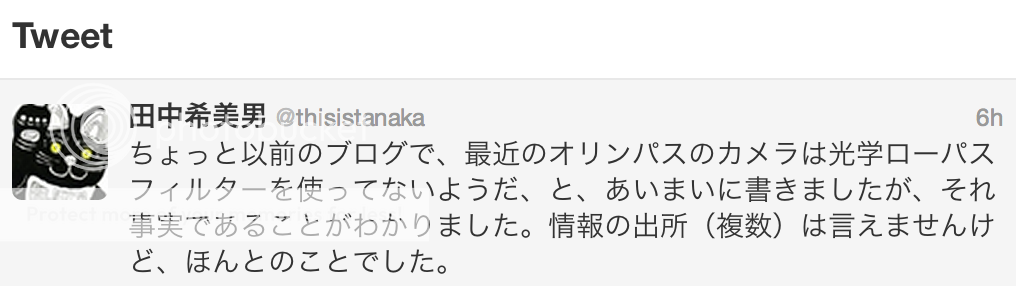




Tanaka is sure recent MFT models have no AA filter.

As you know recently Olympus France first confirmed than denied the fact that the latest MFT models may have no AA filter. So is the story over? Nope! Well connected Olympus photographer Tanaka now says (via Twitter) that his sources told him that “recent Olympus cameras” have no AA filter.
Confusions is back!


Fish
5 months ago |Do you get the impression that this includes the E-M5, or just the PENs that followed it?
Homer
5 months ago |No, just anything made by sony, not olympu shit.
homer
5 months ago |Why are you using my name to post Sony fanboy crap?
Homer
5 months ago |Are you suing my name or am |i using your name or are we using our name? i think you’re a douche. Is that me or you or them or it? LOL
Homer
5 months ago |Not that there is anything wrong with that. I hope you live a happy life.
Homer
5 months ago |anyways, you’re an idiot fanboy nuff said you numbnut. All hail the homer.
TheEye
5 months ago |“Maybe, maybe not.”
Actually, the precedent says that bodies without AA filter cost a little extra, and I’m sure Olympus wouldn’t want to miss out there.
Anonymous
5 months ago |> Actually, the precedent says that bodies without AA filter cost a little extra
which precedent ? D800E is not the case, it has the 2 layers of AA material arranged so that the 2nd layer is cancelling the bifrigent effect of the 1st layer… it is not exactly the same as no AA filter…
Anonymous
5 months ago |sorry, spelling correction, shall be “cancelling the birefringent effect”
Anonymous
5 months ago |now i love talking to myself. im pathetic. lol
sneye
5 months ago |Does it really matter? Recent comparisons (D800E, K-5IIs) reveal negligible differences. Besides, only a few lenses are good enough to show any effect at all.
homer
5 months ago |The k5IIs is much sharper than its counterpart with AA filter
sneye
5 months ago |I can hardly spot a difference at 100% screen viewing so surely prints, even very large ones, would look identical. Moreover, in principle the benchmark for detail (and other variables) is set by the viewer of the actual photograph and not by the results which would have been obtained hypothetically using alternative tools.
Koseng
5 months ago |Do you own both K5 and K5IIs? I do. And I can tell you that K5IIs is significantly sharper, especially when using sharp prime lenses.
sneye
5 months ago |I don’t own either so I’ll trust your word. Thank you for enlightening me.
Anonymous
5 months ago |> Do you own both K5 and K5IIs? I do. And I can tell you that K5IIs is significantly sharper, especially when using sharp prime lenses.
but that could simply mean that K5 has a strong AA filter, that’s it – so you are comparing not with a weak filter… you know that you can manipulate the strength of AA filter by using the different thickness of birefringent material in both layers (hence you can make AA filtering stronger in one direction vs orthogonal one)
Feebs
5 months ago |Are you still around with your racist trolling rants? Admin , get rid of this clown already.
john
5 months ago |Placebo effect
Anonymous
5 months ago |> Placebo effect
you can’t call a visual impression a placebo effect.. even if you have false resolution (artefacts) that still works towards the goal
… in the end photography is about making a certain visual impression, so if it is achieved through artefacts then so be it.
BdV
5 months ago |It only matters if you want to remove it. Knowing it’s there: give it a try. Knowing it’s not there: don’t bother.
homer
5 months ago |its believable, the files are sharper than the GH2 and GH3 so far in my experience
Anonymous
5 months ago |But is that down to AA filter or Sony v Panna sensor difference???
Anonymous
5 months ago |GH2 and GH3 are also intended for video use, so they could just have stronger AA filter… your logical error is that you do not understand the difference between 3 cases “not having AA filter at all”, “having self compensating layers of birefringent material like D800E”, “having weaker AA filter vs stronger AA filter”.
Sören
5 months ago |Possible,
I have problems with moire quite regular when shooting
dragonfly compound eyes.
Lily
5 months ago |I get moire regularly as well.
Anonymous
5 months ago |having AA filter does not eliminate moire 100%, it just reduces it… so you can have it and moire based on a particular situation (patterns present in your subject, lens, no mirror/shutter shock to blur, etc)… I had moire with GH2, GH3 and Pentax Kx cameras… all w/ AA filters
Anonymous
5 months ago |correction, “it just reduces it” -> “just reduces the chance to get it”
Anonymous
5 months ago |You probly get diarrhea regularly as well you idiot.
Martin
5 months ago |If the lenses were good enough, this would be extremely easy to verify or falsify: Take a test pattern close to the Nyquist frequency and look what happens when you get a bit farther away, i.e. go towards and beyond the Nyquist frequency. If resolution simply cancels out then it has an AA filter. If ugly alias patterns occur then it hasn’t (or at least one that has too high a bandlimit to reasonably be called an AA filter).
The only reason that test may fail would be that the resolution of the lense does not even come close to the pixel pitch, in which case the whole discussion is a non-issue.
LEPIDI
5 months ago |The truth must be located between the two: a reduced aa filter…
=)
Tom
5 months ago |I agree, given the applauded pixel-to-pixel strength of the E-5, I’d imagine that they’ve continued with that technology – rather than ditch an AA altogether.
i.e, weak low-pass filter complimented by moire reduced in camera/software. Kodak were doing this years ago with reasonable success. Algorithms improve and processor design has come along way since then so it’s sensible enough.
Next advancement should be temporal noise reduction, given the live-view/video nature of MFT et al it should be possible for stills. AA filters just don’t offer a huge improvement due to Bayer interpolation, trivial and dull…
petreh44
5 months ago |why not rip one camera appart and make sure?
i mean every new gadget gets torn to piece to look what is inside these days.
and there are sure a few broken MFT cmaeras…..
Per K
5 months ago |Comparing Nikon D800 and D800E there is a clear difference in the out of camera files. However with careful post processing, the difference is smaller. It is noticable that in both cases PP is essential for detail and sharpness!
Guess a non AA filter m43 camera will be similarily a bit better. Noticable? Will depend on what kind of subject – and your PP skills.
Don Pope
5 months ago |It obviously doesn’t matter that much if people haven’t noticed it.
Ranger 9
5 months ago |It’s amazing how, whether in politics or photography, enough online hype can make people want something that’s actually bad for them.
Aliasing is undesirable, and it’s better to prevent it from occurring in the first place (via an AA filter) than to try to fix it afterward in software (which unavoidably causes artifacts.) Yet photographers so passionately believe the opposite that they are willing to pay extra for cameras modified to produce aliasing, and to salivate excitedly over the possibility of more cameras with the aliasing “feature.”
It’s as if people stampeded to buy a food whose manufacturer began advertising, “Now with less nutrition!”
Of course many aliasing fans enjoy mistaking their cameras’ image artifacts for “more detail,” but there’s no reason to follow them off the cliff…
Dummy00001
5 months ago |> Yet photographers so passionately believe the opposite [...]
Sharpness is the current fad in the photography.
If you reduce IQ to sharpness alone, then AA filter is “bad.”
Dummy00001
5 months ago |> Of course many aliasing fans enjoy mistaking their cameras’ image artifacts for “more detail,” but there’s no reason to follow them off the cliff…
I once tried to explain to several photogs what is and how does demosaicing works. It all fell of deaf ears: too much math. The knowledge that the colors are often faked – almost 100% faked w/o AA filter – simply doesn’t want to sink in.
I personally hopeful that Foveon-like sensors would arrive sooner than later. That would solve the problem once and for all.
Atlasman
5 months ago |The E-M5 has tremendous detail-rendering capability——stills and video. That’s all that matters to me!
Dummy00001
5 months ago |> Tanaka is sure recent MFT models have no AA filter.

Shoot the B/W resolution chart and check output of the camera for non-B/W colors around small features of the chart.
As demosaicing algorithms were improving, pretty much all cameras this days are having relatively weak AA filter.
DPR has the shots from the resolution charts in their reviews.
E-M5: http://www.dpreview.com/reviews/olympusem5/17
D800: http://www.dpreview.com/reviews/nikon-d800-d800e/20
D800E: http://www.dpreview.com/reviews/nikon-d800-d800e/21
D800E v. D800, at different f-numbers: http://www.dpreview.com/reviews/nikon-d800-d800e/22
Ideally, with suitable AA filter, the areas should have become simply gray and showed no features at all, least colors.
Anonymous
5 months ago |Algorthms blah blah blah, just learn how to shoot a damn picture man. You’re some pc nerd with a camera looking for menus, just shooo the photos man. jeeezus.