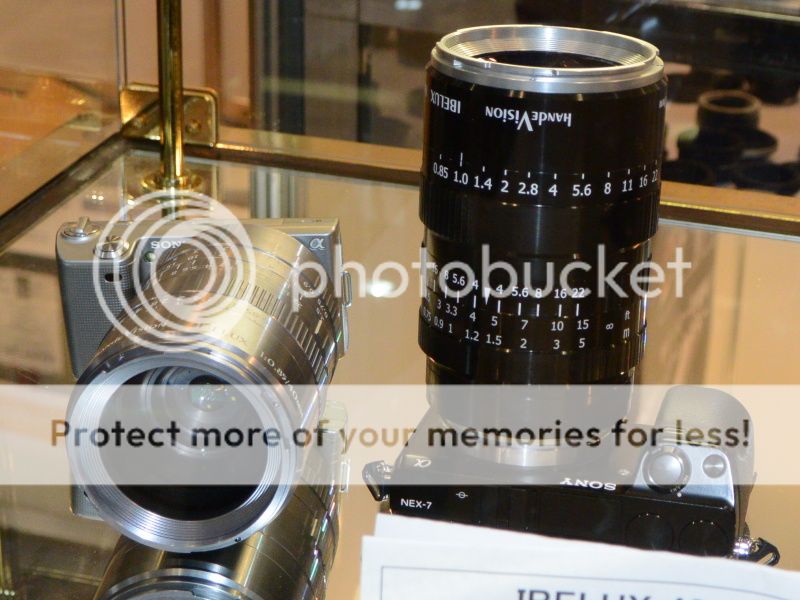





SLRmagic and Cosina watch this: f/0,85 MFT lens coming from Kenko-IBE!

You remember the time when we were excited about all these new f/0.95 lenses? Now we have five of them (3 Nokton and 2 SLR magic). It’s time to set new frontiers, we want it all and we want it faster! Guess what? It’x coming…the IBELUX 40mm f/0.85! This lens has been co developed by the Japanese company Kenko and the German IBE. The lens will be priced at around 1,000 Euro or Dollars and hit the stores in July. It’s a long time til July and you may save this Slidoo search to get notified when it will be available on eBay.
There is yet no image samples or specific info about the lens design. I wouldn’t expect a stellar performance wide open. And good luck when trying to focus on the right spot!
For the record. These are the five f/o.95 lenses:
Nokton 25mm f/0.95 (here one Bay).
Nokton 17.5mm f/0.95 (here one Bay).
Nokton 42.5mm f/0.95 (not in Stock yet, save this search for notification).
SLRmagic 50mm f/0.95 (here one Bay).
SLRmagic 25mm f/0.95 (not in Stock yet, save this search for notification).


Abraham
4 months ago |Just more and more options
Cant wait for you to get some leaked shots of the new camera that fully uses 43rds lenses… Cannot wait
Andrew
4 months ago |How long until f/0.01?
admin
4 months ago |that is the big question. I once saw a f/0.33 lens
mx
4 months ago |f/0.5 is physical limit
admin
4 months ago |Sure? Will ask my bets friend, he is physicist!
Kudo
4 months ago |Physician = Arzt
Pedro del Río
4 months ago |Physiker = physicist
admin
4 months ago |hehe, corrected
Martin
4 months ago |It is possible to go beyond, especially when using mirrors instead of lenses. American Optical is claimed to once have produced an 81mm f0.38 mirror setup. Whether you’d like to have such a beast of more then 21cm diameter in front of your mFT camera is another story…
El Aura
4 months ago |F/0.5 is the physical limit when you impose certain conditions. Unfortunately my memory is a bit hazy on what these were, maybe it was without using aspherical lenses (and no mirrors of course).
Che
4 months ago |Yep, that’s the Zeiss Super-Q-Gigantar 40mm f/0.33 – wasn’t it confirmed to be a fake?
But there is the 0.7 that NASA commissioned from Zeiss, and we know that that is real
Oh and wasn’t Barry Lyndon shot on 0.77 or something?
admin
4 months ago |STanly Kubrick with a Zeiss f/0.7!
OMega
4 months ago |Article with some photographs, although they are low quality Mono copies.
OMega
4 months ago |What happened to the link???
http://www.visual-memory.co.uk/sk/ac/len/page1.htm
Che
4 months ago |Wow, just searched this on youtube, nice clip here: http://www.youtube.com/watch?v=l1g-FDmbXs0
OMega
4 months ago |Excellent clip, well worth anyone watching. Also a good insight into the DOF difficulties involved with such lenses, but please remember this is with a much larger format that the 4/3 sensor.
OMega
4 months ago |http://translate.google.com/translate?hl=en&sl=it&u=http://www.nadir.it/pandora/ZEISS.htm&ei=QhyaTcXzJK7biAL9icWdCQ&sa=X&oi=translate&ct=result&resnum=7&ved=0CEwQ7gEwBg&prev=/search%3Fq%3Dsuper-q%2Bgigantar%26hl%3Den%26prmd%3Divns
Martin
4 months ago |Dream on, we are certainly close to the limits. Aperture sizes wide-open already exceed mount diameter by a considerable factor. The tiny flange distance of the mirrorless concept permits this, but further increase will not only lead to excessive vignetting, but soon start to constrain the light flux even to the central sections of the sensor. Which means that further increases in aperture sizes probably would not translate into serious advances in low-ligt capabilities, unless very special (and hard to make in the required sizes) optical designs are employed.
Esa Tuunanen
4 months ago |Mount diameter has nothing to do with aperture/entrance pupil of the lens.
Long focal length lenses have always had lot bigger apertures than lens mount diameters.
Sensor “based” vignetting comes from exit pupil of the lens being too close to sensor for size of pupil and sensor which leads more light hitting pixels in more oblique angle, with problem increasing with distance from sensor’s center. Sony NEXes and especially NEX-7 are have problems from this also in elsewhere than vignetting.
This can be solved by decreasing angular size of exit pupil viewed from focal plane. Which means either moving exit pupil of lens farther from sensor (like that “telecentric” lens design) or changing optical design of lens to make exit pupil smaller.
Real limit comes from resolution eating lens aberrations being exponentially harder to control with every increase in lens speed.
Es
4 months ago |Slidoo is useless until you’ll be able to select categories. Right now when searching for lenses you get mostly filters, lens hoods, pouches, caps, etc in the search results. Doing the same search on ebay is easier.
admin
4 months ago |Just increase the minimum price to filter them out. Category selector will come soon. We are working on it.
Es
4 months ago |But then you also remove auctions that start at $1 or still have low bids.
admin
4 months ago |Yep, but you will get notified once it reaches the minimum price. Anyway, Category will eb added with next version a long of many other new features
Camaman
4 months ago |Add shipping to Croatia, to!
Es
4 months ago |I have logged in with facebook, and never got any notifications
Pavlo
4 months ago |+1.
Waiting for the announced improvments…
Yun
4 months ago |The main point is , is this a sharp lens ?
Judge by it’s focal length , it should be .
F0.85 is tempting but I still prefer to wait for reviews before decide anything .
true homer
4 months ago |what does focal length have to do with sharpness?
Schweinchen Schlau
4 months ago |We should wait for lenses with negative exposure values. Then Micro FourThirds Cameras will be able to produce light and electricity!
Zoom
4 months ago |I see a NEX behind the lens.. that means it’s not a MFT lens. It will be too big and compromised. I’ll wait for the Voigtländer instead..
MarcoSartoriPhoto
4 months ago |It will come in different mounts, even M, EOS-M, m43. Anyway, I can’t think of a huge leap forward, compared toa f0.95 lens. It looks like a “hey, we have it bigger and faster” gimmik. Tony Stark would love the looks though..
Dannecus
4 months ago |Agree. Getting fed up of manufacturers designing for APS-C and then thinking they can flog a few more to M43 users just by putting a M43 mount on the back. Sigma is a case in point, not interested in their huge lenses, when there are native M43 designs around that do much the same with less bulk. One of the main reasons for M43 is a worthwhile trade off between smaller sensor (which has it’s drawbacks) offset by smaller bodies and smaller lenses. Compared to native M43 lenses like the Voigtländer, these are just too big, and using one would lose one the the main advantages of the system.
Che
4 months ago |TBH this doesn’t bother me at all.
I would prefer to have these lenses adapted for MFT than nothing at all. In the end if there is a market for the smaller native lens, one will be made. As I keep on saying just because MFT enables smaller lenses does not mean that every lens has to be tiny at the expense of everything else.
Ulli
4 months ago |one of the beauties of m43 is to choose from so many format lenses and not restrict oneself to its native mount. Ok, in some cases you have to deal with the bigger size or weight. But should that be a critical factor if its for the benefit of making use of that lens ability not found in the native offerings? In this case the extra DOF control, though i admit its subtle and not for every kind of photography needed.
Sqweezy
4 months ago |Look at the one on the right, probably a NEX-F3. The lens is so huge it sticks out on the top and looks like you can’t even wrap your fingers around the grip. This lens looks ridiculously difficult to use for this system, possibly m43 as well. The price will likely be astronomical as well, and the quality is up in air for now. Wait for the reviews on this one.
JF
4 months ago |Beautiful design, I love these big white numbers on the black lens ! :p
I keep my 45 mm f1.8, don’t need this huge manual lens…
AndrewJ
4 months ago |This is crazy!!! The only real reason I can see people wanting this lens is for razer thin DOF or low light performance. I would upgrade to FF with higher ISO performance and F1.8 primes to get the same DOF performance. A larger format package here would be lighter, faster focusing and more practical with higher IQ(highly likely). Get F1.2 primes in FF if you want unusable crazyness that is unmachable in mft.
Me, I will keep both feet on the ground, stay with MFT, real world lenses and I accept the the real world trade offs associated with this choice.
Bob B.
4 months ago |Well…the other reason someone might buy this lens is so that they could have bragging rights.
)
“I just picked up my HandEvision Lens, by Kenko!”…you have to admit that has a nice ring to it!
(Kind of like a Toy lens from SLR Magic).
AndrewJ
4 months ago |I hear the jokes now… ‘Is that Kenko in your pants or are you just happy to see me’
Bob B.
4 months ago |Sounds like a do-all kitchen appliance from the Home Shopping Network! LOL!
Che
4 months ago |Just thinking…
This lens will be amazing on MFT for low light shooting situations, our depth of field will be much deeper compared to the other mounts which should make it more flexible.
Camaman
4 months ago |Just don’t tel that to the FF equivalence brigade…
Jon
4 months ago |+1
AndrewJ
4 months ago |Che, the physics don’t work that way. DOF is controlled by the lens, crop sensors change nothing there. 40mm @ F0.85 is 40mm @ F0.85 regardless of the sensor crop. Field of view is all that changes. But… You can always close the aperture if you want deeper DOF
Martin
4 months ago |As a consequence of the smaller FoV, the circles of confusion get enlarged more in the postprocessing. Which makes cropping all but neutral on DoF. The DoF of the 40mm at f0.85 on mFT is smaller than on 35mm; it happens to coincide with that of an 80mm at f1.7.
AndrewJ
4 months ago |Absolutely true Martin, if anything the effective DoF is shallower rather than deeper after cropping. That’s difficult for most peoples to get their heads around, so I just let it fly and keep it simple
I once thought about providing the math and presenting it on a little table to post online, but that would open whole can of worms for the emotive and non technical types who I don’t care to deal with. And for me, I know what I need without a table.
AndrewJ
4 months ago |Have you considered how the Speed Booster effects DoF. A 50mm lens is reduced to an effective 35mm, but the DoF the will be deeper than what is found on a true 35mm lens at the same aperture.
AndrewJ
4 months ago |that should have read ‘Different’ not ‘Deeper’ I haven’t done all the math, there are a few variables.
Martin
4 months ago |The speed booster reduces focal length by a facot of 0.7, while the crop factor gives 2. In total, this gives a factor of 1.4, which -being larger than 1- means that both the FoV and the DoF are reduced.
Esa Tuunanen
4 months ago |> The DoF of the 40mm at f0.85 on mFT is smaller than on 35mm; it happens to coincide with that of an 80mm at f1.7.
That’s because DOF is affected only by size of real aperture (not focal ratio) and focus distance.
But you forgot/purposely neglect that while in one sense smaller sensor “magnifies” image projected by lens more because of its pixels being smaller in size 35mm format/sensor doesn’t get advantage from that:
Besides doubled dimensions of details/objects in focal plane that 80mm focal length lens projects also out of focus details/objects to twice the dimensions so sensor’s pixel with twice the size (=same MP count in both sensors) detects equal amount of blur in pixels.
And in case of either sensor having higher MP count than other then blur is larger in pixels in its image.
Martin
4 months ago |But the pixel count covered by a circle of confusion is significant only when looking at 100% crops. When looking at the image as a whole, the ratio between the length of the image diagonal and the radius of blur is the relevant figure. A ratio of at least 1500 nowadays is considered as sufficiently sharp, determinig DoF. In earlier times when prints were smaller, less demanding figures were imposed.
Martin
4 months ago |“That’s because DOF is affected only by size of real aperture (not focal ratio) and focus distance.”
This is not true: despite equal apertures sizes, a 35mm at f/2 will deliver more DoF than a 70mm at f/4, given that both are used at the same focus distance and with the same sensor format. The reason is that the circles of confusion in the object plane have the same size (which is determined by (a) the absolute size of the aperture and (b) the amount the object is off the object plane), yet the larger FoV of the 35mm will provide the smaller image of these.
Except for very close (macro) or very far (hyperfocal distance) object planes, the correct rule is that DoF does only depend on relative aperture (f-stop) and focus distance.
Background blur is another issue: This does only depend on absolute aperture and focus distance.
Martin
4 months ago |Please forget about the part “Except for very close (macro) or very far (hyperfocal distance) object planes, the correct rule is that DoF does only depend on relative aperture (f-stop) and focus distance.
Background blur is another issue: This does only depend on absolute aperture and focus distance.”
The right rules of course are that (1) DoF does only depend on relative aperture and reproduction scale and (2) background blur does only depend on absolute aperture and reproduction sclae.
Mau
4 months ago |Mr Reeee -it’s time to jump boat and leave those darkish VC lenses behind
Zetton
4 months ago |F/0.85 is APS-C-base, or NEX-base.
I suspect that when m4/3, mechanical vignetting by electrode or something in the inner of lens mount, that makes the bokhe shape like a lemon …
F.
4 months ago |To all the f/0,x lovers: Zeiss made a 250mm f/0.03 once.
“A unique 210 mm telephoto lens for night photography. The N-Mirotar has the capacity to transform subjects invisible to the naked eye in near-pitch darkness into bright illuminated daylight-type scenes. Using only general-purpose black and white films, the image amplifier tube of the N-Mirotar intensifies residual light of the scenes 80,000 times and passes it on to the macro lens which delivers illumination to the film plane at 2,500 times the intensity of an f/1.4 lens. The effective lens speed is f/0.03. The N-Mirotar features a special grip for easy handheld shooting and operates up to 40 hrs. on two 1.5V penlight batteries.”
Martin
4 months ago |Well, finally a new type of aperture equivalence: “The effective lens speed is f/0.03″. The FF advocates will like this, starting discussions that their effective lens speed actually is higher than the opening of the lens due to the better high-iso capablities of their cameras!
But what is the (fixed, as it is a mirror-based lens) aperture of this beast? The amplification is 80.000 and log_2(80.000) is 16.3, i.e. the amplifier delivers slightly more then 16 f-stops intensity boost. As an f-stop corresponds to multiplying the f-number by sqrt(2), the opening of the optics should be 0.03*sqrt(2)^16.3, which roughly is 8.5. Hence, no optical wonder, just brute-force amplification with the associated noise.
Driftforge
4 months ago |Can’t do 0.85 on micro four thirds, as the light is blocked by the throat on the way in. 0.95 is as fast as can fit through, just like 1.4 was for four thirds.