






(FT3) Triple rumor: Panasonic ready to release a compact camera with backlight sensor?

I received this rumor from a completely new source. He claims to know that
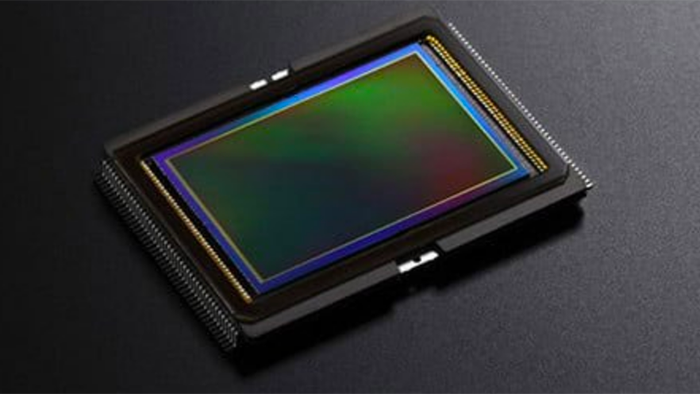
1) Panasonic has designed a new “back-illuminated” CMOS-sensor.
2) Panasonic is ready to release a compact camera using the new sensor.
3) The camera will have a 1/1.3 inch sensor!
A little history first:
Sony was the first company to develop a back-illuminated CMOS-sensor (read more at the Sony homepage). Sony’s new CMOS sensor design made its first appearance in the new HD Handycam video model HDR-XR520VE/500VE. A detailed review of the XR520 has been written by trustedreviews: “Another revelation with the XR520 is how well Sony’s claims of improved low light performance pan out. The image isn’t significantly brighter than that of Canon’s LEGRIA HF S10, but it is noticeably less noisy. The white balance also remains very accurate, so colours are quite faithful. This camcorder will be hard to beat when shooting in poor illumination.”
What are the benefits of the new sensor?
The Sony “back-illuminated” EXMOR-R sensor nearly duplicates light sensitivity while reducing the signal-to-noise ratio. I expect the Panasonic sensor to be able to fulfil the concept’s potential.
What our sources told us
“Panasonic developed a backside ilumination LiveMOS 1/1.3 inch sensor. ”
I asked him if there is a plan to apply the technology to a bigger sensor and the answer was:
“It’s difficult to apply backside illumination technology to large image sensor for comsumer model like MFT. There are some problems about heat and yield ratio.”
And the first compact camera using the new sensor
“…will be launched 3Q-4Q”
If you have questions concerning that news write a comment or contact me at 43rumors@gmail.com and I hope the source can answer your questions.


radis2
4 years ago |Woo hoo, as many have said, this year is a really exciting year
Bluecold
4 years ago |Back illumination won’t do nearly the same for large sensors as for small ones because the electronics are already very small compared to the photo diodes
So not really a big deal that Panasonic can’t apply the process for large sensors.
Is Panasonic Prepping a New Backlight Sensor Design? at Imaging Insider
4 years ago |[...] Read More… [...]
T3
4 years ago |Here, 2 new Sony HD camcorder with Exmor R sensor…
http://www.photoclubalpha.com/2009/07/07/back-illuminated-exmor-in-new-sony-hd-handycam/
zen91
4 years ago |It’s will be good for the next LX4/LX5 :
- 1/1.3″ sensor : just the good size for 12,5 MPixel with the same pixel-size of the LX3 10.1 MPixel 1/1.63″ sensor
- Backlight sensor : + 8DB ? If that’s “only” + 6DB : nominal sensitivity will jump from ISO 80 to 320 and excellent/good quality from ISO 200 to ISO 800 (always comparing to LX3), and max sensitivity from ISO 1600 to 6400…
- We are on Q03, then the LX4/LX5 for Q04 ?
Anonymous
4 years ago |[...] [...]
24x7 Raumüberwachung wichtiger Infrastrukturen
4 weeks ago |I for all time emailed this weblog post page to all my contacts,
since if like to read it afterward my friends will
too.
site monitoring
4 weeks ago |Hello! Would you mind if I share your blog with my twitter group?
There’s a lot of folks that I think would really appreciate your content. Please let me know. Thanks
MapyAssusal
3 days ago |As the American Psychiatric Association unveils the latest edition of what is considered the “bible” of modern psychiatry this weekend, the uproar over its many changes continues.
“This is unprecedented, the amount of commentary and debate and criticism,” said Dr. Jeffrey Lieberman, president-elect of the American Psychiatric Association (APA). “It’s been an interesting phenomenon, but the evidence is what it is. You have to evaluate it and then make your own determination of how compelling it is, and what would be best clinical practice.”
The APA believes that changes made in this fifth edition of the Diagnostic and Statistical Manual of Mental Disorders (DSM-5) will allow for more precise diagnoses of mental illnesses in patients, because this edition better characterizes and categorizes disorders.
But it has drawn fire from critics who are concerned that the revised version will lead to the diagnosis of mental illness in people who are simply being challenged by life.
More than 1,500 experts from 39 countries representing a wide variety of medical fields contributed to the new DSM-5, which was more than a decade in the making. Drafts of the manual were made available online as part of three open-comment periods that drew more than 13,000 responses.
One of the most notable naysayers has been Dr. Allen Frances, chairman of the task force that created the DSM-4, the previous version of the guide that has been in use since 1994.
In a commentary released the day of the DSM-5′s release, Frances wrote that this latest revision introduces “several high-prevalence diagnoses at the fuzzy boundary with normality,” and predicted that the changes “will probably lead to substantial false-positive rates and unnecessary treatment.”
“In DSM-5, normal grief becomes a major depressive disorder, temper tantrums become disruptive mood dysregulation disorder, worrying about medical illness becomes somatic symptom disorder, gluttony becomes binge eating disorder and almost everyone will soon qualify for attention-deficit disorder,” Frances said in an interview.
The main points of contention regarding the DSM-5 include:
The combination of a number of autism-related disorders into a single category called autism spectrum disorder. Although some clinicians believe that placing autism on a continuum from mild to severe will allow for more accurate diagnoses, others are concerned that high-functioning people with autism will find themselves unable to receive services or treatment. This is particularly true of people with Asperger’s Syndrome, a diagnosis that has been eliminated from the DSM-5, critics of the new version contend.
“We’re concerned that people who have Asperger’s — who have high-functioning autism — are going to be dismissed as just being different when the majority of adults with Asperger’s will need people to assist them in parts of their lives,” said Karen Rodman, president and founder of Families of Adults Affected With Asperger’s Syndrome.
“We are very concerned that medicine is going to drop the ball again, and the children who need services won’t get them,” Rodman said. “Fortunately, clinicians and physicians and the public around the world are still going to refer to Asperger’s as Asperger’s. It’s like saying people don’t have a right arm anymore.
“Many people with Asperger’s are concerned there will be a stigma — that everyone will be considered autistic — and when people think of that they think of a child sitting in a corner and spinning,” Rodman added.
Changes made to the diagnostic criteria for attention-deficit/hyperactivity disorder (ADHD). Critics are concerned that changes made to better diagnose ADHD will instead lead to over-diagnosis. In the previous version of the DSM, a person needed to show the onset of symptoms before age 7 to be diagnosed with ADHD. The new version now says 12 is the latest age at which ADHD symptoms can manifest themselves. The DSM-5 also reduces the number of criteria needed to arrive at a diagnoses of adult ADHD from six to five.
A new diagnostic category for children who are hostile or acting out. The DSM-5 includes a new category called disruptive mood dysregulation disorder, which would apply to children who have extreme irritability but fall short of the standards for bipolar disorder or depression. The category was created to deal with the upswing in bipolar diagnoses among children, but there is concern that some clinicians will label a simple childhood temper tantrum as a treatable mental illness.
Breaking out obsessive-compulsive disorders into their own category. Obsessions such as hoarding, hair-pulling and skin-picking had been considered anxiety disorders, but in the DSM-5 they will have their own category. Critics are concerned that this change has more to do with reality television’s recent focus on hoarders than with the need for a new category of mental illness.
12312
12312