




Panasonic patent shows MicroFourThirds Adapter with mirror and phase detection

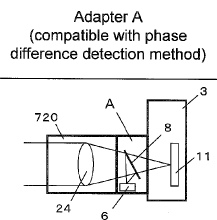
Panasonic latest patent discloses an adapter for MicroFourThirds camera which adds mirror and phase detection on your camera. Remember only few patents do become real products.
Anyway do you really need to turn your mirrorless camera back into a classic DSLR?
source: http://www.freepatentsonline.com/y2010/0091175.html
—
sent to us by Andrea (SonyAlphaRumors)


Duarte Bruno
2 years ago |This is surreal, the CDAF champions patenting retro technology. I guess they are just marking their territory and have 0 interest in pursuing this.
Such is the Intellectual Property system.
Dave-in-Mi
2 years ago |It might be interesting for old school camera fans if they developed an adapter with an optical finder for the GF and EP series cameras. Otherwise, it seems kind of backwards.
omox
2 years ago |Right, they patented it so noone can make that kind of device. Smart move.
Or maybe they can see the future we can’t see yet.
Bruno
2 years ago |this kind of reminds me visoflex rangefinder to slr adapters! http://www.summilux.net/visoflex/Visoflex-1.jpg
careyer
2 years ago |Well, PDAF can and will always be faster than CDAF. There is no way to agrue about that. While PDAF has the possibility to drive the AF-lens directly into the right direction that is not possible with CDAF (at least not unless a hybrid system is used). Thats probably why noone is (seriously) using MFT cameras for sports events yet. So there is a good reason to build such an adapter. However Dave-in-Mi is right… if they produce such a thing it would be nice to have a OVF as well.
patrick
2 years ago |Guys, there are incredible FT lenses made by Leica and Olympus out there. Such an adapter would be a great choice for owners of FT lenses, especially those with SWD that are not CDAF capable.
omox
2 years ago |My friend speculates that this could be new adapter for 4/3 lenses… who knows… if new MFT bodies have some kind of interface to phase AF detector…
AlexV
2 years ago |This could be a workaround for faster AF until CDAF could perform similarly to phase dectection AF.
don
2 years ago |I think no question but this special adapter is to address how to best utilize the existing quality lenses available in 4/3rds and such a development would benefit both Panasonic attracting those that have 4/3 glass as well as benefit Oly from demand for some of their lenses which are not now adaptable to good contrast AF. The best of both worlds as will justify concentrating the camera bodies mainly on m4/3rds without abandoning current 4/3 users. While there was no room for a mirror in the m4/3 register distance, the extra length required to use 4/3 does provide that space. While for now there would appear to be no OVF there is no reason Pany could not display fast live view on back LCD or EVF in left corner while mounting a OVF on the adapter over the middle of the camera.as an option when using 4/3rds glass? This could be fitted over a relatively thin body as the OVF would extend out the front rather than the back. What do you think?
I believe there will alwys be a demand for DSLRs for those who prefer to view thru an OVF for sports and action photography and the speed that PDAF brings, This way there is no need to have both a DSLR and a m4/3 to satisfy these needs for both compactness and versatility. I would expect this versatility only a a pro caliber camera or maybe one made in conjunction with a new E5 if it were to go m4/3rds? It is simply too costly to modify all these quality 4/3 lenses for contrast AF so easier to retain faster AF with this adapter? Why not?
Brandy
2 years ago |@careyer: your argument is absurdly wrong. CDAF is potentially faster than PDAF, it’s not at the moment just because the algorithm isn’t there yet. No one uses m43 to shoot sport because of the long black-out time and shutter-lag. Try shooting baseball you will see – you can prefocus pretty much, but the lags take away all the fun
Julius
2 years ago |Je pense que ceci est une nouvelle bague d’adaptation 4/3 µ4/3 qui permettra d’avoir un autofocus fonctionnel avec certains objectifs 4/3.
patrick
2 years ago |Julius, thank you for expressing my thoughts in french
Miroslav
2 years ago |How about making the film to m43 adapter? It would rid the system of the digital camera shortcomings such as poor DR, aberrations, fringing, shutter lag etc. You frame on EVF, focus electronically, take picture, than the film gets developed and scanned in camera …
Seriously, they better devote their R&D on making adapters that enable AF on electronically controlled lenses that are not supported yet.
Miroslav
2 years ago |Although I agree with don that this kind of adapter would be a good thing for a ‘pro’ camera, an E-3 successor for example.
David Bateman
2 years ago |Brilliant!
If there is a four thirds mount on the front then you get auto focus for all four thirds lens ever made on Panasonic, instead of just four!
However if they can add a glass element in front of the mirror box controlled by the mirror box! Then you can have autofocus (touch up autofocus) for every lens ever made!!
Similar to the Pentax autofocus adapter for A to AF with 1.7x mag. But due to the 20mm reg distance of m43, this adapter would touch up autofocus for every lens ever made for a SLR.
don
2 years ago |Doesn’t Sony also have a patent for providing PDAF on the sensor and is that what is going on here? Ie the image being shown in the EVF or rear LCD is PDAF while the pellicle mirror is deflecting only a small amount of light to activate the PDAF mechanisms in the lens?
matteo
2 years ago |very interesting filing date 13/02/2008 !!!!!!
six months before m4/3 presentation.
Olympus and Panasonic prepared m4/3 from years.
In Patent are presented two different solutions
1) an adapter for existing lenses (4/3?)
2) a Detection phase system directly integrated in a lens.
Matteo
AltraOttica » Blog Archive » Goodmorning 19.04.10
2 years ago |[...] di fase, tipico delle reflex. Panasonic ha brevettato quindi un sistema che prevede la presenza di uno specchio fisso nell’ottica, con incluso un sensore di fase, che dovrebbe sopperire a questa mancanza nei corpi [...]