




UPDATED-> for small sensors -> Panasonic Image Sensor Roadmap (Let’s join the Megapixel race)

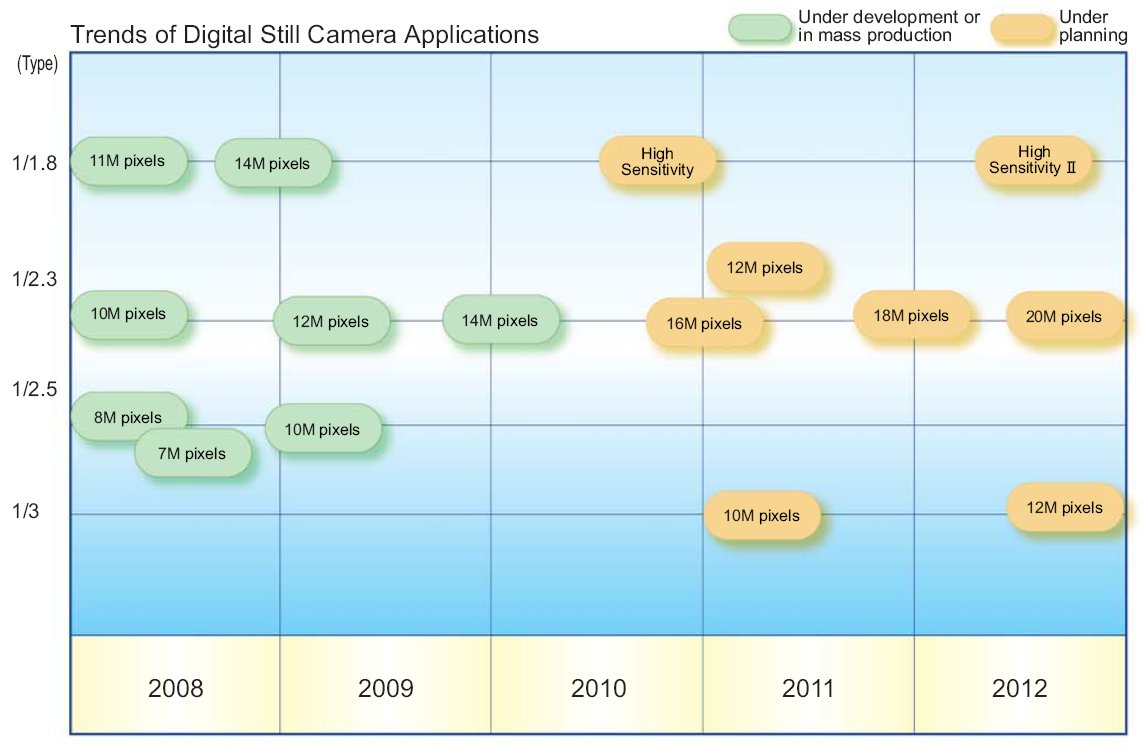
Image Sensors World just found the new Panasonic sensor roadmap! The most interesting graph is the one I posted above. Click on the image to see it at originial size.
But what is coming in 2012? A 20 Megapixel sensor! Don’t get too excited, this is just a roadmap and as pointed by the ISW Blog roadmaps can change…
The pdf is available for download here at http://www.semicon.panasonic.co.jp/en/catalog/cat/pdf/A00006NE.pdf (Yes it is an official Panasonic document!)


Raj Sarma
3 years ago |That isn’t for 4/3s though, that seems like the roadmap for sensors in compacts. Take a look at the sensor sizes on the left.
Nathan Ross
3 years ago |Does this apply to (M)4/3rds as the types down the side don’t list it, instead listing 1.8 (compacts) ranging to 1/3 (camcorders)?
Agent00soul
3 years ago |But these are small sensors for compact digicams, aren’t they? Not for fourthirds.
admin
3 years ago |Thanks guys! I corrected the post!
hannes
3 years ago |at least this 1.8 “High sensitivity” dot at the end of 2010 could hint to a LX3 successor…
lkm51
3 years ago |there is a 14mpx sensor ready already… it’s in the document… hence 12mpx is already bye bye
don
3 years ago |Interesting that the 1/1.3 size sensor has been dropped out of consideration? My guess that slightly larger size would have required slightly larger lenses and Pany decided to stick with LX3 sensor size for future developments in quality compacts while retaining the LX3. This decison probably also influenced by how well m4/3 format is doing at present.
Also interesting to note how most of the activity is centered on the 1/2.3 size sensor for the compact cameras so obviously major improvements in these sensors are anticipated. Given the projected even higher MP certain this will be back illuminated sensors for sure. Resolution and detail from these sensors is already very good so they must be anticipating also better high ISO performance and high speed operations. Also possible this means oversized multiaspect sensors which will enable HD 1080P/60? This will also mean faster small zooms in the future for both cams and digital cameras.
liug
3 years ago |The part I find the most interesting is the High Sensitivity 1/1.8″ planned for the second half of 2010… which is very soon.
don
3 years ago |Just noticed that the existing LX3 sensor size of 1/1.63 is not even listed so the 1/1.8 is most probably a misprint as shown to be existing in 2008 & 2009 but again the 11 and 14 MP size is wrong? Are you sure this is an official Panasonic roadmap release? If so a lot of very obvious errors and questionable data shown.
Ezegzrtg
3 years ago |The LX3 sensor is 1/1.63, which is between 1/1.8 and 1/2.3, and we see a 12 MP announced there for first half of 2011.
compact 43d
3 years ago |…what if the LX3 successor is gonna introduce a mft-sensor?
spanky
3 years ago |“@ compact 43d says:
April 6, 2010 at 12:52 pm
…what if the LX3 successor is gonna introduce a mft-sensor?”
I’d buy one if that were true. A slim/compact 4/3 sensor with a fixed zoom lens that retracts into the camera body would be an awesome walk-around, always-on-you kind of camera.
Jonathan
3 years ago |Do we really need more pixels? More pixels usually comes at the expense of more noise. Although improved technology may help to reduce the noise, I would prefer cleaner images at the same resolution as today’s sensors. Megapixels is to digital cameras as pure GHz is to PCs, that is not a good measure of performance.
By the way, Ezegzrtg, 1/1.63″ would not be between 1/1.8″ and 1/2.3″, but would be above 1/1.8″ on the graph as it is a larger sensor than both of these sizes. It looks as if neither the LX3 sensor nor its replacement are featured.
at
3 years ago |At least we can see a high sensitivity version of a sensor size of about 1/1.8″ to be continually developed in the future Panasonic DC. Well done!
Gabriel
3 years ago |And the lens ? With so many pixels, you need high grade lens. I read the DPreview of the new 18 mpx canon, and the budget lens can’t really make the most of the sensor. There is also more noise, photo files are bigger, you need of course a faster computer to manage your image, and for what ? put your pics on a web account, with a max full hd resolution, print in a full A4 size ? No need of so many pixels.
bilgy_no1
3 years ago |That slide is titled: ‘Trends of Digital Stills Applictions’. So it does not necessarily reflect the actual planning of sensors to be produced by Panasonic. Rather it shows the general development in compact camera sensors over the last few years, which is indeed: more megapixels and technology to improve sensitivity (back lit etc.).
Just look at the 1/2.3 type trend: it’s basically an extrapolation of recent history, where the megapixel standard is now at 14, coming from 10MP in 2008 and projected to be 18 in 2012. Larger compact sensors are another segment (including the 1/1.63 type of the LX3 and the 1/1.7 type in S90) where the general trend is not more megapixels, but improved sensitivity.
I doubt that Panasonic would lay their cards on the table and tell the whole camera world what sensors they will develop in the coming years. When you look at the linked pdf, this table just serves to sketch the general trend of image sensors for stills cameras. Just what the title says. Notyhing more, nothing less. It’s certainly not a roadmap.
Stroncis
3 years ago |by pushing technologies in this way, they can utilize that in bigger sensors by making tighter spaces between containers and so able of push more megapixels into same sensor size or just enlarge of these containers by leaving same megapixel count. in one case you don’t loose dynamic range and s/r in second way you improving these parameters.
Miroslav
3 years ago |One point nobody has fully exploited when big megapixel counts are concerned. In camera cropping instead of zoom when shooting in lower resolutions, extra optical zoom as Panasonic calls it, is the future. Give me a 30 Mpx camera and I’ll shoot at 6 Mpx while using the rest instead of the optical zoom. That way, I can have a more compact camera.
Yes, you get more noise as pixel density increases, but with advances in sensor technology manufacturers should use this more and more. It’s a pity that Olympus does not use extra optical zoom feature in its m43 cameras ( or at least I haven’t found it in the manual yet ).