



Panasonic GH2 sensor test at DxOmark

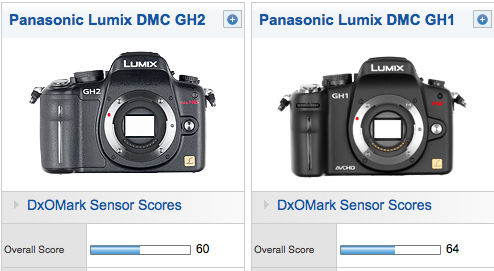
DxOmark tested the GH2 sensor and the results are somewhat surprising! The Overall score (60 points) is less high than the GH1 sensor (64 points). Click here to see the comparison: GH2 vs GH1 vs 7D at DxO
After the first reviews I thought the GH2 has much better resolution and high-ISO results. What DxOmark states here goes against all other previews we have seen so far!
P.S.: According to DxOmark the Pentax K-5 is better than the Canon 5D. Something must be wrong with their conclusions!
P.S.: Amazon links to the tested cameras specs and price:
Panasonic GH1
Panasonic GH2 (no more listed!)
Pentax K-5
Canon 5D mark II
Canon 7D

Vlado
2 years ago |“goes against all other previews we have seen so far!” – NO! it doesn’t …
DxOmark is the only one witch is testing the senzor without the SW on it.
What is say’s is, the most upgrade was made in SW not in the senzor. But this was pretty clear as we cut already see, what was olympus able to get from the old senzor.
frosti7
2 years ago |Its not just “overall score”
In every category the GH1 comes out triumph, could panasonic pull 2 stops more using software? how about the earlier sensor tests that states GH2 higher DR?
The conclusion is very contradicting, im waiting for Dpreview or Imaging Resource test’s to confirm what actually going on
hd72
2 years ago |Considering the results you can get from Noise Ninja or Topaz DeNoise, I’d imagine software can do a lot as these cameras’ processors get better. I just hope this direction of software over sensor improvements doesn’t leave RAW users behind — especially since the camera makers are catering so much to the casual (jpeg) crowd.
Ganec
2 years ago |Maybe because it compare only ISO 1600 with ISO 1600, but in reality GH1 in this case uses ISO 2154 while GH2 1532 (7D uses 1223).
alienchow
2 years ago |“Something must be wrong with their conclusions!”
You don’t say. DxOmark is even more of a joke than DPreview. How those sites have such a following is beyond me.
pisto
2 years ago |And, for a change…. you follow what?
ANGRY Olympus Owner
2 years ago |real world results, btw thats what matters anyways
alienchow
2 years ago |I should have phrased my comment differently. Why people place so much stock in their results is beyond me. I read their reviews for specs and info, but I don’t place much faith in their reviews. I like to see real world photos people put on the forums, go to a store with a memory card, borrow a friends camera or lens, etc.
I have been testing cameras and lenses since the film days, back when you had to run color tests on film stock for jobs that were going to press. The color variations in film, and lenses, could be almost unbelievable, from the same kind of film(different lot numbers) and the same lenses.
What I’m getting at, in a round about way, is the way people treat these reviews as though they are gospel, is a joke. Just remember, these people are not professional photographers, they are professional reviewers.
spam
2 years ago |“these people are not professional photographers, they are professional reviewers.”
Exactly, and to find out what a camera can do you read a professional review like DXO or Dpreview. To find out what suits you pick the parts of the reviews that’s important to you. Comparing random shots on the web or from borrowing a camera in the store says next to nothing unless there is something really seriously wrong.
alienchow
2 years ago |Really? Are you serious? After 20 years of making a living as a photographer, I need a reviewer to tell me what a camera can do? Sorry, you can quote specs and lab results all you want, and yes, they do have their place. But, as with most products(cars and audio equipment are two that instantly come to mind) a lot of the specs and lab results fall by the wayside in the real world.
This is the reason we have a lot of the problems we have in the real world today. Armchair experts who can quote a lot of stats, but who have no practical knowledge.
Stupig
2 years ago |Remember to read the manufacturer ISO, instead of the so-called real ISO rated by DXO. Higher “real” ISO only reflects smaller highlight headroom.
Stupig
2 years ago |For example, using manufacturer ISO: at 3200, GH2 has print color sensitivity of 14.1 bits, compared to GH1′s 13.6 bits. GH1 has color sensitivity of 15.4 at ISO 1600. So the new GH2 is about 1/3 stop better.
Milos
2 years ago |Gh2 sensitivity is lower tha GH1 – it is a trick.
Of course if You lower the sensitivity You lower noise. Dxo mark cannot be fooled by this :]
Person
2 years ago |Seems possible.
I just think people aren’t used to the power of software and processing upgrades. The idea that it’s all about new hardware is increasingly inaccurate.
pisto
2 years ago |Fair. But I am not sure that it is a good deal to get a new hardware just to get a better software.
Roei
2 years ago |so? who’s to trust? this is very confusing
alienchow
2 years ago |Trust yourself, and your own eyes. Trust people whose work you admire. I can’t really think of a major manufacturer that is producing junk right now. 99% of the problems I see in photographs have nothing to do with the camera or lens.
Stupig
2 years ago |As for Pentax K5 – I suspect it’s raw files are in fact “medium-well” when it comes to noise reduction, instead of being raw. Even DXO points out the “smoothed” nature of them. Again, if one looks at the manufacturer ISO at 1600, there’s about 1 stop difference between K5 and 5D2/D700, which is typical between APSc and FF.
Daemonius
2 years ago |Well, if Pentax is “medium-well”, than GH2 is “overdone”.
Cause m4/3s are really good cooked. But, does it matter? As previous owner of G1, I cared about output, not “how”.
And, I dont think they were able to squeeze 2 eV in DR via SW (though ofc its possible, via PP, you can squeeze even more from things like D3X or A900).
darrask
2 years ago |Their conclusions don’t have to be false. DxoMark have a solid methodology.
Interpreting the results, it would mean that the GH2 image quality increase, observed in all reviews, is resulting from a much improved image processing/JPEG engine (GH2 has 3 processors, remember) rather than a better sensor. Is 18MP too much for micro43?…
Concerning the Pentax K5, that is an enormous image quality increase compared to other APS-C sensors, it even gets close to the Nikon D3, but most of that improvement is the result of a 14 stop (!) raw dynamic range. This it not impossible to get when you see how fast APS-C sensors have been improving their DR in recent models, suggesting that pixel depth is not essential to get such a wide DR.
Daemonius
2 years ago |Well, unlike Sony with their new sensor, Panasonic is probably not able to squeeze more MPix into same size with increasing quality of output. But I guess it can change in next camera. 18 mpix is helluva lot for m4/3. If you used same pixel density for APS-C or FF, you would get pretty crazy mpix numbers.
In fact I would say, that considering how much mpix GH2 has, its pretty decent. Not saying that I didnt hope for more..
Zonkie
2 years ago |DxO mark is not a perfect correlation of real world performance, but at least they have a solid testing method and test RAW without being fooled by manufactures “tricks”.
So yes, it looks like the RAW output of the new sensor is actually a bit worse than the old one (though hardly noticeable, to be fair). This is the first bad news.
Up to now all we had seen was a much stronger noise reduction in JPEG, which is meaningless of the quality of the sensor.
The new Sony sensor used in the Pentax K-5 and also in the Sony A580 and Nikon D7000 (the Sony A55 too, but there it’s a bit crippled by the translucent mirror) has made significant improvement, unlike Panasonic. This will only contribute to increase the gap in image quality between 4/3 and APS-C, which is the second bad news.
steve
2 years ago |The image quality gap is not so much between 4/3 and APS-C, but between Panasonic and Sony sensor designs. It looks like there was not a signicant improvement in the raw sensor for the GH2. All improvements came from the new processors. Now it seems this basic sensor design will be out for 3 years before we see a signficant improvement. This is way too long when you are competing with Sony.
43 photo
2 years ago |Very interesting. Mabye this is the reason why Olympus did use the old sensor in E5. More MP’s in a small sensor gives you an edge in marketing but in real world it does make no sense at all.
12 mp can be better than 16/18 mp.
Let us wait until they test E5.
John Krumm
2 years ago |I’ll be surprised if the E5 tests any higher than the other 12mp Oly cameras. Pentax looks like they have made some serious progress in DR and noise control, and all the samples have indicated from the K5. It’s the new DR king, it seems.
CRB
2 years ago |As far as i know, first K5 reports indicate a very very good camera, excellent DR and noise (low)…
Ranger 9
2 years ago |What I find particularly mysterious is that if you look at the actual data for GH1 vs GH2, most of the graphs are almost identical. There are minor differences in specific areas of the S/N and tonal range graphs, for example, but they don’t seem big enough to be statistically significant.
I wish I knew more about how DxO aggregates all these individual measurements to come up with their overall scores, and in how big a difference in overall scores is needed to produce a VISUALLY significant change in images. Lacking that info, I can’t tell how much of this difference is cause by actual lower quality and how much might be just a statistical artifact of how the two sensors fit into DxO’s ratings model.
The good news about this is that maybe some of the pixel-peepers who have been waiting for the GH2 will rush out and buy a GH1 instead, reducing some of the delivery-delay anxiety about the GH2!
Zonkie
2 years ago |The scores are about the same. Mostly insignificant in real world and among normal sample variation (if they tested another sample of GH1 and another one of GH2, results could be the opposite they are).
So it’s not so much bad news that the outcome is a bit worse. The bad news is that there is no significant improvement in the measured areas*.
And it came together with the news that Sony sensors HAVE improved significantly (and they are used by Sony, Nikon and Pentax).
*Hey, not that other things like higher resolution and faster readout don’t count, those are important things too – if not, read about the AF speed improvement mentioned in all reviews.
kesztió
2 years ago |Regarding the seriousity of DxO mark measurement:
Why two almost identical cameras (G2 and G10) show so different results?!
http://tiny.cc/vd6fn
(don’t worry about the link, it‘s shorted by Tiny URL)
e_dawg
2 years ago |There’s nothing wrong with DxOmark’s testing methodoogy. Why does everyone say that when the results are not what they want it to be? It’s not surprising that the GH2 sensor is not better than the GH1′s sensor given the extremely high pixel density.
Maybe now Olympus will be vindicated by their decision to go with the older 12mp sensor in the PENs than beg Panasonic for the GH2 sensor, which is not much better when it comes to RAW sensor output for stills.
There is no question that the GH2 is an improvement when it comes to video, but the only improvement in still image quality is from the improved JPEG processing and NR in-camera, which is irrelevant if you shoot RAW.
Brod1er
2 years ago |think I shall hold out upgrading from my gh1 until the gh3 with electronic shutter arrives. Sensor performance (DR and high ISO) will become much less important when you can have different EVs for individual pixels.
Archer
2 years ago |Okay guys, calm down.
First of all, results from these tests are really only significant to a 10 point difference or so. So on raw performance, the GH 2 and the GH 1 are essentially the same. Given the differences we are seen in photographs though, it may be time to give up on raw as the ultimate arbiter of camera quality. Software really is significant, and there is a lot of data that can be pulled out of the sensor that can only be done by software that knows the sensor intimately. Perhaps the workflow the future for these cameras is to shoot super high quality JPEG, and then convert to 48 bit RGB for processing.
Dana Curtis Kincaid
2 years ago |“Something must be wrong with their conclusions!”
Ah. Also, the world is only 6000 years old, god is a man, the Theory of Evolution is all wrong and Sarah Palin is the next President of the USA. Ya…
Fish
2 years ago |Congratulations. You managed to dredge up just about every topic that no one else on a camera rumors site wants to hear about. There are probably forums for that if you’ve got personal issues you want to talk about.
Dana Curtis Kincaid
2 years ago |“Perhaps the workflow the future for these cameras is to shoot super high quality JPEG, and then convert to 48 bit RGB for processing.”
Ummm… No.
zebarnabe
2 years ago |DxOMark it’s perhaps the most trusted sensor reviewing site out there… but i kinda wonder how they take pixel pitch in consideration :/ (when you grab 16MP and resize to 12MP noise artifacts get a smaller)
Well… with that said… i’m glad my GH1 is not that bad ;]
Ahem
2 years ago |Pixel pitch is naturally included in the results. If you mean whether they normalize for cameras with different # of megapixels, they do: use the “print” mode in different tabs.
zebarnabe
2 years ago |Yep … i went to read further about their tests, they basically have normalized the test of the sensor for 8Mpix printed on 8”x12” (20cmx30cm) at 300dpi resolution…
zebarnabe
2 years ago |An extract from DxOMark:
“Sensor Overall Score AND resolution are two independent metrics of sensor performance.
As a consequence, just because camera A has more pixels than camera B (and thus sees more details) does not mean that its RAW Sensor Overall Score will be better. Rather, Sensor Overall Score measures the quality of the captured signal, either at a pixel level or at the full sensor level. So before comparing cameras with Sensor Overall Score, it is important to first determine the resolution you are looking for (which largely depends on the size of the screen or the print you intend to use or produce).
Once you choose an appropriate resolution, the DxOMark Sensor Overall Score becomes a fair and powerful tool with which to make comparisons.
In a camera, resolution is dependent on both sensor and lens performances. So to compare and rank digital cameras while taking resolution into account, you should look at the DxOMark Lens Peak Score, which weighs a number of image quality parameters, including resolution.”
So … there could be some differences
Inge - M.
2 years ago |I see the big difference by K-5 and A55, is K-5 have 14 bit and A55 have 12 bit
steve
2 years ago |The A55 also has to contend with the mirror. The A580 should produce results much closer to the K-5.
Inge - M.
2 years ago |Yes but only 1/3 stop, so the is not all reason.
MP Burke
2 years ago |These DXO scores suggest that the weaknesses with the Panasonic sensor is the performance at high ISO and dynamic range and those of us who’ve used the cameras would have to agree. The higher number of pixels on the GH2 sensor should enable slightly better resolution numbers to be obtained with good lenses, but I think everyone would welcome a greater DR from mu 4/3 cameras.
muckraker
2 years ago |The DxOMark testers are pixel-peeping at a extremes and say over and over again on the site:
“Disclaimer:This dxomark review evaluates only the selected camera’s RAW sensor performance metrics (i.e., Color Depth, Dynamic Range, and Low-Light ISO), and should not be construed as a review of the camera’s overall performance, as it does not address such other important criteria as image signal processing, mechanical robustness, ease of use, flexibility, optics, value for money, etc. While RAW sensor performance is critically important, it is not the only factor that should be taken into consideration when choosing a digital camera.”
I suggest reading their various in-depth articles in their Insights section detailing their methodology.
Here: http://dxomark.com/index.php/en/Our-publications/DxOMark-Insights/Canon-500D-T1i-vs.-Nikon-D5000 for instance, they discuss why the Nikon D5000 outperforms the Canon 500D – two similar sensors – by 10 points.
One reason, they conclude is that the Nikon was slightly better at low ISOs where they test the cameras.
“The Nikon D5000 sensor obtains exceptional results for low ISO settings and outperforms the Canon EOS 500D sensor in dynamic range and color depth. When ISO increases, however, the differences become smaller, but the Nikon D5000 still maintains a slight advantage.
This said, the Canon EOS 500D sensor is nevertheless an exceptional sensor with a very small pixel pitch and very low RAW noise. Two main weaknesses explain the difference between its score and that of the Nikon:
* The slightly higher readout noise, visible for low ISO settings
* The larger overlap of color responses
We should keep in mind, too, that the sensor launched by Canon presents more technical challenges than a classic 5.5µm pixel pitch sensor, and in principle should provide slightly higher resolution. Of course, this DxOMark review evaluates only RAW sensor performance and should be considered only in tandem with other more global reviews when choosing a digital camera. While DxOMark does take resolution into account for normalization, users should be aware about the minimum resolution they need before comparing any camera.”
So the way I read their analysis is that there is a difference of 3 points between the cameras, which equates to a 1/5 of a stop of signal to noise ration at the lowest ISO, and does not take into account perhaps much cleaner output at higher ISOs (which is what seems to concern most photographers).
In another article they observe that 15 points measures 1 stop.
http://www.dxomark.com/index.php/en/Our-publications/DxOMark-Insights/DxOMark-Peak-Score/DxOMark-Peak-Score-design
“While the Sensor Overall Score describes the results of measurements only on sensors and is essentially related to image noise (for example, a difference of one f-stop offsets the Overall Sensor Score by approximately 15 points), the Peak Score is both proportional to resolution (taking optical aberrations into account) and to sensor dynamic.”
Here’s an interesting quote from their review of the Gh1:
“The GH1 even outperforms a hypothetical four-thirds sensor cut from a (wider) Canon EOS 7D sensor (with the same pixel size). With its 50% larger sensor surface (corresponding to 9 DxOMark Sensor points), one would expect the 7D to have outperformed the GH1 by 9 points. Instead, it achieves a DxOMark score of 64.9 — only slightly more than 1 point above the GH1’s score of 63.6.”
So, I suggest that the difference of a few points is more or less meaningless in real world use, that the GH2 could outperform the GH1 at high ISOs, but, if so, that appears to not increase its score. And that signal processing — even RAW signal processing — may achieve superior results in a camera that may have received a lower rating.
-Muckraker
alienchow
2 years ago |So, in other words, most of their testing is moot. This is what I wish most people would try and understand. They are only testing a single part of a system. Like pulling the motor out of a car and doing bench tests on it. It doesn’t tell you anything about the car. Almost zero practical, or applicable, results. Would you place much stock in an auto review site that tested only engines and transmissions? Real world, people. Real world.
Ahem
2 years ago |Yeah, it’s such a tragedy when some guys try to bring falsifiable data to IQ discussions – we should try to stick to hunches, wild claims and brand preferences when it comes to measurable IQ metrics.
muckraker
2 years ago |I think the DxOmark test is a valuable and worthwhile analysis, and I don’t know anyplace else doing this sort of testing. But it just needs to be placed in the appropriate context.
What made me order the GH2 was actually the great review on Luminous Landscape. I’m sure everyone here has already read it, but just in case, it’s at:
http://www.luminous-landscape.com/reviews/cameras/panasonic_gh2_first_look.shtml
Boris
2 years ago |“Like pulling the motor out of a car and doing bench tests on it”.
LOL
You got it right!
Cameras are NOT for taking pictures!
Nobody cares about them!
We are into bench tests!
Bring them on!
dCap
2 years ago |oh dear
Duarte Bruno
2 years ago |You people should stop this nonsense altogether about GH2 having a worse sensor than GH1.
The truth is they have similar performances because they scale with resolution.
The GH2 as 1,333 the resolution of the GH1 so a 1/3EV stop gain.
15 dxomark points equals 1EV stop advantage.
60+15/3=65 Peak sensor score, which is marginally better than the GH1 score.
In this case levelling resolution you should shift the GH2 graph 1/3EV to the right in which case it’s mostly coincident with the GH1 to make any real difference.
I know most of you embarked on the JPEG trickery ecstasy and now you feel fooled.
I kept my expectations in the safe until today’s results and I can say that even though I though they might be better, a sensor with the same overall sensitivity as the GH1 but higher resolution doesn’t offend me that much!
With all these latest delays the chance of me getting an E-P3 (with a Sony sensor) against a GH2 just rose from 1% to 5%…
But the fast AF, 5fps, touch focus, T&S LCD, 40fps@4MP and best EVF in photo land still make up for 95%…
kesztió
2 years ago |As I understand the score of 60 is ALREADY normalised to (bigger) sensor resolution. Am I wrong?
Ahem
2 years ago |That’s correct. You can compare the results normalized for megapixel counts in the tabs by choosing “print” (on by default I believe).
Duarte Bruno
2 years ago |You are right. I was brought to notice that Sensor Peak Value is already normalized. Comparing the print graphs isn’t a pretty sight.
I wonder who let the Marketing guys in charge in order to screw it up this way.
Boris
2 years ago |“JPEG trickery”
If it’s all you need for a good picture I don’t mind such a trickery at all.
Henrik
2 years ago |Editor should be clear whether he talks 5D or 5DII.
Ahem
2 years ago |When the conclusions don’t agree with your preconceived notions the test results must be wrong?
I’m glad you provided support for your claims of wrong results. Oh, no you didn’t.
DAM
2 years ago |DxO tests the raw sensors without the manufacturers processing algorithms in play. A manufacturer’s processing algorithm can make a big difference in image quality. Even though the sensor score may be statistically insignificantly lower (64 vs. 60), I’m betting their processing has improved quite a bit since the former camera was developed, resulting is better image quality.
From the DxO site:
“All Sensor Scores reflect only the RAW sensor performance of a camera body. All measurements are performed on the RAW image file BEFORE demosaicing or other processing prior to final image delivery. DxOMark does not address such other important criteria as image signal processing, mechanical robustness, ease of use, flexibility, optics quality…”
Philip
2 years ago |If you look at the numbers it makes perfect sense..!
The graphs show the GH2 sensor performing excactly as the GH1 (but with higher resolution). Dynamic range is the same. Color fidelity is the same. Noise is the same!
The reason GH2 gets lower points than GH1 is because they test DR and CF at lowest iso for best performance. Lowest ISO for GH1 is ISO 100 and lowest for GH2 is 160. The differance is about half a stop in DR and CF which is about 4 DXO-marks. IQ between sensors is the same. It’s just 2Mpix higher rez. That’s a bit unexpected and.. well.. the GF2 and E5 sounds a bit more interesting now when I know there’s no better sensor for the m43 anyway.
kesztió
2 years ago |„Lowest ISO for GH1 is ISO 100 and lowest for GH2 is 160.”
This is wrong. Lowest manufacturer ISO is indeed 100 for GH1 but the LOWEST MEASURED ISO (a.k.a. base sensitivity) is the same for both cameras: approx. ISO 160. So unfortunately the difference shouldn’t be caused by the different manufacturer ISO.
peter
2 years ago |make photos you loosers…..
all your tech talk abd your photos sure look like shit…. still….
Philip
2 years ago |Lowest specified is ISO 100 for GH1 and 160 for GH2. In the test discussed the lowest measured in Dxo-test was 137 for GH1 and 167 for GH2. The GH2-sensor behaves almost excactly as the GH1 except a limit in low iso setting. It wasn’t quite half a stop as I thought. 30 ISO is closer to 1/3 stop and should give around 3 dxo-marks. But as others have said measurments are not really that precise, but it might explain a bit of the lower score.
alienchow
2 years ago |Amen.
Imants
2 years ago |I wouldn’t have the faintest idea about all this but if all is the same then buy it for the video. I just PP all my work
Reverse stream swimmer
2 years ago |I guess that the Panasonic DMC-GH2 is optimized and aimed primarily at the video market. Exactly the opposite as the Olympus E-5, targetting the digital still photo market.
However a newer generation silicon process paired with newer circuit topologies through finer gate lengths, should give both a video camera (faster circuits and processing throughput) and a still camera (larger photosensitive areas = improved fill factor) a boost in performance.
I’m looking forward to a comparison between the E-3 & E-5 as well as between the GH1 & GH2. Furthermore, how does the E-5 compare in video applications compared to the GH2, and what about the GH2 in comparison with the E-5 as a digital still camera?
Catastrophile
2 years ago |i have always found DXO results to be confirming of my IQ observations based on real-world photo’s that i see online for all sorts of cameras, with just one single exception and that is the GH1, their results suggest that it has a considerably better IQ than G1 & GF1 which is not the case IMO. maybe their testing of the GH1 was somehow erroneous or fooled by a certain trick in the GH1 RAW files. their GH2 results is in line with what i would expect.
Neonart
2 years ago |I agree. While DxO may not say everything, real world photos are usually in line with their findings. Cameras that get good high iso scores do better at low light shots.
Don’t pick your camera based on their results, but their findings sure can help make a choice if you’re looking to improve in a specific area like ISO or DR.
How about that K5, huh!?
Olaf
2 years ago |I may be stupid, but how can DxO just measure the sensors RAW ability without the camera? Do they dismantle the sensor and connetct them to their own electronics…..?
frosti7
2 years ago |Quote of Michael from Luminous Landscape (the reviewer of gh2)- “Subjectively the GH2′s IQ is far superior to that of the GH1. I am at a loss to understand DxO’s numbers. They fly in the face of my own experience with these two cameras”
url-
http://www.luminous-landscape.com/forum/index.php?topic=47895.new;topicseen