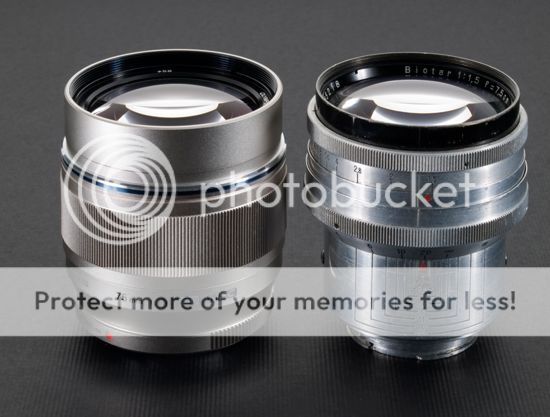




Olympus versus Biotar 75mm lens battle (BHphoto is shipping the lens!).

On left the Olympus lens, on right the Zeiss Biotar 75mm f/1.5.
CSCmagazine (Translation here) posted a crazy comparison between the Super New Olympus 75mm f/1.8 lens and a a lens who’s design is from 1939(!)…the Zeiss Biotar 75mm f/1.5! So if you are curious to see how big a 70 year difference looks check out the image comparison on CSCmagazine. Meantime we have been told by our readers that BHphoto (Click here) has shipped their lens preorders! Finally!
More Lens preorders at Amazon, Adorama, BHphoto, Amazon Germany and Amazon UK.
Olympus Lens alternatives (if you don’t care about the missing autofocus and electronic contacts):
1) Dallmeyer 75mm f/1.9 (Here on eBay). This is an extremely expensive lens and I don’t know why it is so. Only crazy guys would buy that ![]()
2) Leica Summilux 75mm f/1.4 (Here on eBay). Extraordinary high quality lens for an extraordinary price (although it’s still less expensive than the mysterious Dallmeyer). It’s the fastest of all 75mm lenses
3) Zeiss Biotar 75mm f/1.5 (Here on eBay). Fast and also a bit exotic lens made for the Exacta series.
4) Leica Summarit 75mm f/2.5 (Here on eBay). High quality and relatively compact lens. A bit slow compared to the Olympus (f/2.5).
5) Voigtlander Heliar 75mm f/1.8 (Here on eBay). Probably the best alternative of the new Olympus 75mm f/1.8 lens. Same aperture, superb high quality and cheaper.
6) Fujinon 75mm f/1.8 (Here on eBay). This is a very cheap TV lens and I don’t expect the quality to be very good. I wouldn’t buy that unlike your really need that focal length and you have a very low budget.


Darwin
10 months ago |First! I’ve always wanted to do that!
The Master
10 months ago |I’d like to take this opportunity and say that I support you in making an effort to realize your dreams. Ataboy!
Darwin
10 months ago |I could not have done it without your inspiration.
MikeH
10 months ago |Someday we will evolve to not have to do that. You’d think ‘Darwin’ would have been there already.
Darwin
10 months ago |lol… Does it hurt with the stick stuck up there?
Ronan
10 months ago |I don’t know, do tell us Darwin.
Darwin
10 months ago |So witty and original. Must bow to your cleverness. Bravo!
Jordan S
10 months ago |BH photo hasn’t shipped my preorder yet. Hopefully it’s a good sign that we’ll all get the lens soon, though.
Anonymous
10 months ago |Well, the new lens is much better, hardly a suprise. Some people seem to think that technological progress doesn’t apply too lenses though.
jennykicks
10 months ago |this comparison made no sense whatsoever…. the Biotar 75mm was a full-frame lens so would become a 150mm when mounted on a micro4/3 body….a more appropriate comparison would be a fast 35mm or 40mm
southbymidwest
10 months ago |Did I just read that?
yortuk
10 months ago |I know, right? Everyone knows a fast 35mm, e.g. F1.2 would actually be F2.8 on m43 sensor, so there really is no valid comparison, except to conclude that full frame lenses will always be better! They just gather more pixels!
bli
10 months ago |@yortuk: funny, but the question is whether those talking about a correct comparison with the 75/1.8 should be made with a 35-40 mm understand your sarcasm
Bob B.
10 months ago |Of course they would understand the sarcasm. Everyone knows that a 35mm f/1.2 would gather twice as many pixels as the Olympus Micro 4/3′s 75mm f/1.8. It would be great if the full-frame 35mm could just figure out a way to deposit all of its pixels on the MFT sensor……
E-1
10 months ago |Lies! According to equivalence theory FF has a quadrizillion more photons in the lens than m43!
BLI
10 months ago |But if you include Heisenberg’s uncertainty principle, everything becomes… eh … uncertain.
mooboy
10 months ago |Uncertainty principle? Heisenberg needs to grow some balls.
K
10 months ago |WRONG! 75mm is 75mm, olympus even says its 75mm is 150mm equivilent
JHCCAZ
10 months ago |jennykicks,
Your message created a small stir, but so far not a real explanation back to you, so I’ll try:
The 75mm Biotar is the real focal length. The 75mm Olympus is also the real focal length. They are the same in this respect; the magnification on the 4/3 sensor will be the same with either lens mounted. True, this is sometimes referred to as a “150mm equivalent” magnification when comparing to classical 35mm or so-called “full-frame” cameras. But again, the focal lengths and magnification of these two lenses are the same on any camera.
It is also true that the Biotar was originally designed to cover a larger image size than the Olympus, and as I often remind people, that design requirement creates a theoretical disadvantage in achievable resolution.
However, the previous point is really not the limitation or the source of the difference in this case. The issue here is that the Biotar, while an impressive lens in its day, is a very old design, hand-computed, with less advanced glass formulation and primitive surface coating. It may or may not be an issue that telecentricity (parallelism of the exit rays) is also hurting the Biotar performance on a digital sensor; this lens is long enough for that to be _probably_ a minor concern.
I’ll keep saying; no one should be surprised when a modern, high end, _purpose_designed_ lens for a given system out-performs a “classic” lens, or for that matter out-performs even a modern lens designed for a different system.
Mymaco
10 months ago |I just picked it up at my fav local store!
BTW it’s amazing!
jevfp
10 months ago |wow ,i begin to believe this lens is one of the most sharpest lens,.in any lens,.both mirrorless and Dslr,.
i’m waiting for my pre ordered to be shipping,.this weeks,.cant wait ,.to use it for Steve Vai concert at Best Buy theater ,.Times Square ,.
Sky
10 months ago |Should have seen a lens used in Nokia 808. That’s an amazingly sharp piece of glass easily beating this lens in lpm sharpness. Only problem is that… it covers tiny sensor.
- Identical problem is with this lens when you compare it to DSLRs – yes, it’s super-sharp, but noone gives a **** about it in DSLR world as not only it covers just a small portion of DSLR sensor, but also has by far smaller flange focal distance so basically – it’s as relevant for DSLR users as Nokia PureView lens is.
Kasey
10 months ago |I received my 75mm through the Olympus store on Friday. I pre-ordered on May 24th. my Paypal payment expired twice while waiting, so keep on your order to be sure it’s still active! Off to shoot now. It’s so fast to focus, not to mention looks cool on the camera. I just hope it’s all the lens it’s billed to be!
Camaman
10 months ago |Wow that oly 75 is just as big as full frame 75mm…
Who knows if it was partialy designed with larger image circle in mind and finished to use only the optimal center.
Anyway that biotar has just enogh room arount its barrel to implement auto focus gears.
Maybe leica could go for in body AF motor and AF geared lenses.
…maybe in 20 years.
Tim van Vliet
10 months ago |Bought it the other day. Have been playing with it for awhile now and i must say it is impressing!http://www.flickr.com/photos/timvanvliet/7711995292/in/photostream/lightbox/
Tim van Vliet
10 months ago |By the way i got it up at cameranu in Urk Netherlands.They had one what was very nice for me!
ulli
10 months ago |congrats! I do envy you!
BLI
10 months ago |Nice pictures
The Real Stig
10 months ago |Very nice photos.
As we can all see with our own two eyes from your examples, 75mm is obviously way too long for portraiture. What were Olympus thinking?
You and Olympus obviously know more about photography than the fools who think that way. Well done
Horacio
10 months ago |Very nice pictures.
I want to know how far the camera was from subjects in pictures called sample-3 and sample-8.
Thank you
Bob B.
10 months ago |Fun comparison…the Zeiss is very cool looking visually!
ejiop
10 months ago |Not really a fair comparison. It was designed for fullframe sensors and using it on m43 will crop out the center part of the optics.
Therefore when used on a camera it was designed for, the central portion of the images would be sharper, but the corners probably even softer.
It is of course a fair comparison when only adaption on m43 is in mind.
Fish
10 months ago |ejiop,
Why would the image center be sharper on 35mm than on m4/3? I’ve not heard that before.
Bart
10 months ago |135 format (35mm) uses a larger medium and hence requires less magnification for a specific print size. The result is that a lens doesn’t have to provide as high a resolution as on for example the 4/3″ format for the same end result.
So a lens that looks somewhat soft on a m4/3 camera may look nicely sharp on a 135 format camera.
Jon
10 months ago |My Cosmicar 75mm 1.4 C-mount ain’t bad from 2.8 and above. At less than 1/9th the price of the Oly 75mm 1.8, it’s already a winner!
https://lh3.googleusercontent.com/-WoYGgJPc3e8/UBzIe7W3BgI/AAAAAAAADFk/MOGS_qSAQpg/s640/KF1_9892.jpg
Kylberg
10 months ago |I made a similar comparison: Oly 45/1,8 vs Zeiss 50/1.7. The Zeiss was made for Contax and in the 60′s was tested as the best SLR standard lens ever.
Using both on a Pana G3, Oly won in sharpness. In color, Zeiss was the winner. Not least rendering skin tones. The Oly had higher contrast, but in micro contrast the Zeiss was better.
Conclusion 1: The 50 year old lens makes more beautiful pictures
Conclusion 2: Today’s lenses are optimized towards what testers emphasis. Sharpness etc that can be numerically measured and compared. Everybody understands…….
Looking at the test shots, the Oly 75mm is a clear winner. But looking at the real world photos above, the Biotar image is much more “alive” than the Oly.
Conclusion 3: In the 60′s, Leica and Zeiss made, by far, the best “FF” lenses. Division two was CaNikon, division three the rest.
Today, in spite of all lens CAD systems measurements modern Leica and Zeiss lenses still are on top! The produce the best photographs.
Conclusion 4: Beauty is not easily mesured. You must learn and trust your own judgement……
rUY
10 months ago |I have to agree your point, particularly about Contax lens. If you got 50/1.4, it is even better than 50/1.7 in terms of color and sharpness. go and get one, I sure you will love it.
The Real Stig
10 months ago |“Looking at the test shots, the Oly 75mm is a clear winner. But looking at the real world photos above, the Biotar image is much more “alive” than the Oly.”
I would like to see Admin do a poll on this, because to my eyes that is not the case and the Biotar images look horrendous by comparison.
The bokeh in the Biotar image is a complete mess, the colour rendition is off and looks to be subject to a lot of CA
Look at the full rez version of each image of the lavender, with the tip of the in focus frond centre screen. The Biotar image reminds me of what I would expect from a ’90s disposable film camera. That image isn’t alive, it’s a month old corpse.
Kylberg
10 months ago |First: I deliberately did NOT open the full res versions.
The color rendition is very different. – At least on my hw calibrated screen.
I can agree with Sig that Oly wins the bokeh battle.
Lenses for film were designed for that. Contemporary lenses are designed for digital and for the current fashion: Sharp and clean above all! No other image criteria matters……. Well, matters that much
Esa Tuunanen
10 months ago |> First: I deliberately did NOT open the full res versions.
No doubt because any bigger image would show there’s no comparison…
Biotar’s image is as much alive as some lifestyle junkie/wino.
Hardly anything even remotely sharp because optical performance falls apart in front of high resolution requirements of digital sensor and even blurred parts look disturbed and messy.
You sure you haven’t been disposing film development chemicals by drinking them?
You sound little too much addicted to film era.
cL
10 months ago |First, this one is a Carl Zeiss *Jena* Biotar. Very big difference between just Carl Zeiss and Carl Zeiss *Jena*. Zeiss Jena is a lower price version, while still nice, but not as nice as a full Carl Zeiss.
Second, the lens is made for FF. Lots of problem with that when adopting it to smaller sensor cameras. 1) the rear element is too big so diffraction issue will lower resolution. 2) a 4/3 lens needs “twice” the resolution of a FF lens to give the same photo. Most of the old lenses especially do not have not kind of resolving power, because they were designed for films, and most of the films in the olden days don’t have that kind of resolution (only modern emulsion can compete with digital), so most lenses don’t have that type of resolving power in mind.
Third, such an old lens does not have modern coating technology, so CA and flare problems are expected. Again, something that’ll lower resolution significantly.
mooboy
10 months ago |One thing I do find interesting is that a 75mm f/1.5 Designed for 135 film seems to have a similar diameter at the front as a 75mm f/1.8. Can minds superior explain this?
The Real Stig
10 months ago |It implies that the lens is somewhat over-designed in having a larger image circle than necessary, which results in outstanding corner-to-corner sharpness because the ‘real’ corners don’t get imaged on the sensor because they fall beyond it – which is what happens when using 35mm film lenses on M4/3.
That’s my best guess, anyway.
bbking
10 months ago |“Well, the new lens is much better, hardly a suprise. Some people seem to think that technological progress doesn’t apply too lenses though.”
“Not really a fair comparison. It was designed for fullframe sensors and using it on m43 will crop out the center part of the optics.”
Wow. Really? Wow…