



Olympus patent: This may be the bridge sensor to support FT lenses on MFT cameras.

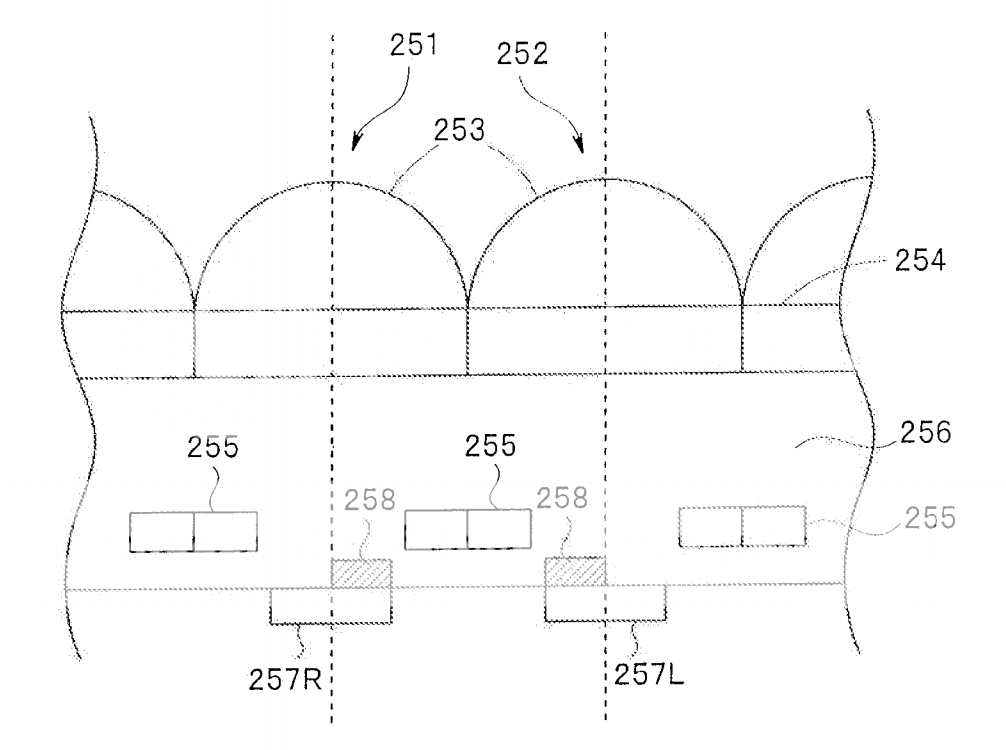
We all know Olympus said they will bring full Four Thirds autofocus support on Micro Four Thirds cameras. And obviously on sensor phase detection is needed to achieve this. But the issue with this is that you have a sort of “waste” of Megapixels because you have to give up some space for the AF pixels. US patent Application Number US20130016274 discloses such a sensor made by Olympus that seems to solve that issue: “To improve autofocusing performance, however, a relatively large number of AF pixels need to be arranged in the image pickup device, and lack of image signal of the AF pixel portions disadvantageously causes degradation of picked-up image quality. For this reason, Japanese Patent Application Laid-Open Publication No. 2007-155929 proposes a technique for reducing the number of AF pixels by using normal pixels to estimate pixel values for AF pixels.”
This may be the right solution for the high end bridge MFT-FT camera


bonzo
3 months ago |I guess that Sony needs that patent since Oly won’t be producing sensors, right?
By the way check that discussion on Pekka Potka’s page:
http://www.pekkapotka.com/journal/2012/10/2/discussion-with-mr-terada.html
james70094
3 months ago |No, Olympus would hve the patent and commision Sony to make the sensors to their specs. This would mean Sony would not be able to produce these sensors for competing companies.
JimD
3 months ago |I don’t think many here understand the origin and ownership of items. For example they accept that epson makes an EVF and it may or may not be used in a camera made by Olympus but its still an epson EVF. On the other hand understanding that a sensor may be designed and made by sony and sold to olympus is one thing. But that a sensor designed by Olympus and made by sony is something total different. One is sony the other is an olympus. Not that it may or may not be the reality of life at this time, but there is a difference.
ted
3 months ago |I think a simple way of explaining how complex a device can be, is the iphone.
As it says on the back, it is designed by Apple in California – but it is assembled in China by a Taiwanese company called Foxconn.
The A6 chip in the iphone is based upon ARM, a CPU spec from a British company called ARM holding. The specific implementation of that design, the A5, is designed by Apple and manufactured by Samsung (yes, Samsung!).
The screen is manufactured by a Japanese company called Sharp. The wireless comms chips are provided by an American company called Qualcomm.
Matt
3 months ago |Patents have little to do with who can use anything. Everyone buys and licenses patented technology from everyone. The point of a patents rarely to keep it secret and close. It’s to make $$$ and the best way is to have someone else make the $$$ for you.
lnqø-M
3 months ago |I think than patent is a solution for a hybrid M43/43 camera, but not a higt end camera if the give more bad IQ.
ted
3 months ago |Not meaning to be rude, but your comment does not make any sense
lmqø-M
3 months ago |LOL is maybe better from PC
I think them patent is solution from hybrid M43/43 camera, but not for a hight end camera so maybe give more bad IQ.
Eric
3 months ago |Ted just meant the grammar was confusing. I assume English isn’t your native language. Not complaining of course, I couldn’t right a grammatically correct non-english sentence if my life depended on it.
Try this: “I think the patent is a solution for hybrid M43/43 cameras, but not for high-end cameras if the pixels used to estimate phase-detect AF negatively impact image quality”.
Probably not grammatically correct either, but I hope that helps.
Esa Tuunanen
3 months ago |Nikon 1 has integrated PDAF but its image quality is considered very good for sensor size.
Camaman
3 months ago |Phase detection on sensor means no IBIS in viewfinder?
Only after pressing shutter?
Anyway I don’t thing IQ degradation would be very noticeable.
zozio32
3 months ago |why would it limit ibis?
pete
3 months ago |It wouldn’t at all…he’s confusing the AF mechanism with IBIS.
explorer76
3 months ago |I think Camaman’s point is that since the AF pixels are on the sensor so if the sensor keeps moving around then it might interfere with the working of the AF algorithm. However Camaman I think that it would be the other way around. IBIS might actually help the AF system by ensuring that successive readings by the AF sensors are from the same part of the scene
camaman
3 months ago |That was the the issue I was referring to.
However I think you might be right, and I am glad I am wrong.
Sensor moves but does so to “see” the same scene and thus can always focus on the points you selected. IBIS helps.
Cool!
Esa Tuunanen
3 months ago |Just like ILIS helps focusing by making image more stable IBIS helps for any form of AF using main imaging sensor as input.
Unlike with separate SLR PDAF (like in 4/3 DSLRs) which doesn’t benefit from IBIS, which neither helped OVF in them.
Camaman
3 months ago |I guess it’s a win win then.
Not a lot of those around.
Still I expect some catch 21 to appear.
Steve
3 months ago |admin, did you see this patent for a 12-40mm f2.8 lens.
http://egami.blog.so-net.ne.jp/2013-03-15
∞
3 months ago |Please don’t hijack comments for off topic discussion
8
3 months ago |Please don’t answer comments you you feel are off topic.
ton
3 months ago |Admin already posted about that topic a couple of days ago…
http://www.43rumors.com/patent-olympus-12-40mm-f2-8/
explorer76
3 months ago |Sony NEX gets not-so-great PDAF performance even with “proper” AF pixels on sensor. I wonder what would the performance be like when the AF pixels are approximated by image pixels.
DAVID MORISON
3 months ago |I’m afraid that Olympus have dug themselves into a big hole with the introduction of the E-M5 and the problems it caused for 4/3 lens owners. I genuinely hope that the forthcoming solution, whatever form it takes, will pull olympus out of this hole but I don’t have a lot of faith at this point. As one who was bitten by the 4/3 lens AF problems and forced to sell some expensive glass to fund a parallel Canon outfit, it will take not only a lot of positive reviews and some personal hands-on testing before I commit myself to significant expense again.
bart
3 months ago |Hi David,
Did the E-M5 cause that problem, or did you for some reason have expectations which it couldn’t fulfill?
AF is slow on m4/3 cameras in general, this was the case before the E-M5 got introduced, and while Olympus did tweak it to get a bit better performance, they have been rather explicit about it NOT addressing the 4/3 lenses ‘issue’.
Hence I fail to see how either the E-M5 or Olympus caused this issue, at best they did not address the issue.
The E-M5 does a bit better then older cameras, especially with SWD lenses, and people were initially positively surprised by that, and have been saying that the E-M5 now focuses 4/3 lenses. Any short hands-on test, or even a short video that demonstrates the focus speed of a 4/3 lens (non CD-AF) will show that it isn’t very useful unless you are dealing with near static subjects. It is marginally better then older cameras, but nothing revolutionary, and if it wasn’t usable on older cameras for your kind of photography, the E-M5 didn’t change that. I don’t know who promised that it did, but neither the camera documentation, nor the statements from Olympus did.
Hence, I’d say it is more a matter of want (I want a proper solution for my remaining 4/3 lenses as well, but I knew the E-M5 wasn’t it, and I had mine only hours after it first appeared in Europe) and reading too much into reviews?
bart
3 months ago |While my post is awaiting moderation, and lacking an edit button, let me post a correction (which you can read before whatever is being corrected…)
“AF is slow on m4/3 cameras in general, ”
Should read AF of FourThirds lenses is slow on m4/3 cameras in general
David Morison
3 months ago |Bart
Let me me first say that my specialty is bird and wildlife photography, including birds in flight. I was well aware from reviews that CDAF is not so good on fast moving objects but that didn’t matter as I still had the E5 which could do a reasonable job with BIF. So I bought the E-M5 because of it’s sensor in the hope that I could use it for more static wildlife with my ED300mm f2.8 and ED 50-200mmSWD. Three problems arose which made the camera no longer the tool of choice using these lenses:
1. Spot AF covered too large an area and was extremely difficult to use on a small bird in a large bush
2. When raising the camera to the eye the delay, even if slight, before the EVF came into operation was enough to sometimes lose a bird which was moving about from the field of view. T
David Morison
3 months ago |For some reason my message posted before I had completed it so here is the full version
Bart
Let me me first say that my specialty is bird and wildlife photography, including birds in flight. I was well aware from reviews that CDAF is not so good on fast moving objects but that didn’t matter as I still had the E5 which could do a reasonable job with BIF. So I bought the E-M5 because of it’s sensor in the hope that I could use it for more static wildlife with my ED300mm f2.8 and ED 50-200mmSWD. Three problems arose which made the camera no longer the tool of choice using these lenses:
1. Spot AF covered too large an area and was extremely difficult to use on a small bird in a large bush.
2. When raising the camera to the eye the delay, even if slight, before the EVF came into operation was enough to sometimes lose a bird which was moving about from the field of view. To add to this when taking a rapid sequence of shots of a bird the subject disappears from view momentarily between shots making it difficult to follow a bird that was moving (not flying).
3. The most serious problem was that using these lenses the focus was inaccurate in 70% of cases even when the camera had locked focus and confirmed!
So I had a problem in that I had the undoubted capability of the E5 but needed the sensor performance of the E-M5, which I still have and enjoy using for landscape and macro. So I decided, after having borrowed a friend’s Canon outfit to sell the E5 and the two lenses to fund the Canon. I’ve never regretted this as it’s performance for bird photography is a revelation.
I have been loyal to Olympus for years and do hope that they achieve something to satisfy the huge numbers of 4/3 users out there with SHG and HG glass still in there bags.
For me I am probably only lingering on the edge of m4/3rds so it isn’t really a big issue.
bart
3 months ago |David,
First of all, I wouldn’t generally use the 50-200 with the E-M5, unless it is on slow or static subjects where manual focus is a good option.
At any rate, the issues you mention:
1. agree about the too-big AF area, through there is a workaround for this by means of the magnified live-view feature.
2. you can simply disable the eye sensor, and eliminate the need for the EVF to switch on
Regardless, with the kinds of subjects you are mentioning, I wouldn’t suggest using an E-M5, it can do it, but if its a major part of your photography, you’ll soon run into the E-M5 not being very good at it.
Your initial statement about wanting some hands-on experience with a camera before buying it is something I rather agree with, and for me it is reason to buy from local resellers. Not only do they let me ‘play’ with things in their shop for a bit, but due to being a good, repeat customer, they have no issue in letting me go outside for a couple of hours, or let me borrow a camera for a weekend to get some hands-on experience.
That all said, I still believe that what you are posting has everything to do with your expectations not being met, and not at all a case of the E-M5 causing problems for 4/3 users. If your expectations had been realistic, tere would not have been any issue.
Dave
3 months ago |David, I’m afraid you are overstating the size of this “hole” Olympus has dug themselves in. They stopped shoveling this hole two years ago, and I stepped out with many other 4/3 users then or shortly after.
You, however, are still inside and wondering when someone’s going to come pull you out. Guess what? You need to pull your head out. Of your hole.
In the meantime, if Olympus puts any more effort into satisfying a very few 4/3 owners looking for an upgrade, they will then be wasting assets and digging themselves a new hole.
David Morison
3 months ago |Dave
Sorry you are incorrect, I am not in a hole myself and don’t need to be pulled out by anybody, as I now have a fully functioning Canon 7D set-up and I know that a new 7DII with 24 mpx will be announced later this year. I value Olympus quality as do many others and I know that many 4/3 users are not totally happy with the performance of the E-M5 with their SHG and HG glass so I hope that Olympus can reach a satisfactory conclusion on this.
I hope this sentence is not meant to be offensive, if it is I feel you will have let yourself down:
“You, however, are still inside and wondering when someone’s going to come pull you out. Guess what? You need to pull your head out. Of your hole.”
Let us remain civil please.
bart
3 months ago |“In the meantime, if Olympus puts any more effort into satisfying a very few 4/3 owners looking for an upgrade, they will then be wasting assets and digging themselves a new hole.”
First you have absolutely no idea about how many owners of 4/3 lenses are left, and how many of those would be in the market for upgrading. Unlike gearheads and equipment collectors, photographers do not replace their camera every couple of months or every year, much more like every 3-5 years. Hence there are very likely quite a few E-520/620/30/3/5 owners around, and not ‘a few’ as you claim. Sure, compared to the number of 550D or D3100 owners its going to be ‘a few’, but that is a totally irrelevant metric, there being enough to make it worthwhile is the ONLY relevant metric with regards to the number of users.
Second, Olympus has a history of aborted systems. Not showing that they learned their lesson from that by ensuring there is a valid migration path from 4/3 to m4/3 means they will reconfirm not being a ‘partner’ you can count on when using their equipment for business. Hence, even if they can only just break even on producing a solution directly, not doing so will ensure many serious users will not consider Olympus equipment.
bart
3 months ago |@admin and others
Phase detection is NOT needed for focusing FourThirds lenses on a m4/3 camera.
What is needed is 2 things that phase detection provides, and for which phase detection is the only publicly known way to get those things in a somewhat generic way:
1. should focus move back or forward to obtain best contrast
2. how far should it move
There exist known alternatives, but those are less generic. The best known alternative is called chromatic defocus, and is used by some animals (especially certain frogs) to figure out the exact distance to objects (prey, something they want to jump on, etc). Olympus does have a patent on an electronic version of this idea, but there are some issues with a generic implementation, specifically that the measured defocus (the info on how and how much focus should move) is highly dependent on the optics, far more so then for phase detection.
Anyway, it might well be that Olympus or someone else figured out yet another way to get those 2 bits of information, but didn’t publish it yet (or we simply did not manage to spot the patent yet).
Jesse Brauning
3 months ago |IBIS and 24p and I will buy this camera. Olympus has never put 24p in a camera yet, right? Curses.
[ Patent ] One step closer to supporting SHG lenses on MFT cameras.
3 months ago |[...] [...]
Es
3 months ago |Why would Olympus flood the m4/3 market with a ton of cheap, used lenses that have perfect autofocus? It doesn’t make economic sense.
Everett
2 months ago |A patent that proves you CAN tell by the pixels