






(UPDATED) E-M5 at Amazon! E-M5 dynamic range test explained…

The Black E-M5 with 14-42mm kit lens is now in Stock for the normal price at Amazon US (Click here to grab the deal). And it’s selling that good that is damn close to dethrone the NEX-7 from the first place of Amazon mirrorlress ranking (Click here). While it already dethroned the NEX at Amazon Germany (Click here).
UDPATE: It is now alreayd SOLD OUT
And now an updated about the Techradar E-M5 test results I linked last week:
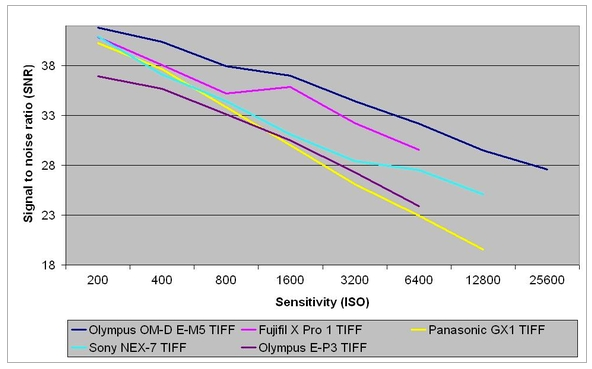
The surprising RAW Signal to Noise ration chart from Techradar.
Last week I posted the graph from Techradar showing that the E-M5 has the best RAW dynamic range and noise handling. yes, even better than the Fuji X PRO 1. But as I told you many times you always be aware that there are so many variables that influence test results that you really have to be very careful. I asked Techradar to explain me their test procedure and they gave me that link (Click here).
I have two more doubts:
1) The super German experts from Digitalkamera DIWA lab (Click here for the translation) discovered that the real sensitivity of the E-M5 starts with ISO 120 (when the camera is set at ISO 200) and ends with ISO 14.200 (with the Olympus setting being at 25.600).
2) It’s known that there are not decent RAW converters for the Fuji X Pro 1.
Anyway, we are talking about small differences. The E-M5 is a damn good camera and it will not change the essence of your photography skills to know that it is a tack better or a tack worse than the Fuji


JF
2 years ago |Excellent thing if the real base ISO is 120 !!
metalaryeh
2 years ago |+1
OM-4ever
2 years ago |Got the last one! Cancelling my preorder (since 2/7) for the black body. Lucky to get one, it seems…..
Dummy00001
2 years ago |I know people here like WA lenses:
http://boingboing.net/2012/04/23/giant-6mm-nikon-fisheye-for-1.html
bilgy_no1
2 years ago |Base ISO120… Not again this discussion please!!!!
Ranger 9
2 years ago |“But as I told you many times you always be aware that there are so many variables that influence test results that you really have to be very careful” … “I have two more doubts” … “It’s known that there are not decent RAW converters for the Fuji X Pro 1.”
And again I ask: If someone had published test data showing that the X-Pro 1 was BETTER than the E-M 5 (or whatever) would you feel compelled to voice all those doubts? Or would you simply accept them without comment, because that’s what you already were predisposed to believe?
I suspect this is simply confirmation bias in action. The fact is that these types of caveats are appropriate for reading ALL test data.
El Duderino
2 years ago |For me, I don’t care if it’s better or not. I just like the E-M5 for what it is. Sure I’d be jazzed if it was better I guess, but the body of the Fuji alone is $750 more than the olympus. Not to mention the lenses are a lot more too. So if I got nearly as good, or a little less than the XP1, I’d be happy.
Plus the OM can focus, which seems difficult to say the least for Fuji to master.
Ernest.orf
2 years ago |Hell yeah el duderino , im reall good with my em5 , i will never pay for fuji lenses while i have me old zuiko 50mm 1.4 ^^
Vlad
2 years ago |Talk about overreacting. What you call “bias” is the simple fact that it is just more plausible for the X-Pro to have better DR, given the bigger sensor and the many reviews praising its IQ.
JimD
2 years ago |Photographs are made to look at.
The eye is used to look at photographs.
The eye is the judge of a photograph in all its aspects.
Can any one deny this?
Camaman
2 years ago |So top iso is 10000 less really?
There goes that one stop improvement if other cameras report it correctly! LOL!:-P
Atle
2 years ago |No it doesn’t
bilgy_no1
2 years ago |See my post above… sigh…
JimD
2 years ago |So what.
The proof is. that it takes better pix (or as good as) in the dark than most of the others, DSLRs included (not all but most).
Who cares if you call it ISO or magic.
Fact is the results show.
If its so far out how come Steve Huff (and many others) takes a shot with both em5 and Fuji Pro1 with the same settings and the shots have the same exposure.
OK how.
So what does it matter.
Zetton
2 years ago |Its good timing to think about DXO test for me, because I am thinking about how the test is very long time.
I have an experience with digital audio engineering. In that, Dynamic range is equal thing of S/R (in Analog audio, they are different).
Anyway I also want to know how measurements are achieved, but I’m not satisfied with the answer that 43 rumor got and post here…
A/D converter has two major characteristics: dyadic range (same as S/R in digital world), and linearity (how precisely digitized for every input level. i.e. a analog input to a digital bits is correctly encoded or not. in sound, linearity infuences the sound distortion ration. dynamic range is directly same as S/N (ideal dynamic range is aprox. A/D bit number x 1EV or x 6dB )
This should not ” camera ” or “audio recorder”, but this is desecrate mathematics and digital signal theory.
but I’ve read every dxo test, but I can’t image what they explain…
somone, give me the precise defitions for DXO’s Dynamic range, SNR for RAW, JPEG, TIFF, etc…
Bart
2 years ago |There is more to S/N ratio and dynamic range then the specs of your A/D converter. In case of audio this may be easier to understand, every step before A/D conversion also affects dynamic range, such as the (analog) microphone and (analog) amplifier used for a recording. The A/D converter (and its resolution) and the digital signal processing that follows it, is usually not the limiting factor in this.
Additionally, the entire process is non-linear and the relationship between light sent at a sensor, and the actual value recorded in a raw image is expressed by curves, which differ between cameras, and even more between manufacturers.
Because the signal is also processed with analog means before it ever gets converted to digital, you cannot use digital signal processing theory exclusively when looking at sensor performance.
Zetton
2 years ago |Add more.
The graphs.
x axis. for exampe. first “vertical line” is 300? 200? 500? it’s not what scientific or engineering person writes…
and no “unit” sometimes in some axis. Above graphs. 36 what? 36dB? 36 mW? just an ratio 1:36 ??? (I don’t think 36 EV…)
X axis is OK, because it is said as ISO. but notch (small vertical line )and number relation is very vague…
babbit
2 years ago |The x-axis vertical lines do not mean anything. This is a scatter graph where the x,y points are directly above the labeling…i.e., for ISO 200, the point is above the middle “0″. Plenty of scientific papers and engineering white papers use the same style of graphs. Because the x-axis scale is not linear but the lines are linearly spaced, it has no meaning in terms of trying to intepret the graph.
The y-axis is SNR (signal to noise ratio). There are no units. If you want, you can make it in dB if you want logarithmic units.
Jb
2 years ago |Crazy Comparison High ISO and Exposure! Olympus OM-D E-M5 vs Fuji X-Pro 1 vs Sony NEX-7 – JPEG
http://www.stevehuffphoto.com/2012/04/20/crazy-comparison-high-iso-and-exposure-olympus-om-d-e-m5-vs-fuji-x-pro-1-vs-sony-nex-7-jpeg/
E-M5 have the better AF system, the fastest and most effective
Charlie
2 years ago |I wouldn’t order w/out the weatherproof zoom lens, personally.
Bart
2 years ago |MMF-3 and a 14-54mk2 (4/3 mount) will do quite fine. Obviously if you don’t have that lens, then the 12-50mm kit lens is a very nice option, offering faster AF and a bit better ‘wide angle range’, but the 14-54mk2 has a faster and very nicely rounded aperture, and better optical quality, and is CDAF enabled and offers pretty decent AF speed still.
So… I’d say it rather depends.
OldAlaskan
2 years ago |I overlayed the Oly E-M5 SNR range curve onto the graph after adjusting for the reported sensitivity measurement. The “real” E-M5 SNR curve matchs the Fuji X Pro1 quite closely. The E-M5 extends further to the left and right but other than that the only difference is that where the Fuji has a dip at ISO800, the E-M5 does not.
At “true” ISO800, the E-M5 has about a 2/3 stop advantage over the Fuji and a 1 stop advantage over the Sony NEX-7
Regarding the vertical scale: It would be more user-friendly if the divisions were every 3 dB since that corresponds to 1 stop.
Kenny
2 years ago |17th St. Photo has some 14-42mm black kits in stock:
http://www.17photo.com/ProductDetails.aspx?SKU=V204041BU000
edit: found via dpreview forum