



Olympus 75mm gets DxOmarked. It’s the best MFT lens yet.

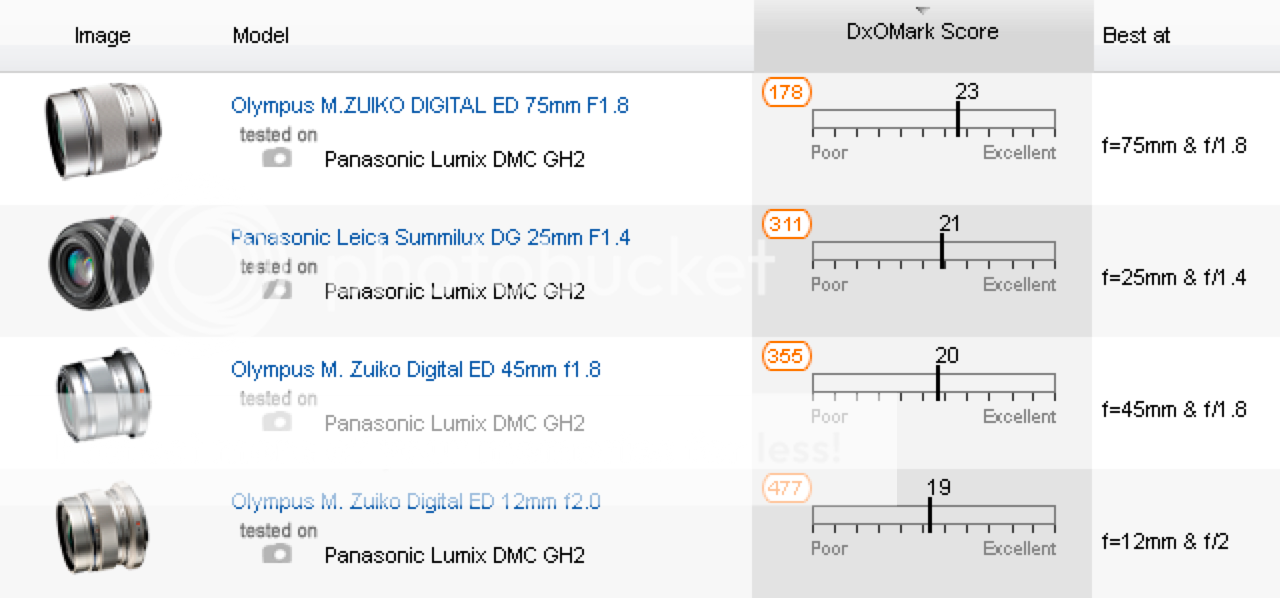
DxOmark (Click here) tested the Olympus 75mm f/1.8 lens and writes that this is the “best lens DxOMark have tested for the Micro Four Thirds hybrid camera system.“. The only downside is the relatively high price: “If the high cost of the Olympus M.ZUIKO DIGITAL ED 75mm f/1.8 is out of reach then Micro Four Thirds photographers will be pleased that the cheaper $400 Olympus M. Zuiko Digital ED 45mm f1.8 is a good alternative. As we’ve seen it’s not as sharp as the 75mm version and edge sharpness is inconsistent, but it represents better value if budgets are squeezed.”
I guess nobody here had ever a doubt that this is the best available MFT lens. The real annoying part may be the high price of the extra hood. But that’s an easily to solve inconvenience. Just buy a third party hood at n US ($7 on amazon), US ($32 better quality), Germany (ebay) and Hong Kong (ebay).
The lens itself can be found at Amazon, Adorama, B&H, J&R, eBay.
—
Olympus 75mm f/1.8 Lens alternatives (if you don’t care about the missing autofocus and electronic contacts):
1) Dallmeyer 75mm f/1.9 (Here on eBay). This is an extremely expensive lens and I don’t know why it is so. Only crazy guys would buy that ![]()
2) Leica Summilux 75mm f/1.4 (Here on eBay). Extraordinary high quality lens for an extraordinary price (although it’s still less expensive than the mysterious Dallmeyer). It’s the fastest of all 75mm lenses
3) Zeiss Biotar 75mm f/1.5 (Here on eBay). Fast and also a bit exotic lens made for the Exacta series.
4) Leica Summarit 75mm f/2.5 (Here on eBay). High quality and relatively compact lens. A bit slow compared to the Olympus (f/2.5).
5) Voigtlander Heliar 75mm f/1.8 (Here on eBay). Probably the best alternative of the new Olympus 75mm f/1.8 lens. Same aperture, superb high quality and cheaper.
6) Fujinon 75mm f/1.8 (Here on eBay). This is a very cheap TV lens and I don’t expect the quality to be very good. I wouldn’t buy that unlike your really need that focal length and you have a very low budget.


Brian
4 months ago |They haven’t tested the P20 yet though!
camaman
4 months ago |P20?
El Aura
4 months ago |Presumably the Panasonic 20 mm f/1.7.
Cheng
4 months ago |begin sarcasm
oh that was so obvious!
end sarcasm
The purpose of language is to communicate. If people cant understand what you mean, then you aren’t communicating.
Chris
4 months ago |Don’t be rude. Here on the Internetz that’s the quick way to refer to Micro 4/3 lenses. P20 is a Panasonic 20mm, PL25 is a Panasonic/Leica 25mn, etc. If you don’t understand something try Googling it next time instead of going straight to being rude.
The Real Stig
4 months ago |So 20+ people reading this should have to resort to DuckDuckGo in order to find out what the bone-lazy person meant – a shed load of effort that would have been saved if the person attempting to communicate had just typed a few more characters?
I don’t agree with you.
Ulli
4 months ago |I thought he was referring to Hasselblad, that P20 module…..
Anonymous
4 months ago |The 12-35mm F2.8 and 35-100mm F2.8 could be very close to it. Sharpness isn’t everything though. I would much rather have a useful zoom range and IS than a bit sharper lens.
kavat
4 months ago |sorry but there is a huge difference in image quality. The zuiko 75mm is much sharper than the overpriced lumix zoom.
Pat
4 months ago |not really, Having shot on both and bought the 12-35. I think the 12-35 is amazingly sharp.
Anonymous
4 months ago |I want to see it tested on the GH3. The GH2 is over two years old now.
bRinda
4 months ago |it doesn’t matter as there has been no increase in resolution between the GH2 andGH3 or the E-M5 and has bee mentioned by a couple of posters already. Four times the the mp doubles the resolution so we need to go from the 12mp sensor to a 48mp , as we have only moved to 16mp it ain’t a big deal.
Garypen
4 months ago |bRinda – Of course it matters. There is a huge jump in IQ between the GH2 and GH3 or EM-5.
JimD
4 months ago |Once its on a camera the only test is the personal visual image test (called eyes, once upon a time). A lens test should not include a sensor. The lens test is a stand alone. Once the test of a lens is on a camera sensor, it is no longer a lens test. It might be nice to see some combinations but, that is all its nice.
Anyway, tests are mainly irrelevant. What the eye sees of what the photographer took and intended is all that matters.
Print any bods shots at different sizes and you will get different results. Put them on social media and nobody ( that is 99.9% ) will ever know what lens or camera were used.
hfhi
4 months ago |For any lens test the one stop advantage of the newest mFT sensors is irrelevant as it has no effects on the lens They are all 16mp sensors {the one criteria that can effect resolution }so it makes absolutely no difference be it GH2 -GH3 or E-M5 .As it is a lens test thus testing lens criteria such as transmission etc which is not sensor dependent.
Bob B.
4 months ago |I have no faith in anything that DxO has to say about anything. …but I own 9 MFT lenses, the 75mm being one of them.
The 75mm is definitely the sharpest MFT lens that I own. It truly has WOW factor. The 20mm is good ..but no WOW! LOL.
Fish
4 months ago |Can anyone explain why it looks like this lens is still so far from “excellent” on the DXO chart? Most reviews have rated it much better than that.
Reggie
4 months ago |Go on to the site, and compare it to the Sigma 35mm f/1.4 for Canon mount (one of the top lenses that they have tested). You can immediately see where it got its low score. The Sigma Gets an excellent score on a 5D MII, but the biggest difference is sharpness. The way that they measure sharpness is largely dependent on the sensor. It’s based on the number of perceived MPs resolved. Higher resolution camera in their tests = more sharp. Change the camera tested on to a Canon 30D for the Sigma, and the overall score drops to an 18 (from a 30, and now lower than the 23 the Oly got).
Add to that the “Transmission” which is the actual amount of light transmitted when wide open. This score is stupid to include in the overall test score, to me. It means a 1.4 gets a lower score than a 2. But of course it transmits less light, you EXPECT it to. I think that score should be relative to the advertised f-stop, not an absolute measurement.
But again, the real reason is the sensor it’s strapped to. DXO scores are fine, but the topline scores are pretty meaningless, in all cases with DXO, sensor and lens, you really have to dig in to get the meaningful data.
Betiko
4 months ago |Reggie: “The way that they measure sharpness is largely dependent on the sensor. It’s based on the number of perceived MPs resolved. Higher resolution camera in their tests = more sharp. ”
Could you explain why the combination Nikon D700 + 85mm 1.8 has better score than Oly 75mm f1.8?
Archer Sully
4 months ago |I think that Reggie is mistaken: it isn’t pixels that matter to DxO, but sensor size. 4/3′s is always at a disadvantage relative to APS-C, which is in turn at a disadvantage compared to 135.
Betiko
4 months ago |Ok, but in this case the pixel density gh2 is bigger than pixel density in D700 which requires more sharp lens! DxO labs testing methods are prepared for Nikon/Canon. There is no normalization of the results which is strange.
Reggie
4 months ago |Sensor size is not relevant:
“P-Mpix is the unit of a sharpness measurement. The number of P-Mpix of a camera/lens combination is equal to the pixel count of a sensor that would give the same sharpness if tested with a perfect theoretical optics, as the camera/lens combination under test.
For example, if a camera with a sensor of 24Mpix when used with a given lens has a P-Mpix of 18MPix, it means that somewhere in the optical system 6Mpix are lost, in the sense that as an observer you will not perceive the additional sharpness that these 6Mpix should have added to the photos if everything was perfect.
In other words it indicates the ability of the lens and other optical components of a camera to utilize, from a visual perspective, the number of pixels of the camera sensor. P-MPix expresses the result using a figure that can easily be compared to the camera sensor’s MPix figure to show the quality of the lens.
This measurement bypasses the problems inherent to MTF:
Describes resolution with a single number,
Correlates with the way the human vision perceives resolution
Uses a unit that is well-known to photographers — the megapixel.
The result is a more easily understandable measurement for users that makes comparisons between camera and lens combinations very simple: the higher the Perceptual MPix score, the better the perceived resolution.
Photographers of all types can relate to megapixels, as it is a figure that camera manufacturers provide to describe the resolution of their cameras’ sensors.”
GRaey.o j
4 months ago |you are exactly correct Archer the resolution advantage of larger formats is a well known fact. The pathetic need for some mFT whiners to try and claim the format and lenses as the best is embarrissing for those of us who are not retarded .Reggie is a well known DPreview nut job using a different name
Reggie
4 months ago |lolwut? I don’t think that I have ever posted on DPReview (I could be wrong, but I don’t think I have). And while I do own a GF5, I also have a D3s. I think I appreciate the advantage of sensor size. But the P-MPix measurement used by DXO is based on perceived megapixels, I was QUOTING the explanation FROM DXO.
HUybko
4 months ago |The sensor to resolution ratio is well established and explains why the FT and now mFT lenses have to be double the lens resolution to attempt to match the resolution of a FF lens on a FF camera . The D3s is naturally optimised for Its high Iso output. Think about it logically if pixel density had anything to do with it the P&S cameras would have spectacular resolution numbers .
Betiko
4 months ago |The approach of DxO “labs” to compare D3X and middle level Lens 85mm f1.8 with GH2 with Pro level lens – 75mm 1.8 looks like comparing apples to oranges?
Look at these professional level Lens tests:
http://www.lenstip.com/333.4-Lens_review-Nikon_Nikkor_AF-S_85_mm_f_1.8G__Image_resolution.html
http://www.lenstip.com/351.4-Lens_review-Olympus_M.Zuiko_Digital_75_mm_f_1.8_ED_Image_resolution.html
Also test results without samples that prove the results is a real joke!
ProShooter
4 months ago |And you’re a well known nutjob and whiner everywhere on planet earth. I dare you to prove me wrong.
Reggie
4 months ago |Got me there, can’t disprove that.
I just find it hilarious that the nutjob comment was in response to me Copying and pasting a QUOTE from DXO to describe their metric. I mean, can’t get crazier than that, I guess.
hsusb
4 months ago |sensor size is a vital component of output resolution as we are combining a sensor plus a camera. Just to compete the mFT lens needs double the resolution and look to the photo zone links below to show the difference that sensor size means to the resolution of a lens when mounted on different sized sensors. The physics behind this is so basic I honestly don’t see how anyone can argue about it. The DXO test is a reflection of how we actually take photographs namely lens + sensor = image. The tests that just test the lens in isolation is a waste of time as far as I am concerned , as I am not interested in comparing bits of glass, I am interested in output as I suspect are most photographers.
Reggie
4 months ago |It certainly has an impact, but it’s more nuanced than bigger sensor = more resolution (as all other things are rarely equal outside of the lab). I have found that DXO tests are not at all a reflection of how we take pictures (at least their topline scores).
I don’t shoot in a studio, so a lot of cameras that “beat” my D3s, According to DXO, in things like dynamic range, don’t actually beat it in dynamic range at the ISOs that I often shoot at. Comparing the D3s with the Phase One IQ180 Digital Back, the PO beats my camera in dynamic range and color depth. However, the D3s has surpassed that sensor by ISO 200 in DR, and by 400 in color depth. Nuance.
Lenses are the same way. Their sharpness is often way off. I use a 14-42 all the time on my GF5, and it gives me perfectly acceptable shots. But I unloaded my Sigma 24-70 because I found it too soft. DXO rates that lens as being crackingly sharp on my camera, but when you dig in, you find that the sharpness is in a very narrow aperture range. I got the lens to shoot wide open, and it’s soft wide open. You won’t see that in the topline score of the lens, you have to look at more data.
bRinda
4 months ago |the only data set being measured by DXO is in effect output resolution which is what matters . MF lenses are relatively poor due to the converse of mFT being true namely their lenses need much lower resolution compared to FF lenses to achieve the same results. Other sensor dynamics are a different matter and dependent on a number of factors MF sensors are not that clever compared to the best FF sensors as they are optimised for low ISO obviously there has been much more development of smaller sensors and they are in fact far more efficient than MF alternatives.
Betiko
4 months ago |Because of the company name. Nikon is better by default!
DxO has written in conclusion: “If you’re a convert to the smaller and lighter Micro Four Thirds cameras then the Olympus M.ZUIKO DIGITAL ED 75mm f/1.8 is excellent, but to put it into some context it’s not in the same league as other portrait lens and camera combinations. Take for example the Nikon 85mm f/1.8G mounted on a Nikon D3X lately reviewed.” If you choose even the 12 MPix d700 the
Nikon 85mm f/1.8G has better score. According all other serious testing sites(LensTip.com, SLRGear.com) Oly75mm f1.8 is the better lens. I think that all testing methods of DxO are funny!
Milan
4 months ago |That’s why I always prefer sites that actually show the pictures. Here from SLRgear.com, the Oly 75mm 1.8 (wide open) on an E-P1 and the Nikon 85mm 1.8 (also wide open) on a D7000:
http://img5.imageshack.us/img5/8445/snapshot51.png
lmqø-M
4 months ago |Agree,…LOL
PeterMh
4 months ago |To be fair the D7000 will have much lower resolution than a FF model like the D800/D3x , there is also the DOF issue fro comparing different formats at the same relative aperture is not very reliable.
bart
4 months ago |DOF only plays a role when testing with a subject that has some ‘depth’ instead of some flat surface or test chart.
Homerj
4 months ago |@Bart , in theory this is correct but the reality is you are not comparing the same thing when looking at an mFT lens compared to a lens on FF as you are in essence comparing the FF lens at an effective aperture that the mFT cannot match. The FF camera at F3.6 will allow in exactly the same total light and have the same DOF as the mFT lense at F1.8. It is because of those variables that all the major test sites point out the errors of comparing cross system.
If I was wanting to compare an mFT camera to a FF camera I would have them both set up to give the same AOV and DOF as that is how I would take the images in real life. I don’t want to know what one is like with half the DOF or double the DOF . The objective is the final image and if you want to waste time comparing different systems why would you compare them at such different settings. It is just as silly as comparing different AOV
Ulli
4 months ago |Homer, ok, if you compare the camera/lens combination you prefer to use the same aov and dof on both systems. For me, i prefer the use the dof setting i always use when shooting, which is shallow. So if i must compare 85 mm (one of my fav FL on both 24×36 and MFT) on those 2 systems, I set both wide-open, as it gives me the setup i use on whatever platform for object isolation. Thats why i never care much about clinical lab testings and prefer photos done by photographers who are into people/model photography as well, as those give me more easy to understand results/info if the lens could suit me (though i must admit that great artistic content/talent can even make a poor lens look good, a trap easily taken, depending on your own talents….)
bart
4 months ago |For a resolution test having the same aperture diameter is pretty much irrelevant until diffraction becomes the limiting factor for resolution.
I agree with what you say about comparing cross system at least when it comes to comparing resolution measurements and the like. While you can achieve approximate equivalence if you try, it will never be exact (distribution of DOF in front and behind the plane of sharpest focus changes subtly with focal length and independent of field of view to name one reason why equivalence is not exact, tho usually good enough for practical purposes).
The main issue however in my opinion is that comparing systems by trying to eliminate the differences is an exercise in futility. Its in my opinion much more useful to focus on and try to exploit those differences and see what is the most useful for your own photography. For the large majority of pictures, the differences that exist between systems using equivalent field of view and dof and use a similar level of technology are small enough to be irrelevant.
However.. DXOmark was supposedly testing lenses, and well, uses a scale that is seemingly used for all systems instead of one that allows for comparison within the system, and then state a conclusion that is contradicted by lots of real photographs.
As an aside, total amount of light is irrelevant for exposure, brightness is what counts. Not from a mathematical point of view, but if a photographer uses an external light meter or flash meter, its all about brightness, and there all that counts is relative aperture.
Betiko
4 months ago |You are right. Very good example!!! Middle level lens(85mm) vs Pro level oly 75mm!
hsusb
4 months ago |@ Betiko , Milan the resolution advantage of FF at output is very well known , an image is a combination of sensor plus lens .The sites that test the lens in isolation of a sensor serves no purpose as they have to be mounted on a camera. For obvious reasons just to compete with a FF camera a mFT lens must have double the resolution of a FF lens on a FF body. THis has nothing to do with your fanboy nonsense claims of bias from DXO but rather a simple matter of physics.
By the way Milan you do know a D7000 is a DX camera which does not share the same advantage as a FF. Do you guys honestly think that the tens of thousands of pro photographers using FF do it for fun.
example 85mm F1.8g
FF max resoloution 3872 LW/PH
http://www.photozone.de/nikon_ff/717-nikkorafs8518ff?start=1
same lens on D7000 max resolution = 2759 LW/PH
http://www.photozone.de/nikon–nikkor-aps-c-lens-tests/718-nikkorafs8518dx?start=1
these camera + sensor results are the only results that matter. The 75 mm is still a fabulous lens and the best performing lens I have ever had, just because I use mFT doesn’t mean I need to be blind to physics.
Spencer Salva
4 months ago |I’m curious, how exactly do other sites do a lens test without a sensor involved? All the tests I’ve seen have involved photos, which I believe require a sensor. I’d like to know who’s testing lenses without a camera so I can stay away, plus I’m somewhat intrigued by this process, which I will call ‘magic’ for lack of a better term.
HKj ,
4 months ago |the images shown are just to give you a visual indication of how the camera looks .
bRinda
4 months ago |here you go spencer , optical benches , MTF calculation etc
http://www.photonics.com/Category.aspx?CatID=41780
Ulli
4 months ago |I believe FotoMagazin test lenses by putting them on a special projector device since 2004.
JimD
4 months ago |Tests based on images from the camera are full of induced errors.
Look and then how its done with lens only and lots of gear.
At http://www.trioptics.com/imagemaster/description.php
Download and watch the second of the downloadable videos (MTF Testing with ImageMaster® Universal). Its very interesting.
The tests show the lens functionality with no sensor.
An explanation of MTF can be found at http://www.lensrentals.com/blog/2009/06/have-you-seen-my-acutance for MTF
And a video at http://www.youtube.com/watch?v=1VgqsMqBpKc This video is excellent.
Salty
4 months ago |Can anyone recommend something a little longer than 75mm in cheap/commonly available and relatively compact?
I quite like the idea of a fast prime for gigs
sneye
4 months ago |The Samyang 85/1.4 may be a good option, although it’s heavier, bulkier and manual focus. Still relatively small and rather sharp.
Salty
4 months ago |Thanks, sorry yes I meant manual focus older lenses.
I’ve got the 20mm 1.7 and 45mm 1.8, this 75mm looks lovely but too much money for me and none of the telephoto zooms are very appealing
neonart
4 months ago |There are bucketloads of 50mm lenses that make great portrait lenses on 4/3. One of my personal favorites is the Hexanon 50mm f1.7.
Salty
4 months ago |Not much point for owners of the 45mm 1.8 though eh?
bro
4 months ago |Olympus Zuiko 100mm 2.8 and 135mm 2.8 are both good lenses, the 100mm isn’t very big, sells for $150-200-ish on ebay. Zuiko 135/3.5 is small too and very cheap.
You can find a lot of M42, FD, Nikon, etc lenses in the 85-135mm range as well, but the Zuikos tend to be a bit smaller. You have to go to rangerfinder lenses to get much smaller than the Zuikos, at that point the price is generally a lot higher.
Though the russian Jupiter-9 in M39/L39 leica thread mount is both fast, small and not too expensive at $150-200-ish.
Salty
4 months ago |Thank you, will look at those.
Ranger9
4 months ago |Until I got the 75, I used a 100mm f/2 Canon rangefinder camera lens in Leica screw mount, with an adapter. More compact than most SLR lenses of same focal length/speed, balances well on M4\3 camera, pretty sharp even by today’s standards although lower in contrast. Not necessarily easy to find, though. Caveat: The 75mm Olympus is so sharp that you might still get better overall image quality by shooting with it and cropping.
Fish
4 months ago |Congrats on the 75mm Ranger, I am still trying to justify getting it over the 60mm.
MarcoSartoriPhoto
4 months ago |Sharpness sharpness sharpness! Here are three of my fav shots taken with it. jpegs out of the camera.
http://m.flickr.com/#/photos/marcosartoriphoto/8352655273/in/photostream/
http://m.flickr.com/#/photos/marcosartoriphoto/8340825235/
http://m.flickr.com/#/photos/marcosartoriphoto/8327489820/
JimD
4 months ago |That’s a great set. Love the courtyard shot. The iron lace and steps is just perfect.
Who needs a test. Especially when the test result is going to be different from each tester. And some include a camera? horror of horrors!
The ultimate test tool? The eye.
Anyway when and image is adjusted for social media nothing matters any more.
Just like a 50-50 shandy, any beer will do. With 50% lemonade who will tell.
Salty
4 months ago |Thanks will lookout for the 100mm f2
Ulli
4 months ago |Salty, I hear the best 85 mm for little money is the Jupiter 85mm f/2.
prices varies from around 15 euros in Russia to 50-100 euros in other countries. and its very compact too.
Salty
4 months ago |Thankyou I’ll have a look. Hard to find bargains now. The days of finding a great lens cheap in a charity shop have gone it seems.
Ranger9
4 months ago |Admin’s “alternatives” plus my comments, which I’m going to keep posting everytime this boilerplate appears:
1) Dallmeyer 75mm f/1.9 (Here on eBay). This is an extremely expensive lens and I don’t know why it is so. Expensive solely because of collector interest. Not worth it for actual use.
2) Leica Summilux 75mm f/1.4 (Here on eBay). Extraordinary high quality lens for an extraordinary price (although it’s still less expensive than the mysterious Dallmeyer). It’s the fastest of all 75mm lenses. Whether it performs better than the Olympus on a M4\3 camera is highly debatable.
3) Zeiss Biotar 75mm f/1.5 (Here on eBay). Fast and also a bit exotic lens made for the Exacta series. Very, very soft and flarey except in the very center at f/2.8 and below. Pretty effect, but more of a special-purpose lens (e.g. misty nudes and hazy portraits) than a general-photography optic. Also, these are EAST German (pre-unification) Zeiss lenses, so don’t expect them to look or feel like a modern Carl Zeiss optic — the aluminum barrels tend to be kind of nasty.
4) Leica Summarit 75mm f/2.5 (Here on eBay). High quality and relatively compact lens. A bit slow compared to the Olympus (f/2.5). More expensive, less convenient, and no better performance than the Olympus. Why buy it?
5) Voigtlander Heliar 75mm f/1.8 (Here on eBay). Probably the best alternative of the new Olympus 75mm f/1.8 lens. Same aperture, superb high quality and cheaper. Per the US importer, this lens is specifically designed to be soft at full aperture for portrait purposes; sharper once stopped down. If that’s what you need, great. If not, it isn’t really an “alternative”.
6) Fujinon 75mm f/1.8 (Here on eBay). This is a very cheap TV lens and I don’t expect the quality to be very good. I wouldn’t buy that unlike your really need that focal length and you have a very low budget.?
admin
4 months ago |Leif
4 months ago |DxO is still testing MFT lenses on the old GH2. Also their new score types are a bit confusing. Wouldn’t care that much about their tests.
hsusb
4 months ago |@ Leif , did you not notice that the GH2 is also a 16mp the E-M5 or GH3 have no higher resolution , FF lenses on FF sensors are always at an advantge. The E-M5 is less than one stop better than the GH2 any way.
JF
4 months ago |I’d like to see 12-35 f2.8 and 35-100 f2.8 tests.
hsusb
4 months ago |I cannot speak for the 12-35 as I do not have it , however my 75 mm is noticeably better than the 35-100 I also own not that it is not a very good performer . it would be a surprise/ shook if the zoom outperformed the 75mm
Pat
4 months ago |I dont think it will outperform it, but in my testing, the 12-35 is very very sharp. as good or better than my L25
jules
4 months ago |Whatever 3 points ahead of the 45mm or 2 points ahead of the 25m means, my feeling is that it err on the academic side. It does confirm the quality, tho.
dave
4 months ago |I would really like to see both the Olympus 60mm f2.8 marco and the Panasonic 20mm f1.7 compared to the listed lens.
The Panasonic has been very popular, and recommmend as one to own, so I’m surprised that it has not been reviewed as yet.
Many reviewers have said that the 60mm f2.8 is as good as the 75mm, so I would like to see how it technically compares.
Thanks
Abraham
4 months ago |MTF scores are much better for this type of thing. DXO will test the lens body combo then never update it. These scores are very much MP dependent due to the sensor used.
HKj ,
4 months ago |To double resolution on a given sensor size you need to quadruple the number of MP , thus the difference from 12mp to 16mp is insignificant enough to be unimportant. Plus the mFT lenses on DXO that I have noticed seem to be tested on the GH2 with its 16mp sensor. The results of the NIkon lenses will have somewhat higher resolution on the D800 but nothing like some people imagine.
I do not see any 64MP mFT cameras on the horizon and even if there was you would need the lens to be far far higher in quality to hope to utilise all the extra resolution. 64mp on mFT is the same pixel density as 245mp on FF.
Abraham
4 months ago |But you are talking about pixel density not resolution. A 12mp ff body vs a 12mp m43rds body with lenses that resolve comparably on for their respective sensors would achieve equal scores.
If you compare a 16mp sensor vs a 24mp sensor you begin to skew the resolving power of the lens in favor of the higher resolution sensor etc. Now you are right in one sense that there will be a limit to the resolving power of a m43rds lens on a m43rds body simply due to pixel densities, however it is doubtful we are there yet.
It would be better to do these tests with similar resolution cameras.
lmqø-M
4 months ago |Yapp i hope DxO test 60mm F2.8 soon, but also 17mm F1.8.
This lens have very good IQ too.
james70094
4 months ago |The problem I have with the DXO Lens Test is that it’s not just the lens being tested. Telling me what the expected result is using that lens and a camera body is useful, just not an indication of the lens alone. If you test these lenses on different cameras, you get different results overall. I don’t expect a lens to perform the same on my E-P1, GH2 and E-PL5.
HKj ,
4 months ago |As mentioned above you need to have four times the megapixel count to double resolution ( assuming any lens was capable of doing this) so any mFT camera not tested on a 16mp model and instead tested on the 12mp sensor will have a minimal disadvantage .I have only looked at a couple of mFT results and the GH2 has been used so no higher MP body is available and certainly no 64mp mFT cameras are likely any time soon ( I hope) .
Look at it this way as we already knew the 75mm is the best mFT lens yet ( I love mine) and comparisons with different systems with different sensor sizes and different DOF are truly pointless.
james70094
4 months ago |There’s more to it that megapixel count. The 16MP sensor in the GH2 and E-PL5 perform differently and, the way DXO calculates its scores, it makes a difference. That’s my point, the score they give matters little. What matters most is how the lens actually performs in regards to sharpness, Chroma, etc. And that “minimal disadvantage” is noticable in larger prints.
I don’t make comparisons with other systems and sensor sizes because they are not relevant.
BdV
4 months ago |It’s a bit like testing if the strawberries in the strawberry ice cream perform better than the apples in the apple pie.
But I would love to do the test, sure.
bart
4 months ago |lol
veteran of the ligth
4 months ago |It’s amazing lens with no use. 150mm (in 35mm term) is simply focal length in the no-land, useful for zoom but not fixed lenses.
First, it’s fixed as I said and you have to have 30 years of photography behind you (like me) to point a camera at subject of your interest and make a quick shot (it’s F1.8 for a reason). Otherwise, you will use it as a binoculars only…searching for composition at the wrong places, and after a while you get bored with flattened perspective so you get some (stupid) shots. Maybe a footballer spiting on the ground. In the meantime – the goal was shot by the way…
If it would be a zoom lens (say 25-70) would be a different story. It’s natural to begin your composition shorter, and hunt for detail later on.
It’s not long enough. It’s neither for safari/wildlife/birds (is simply too too short even for domestic squirels that like feeding here in London) where 200mm is the minimum I’m starting with. Is neither for concerts (again, if you sold your kidney and you got good position in Wembley Stadium is a lens for you, otherwise too short for a singer/guitar shot).
Is neither general lens, definitely not architecture, street life, portraits (unless you are ugly photographer and you need to keep yourself at distance as you smell – I laugh ppl are saying 150mm is portrait lens. Have you seen the flat face with no shadows contour it’ll produce?) nor anything.
It has it’s uses – as sometimes you are at the spot you ‘zoom in’ and shoot a wonderful picture. At 150mm. With your 70-200mm lens on your Canon. So at this moment, beating your way through a crowd at the red carpet – you’re happy how the actors turned in your picture. Great fitting composition. Because you had zoom.
But this will be the only shot you had at 150mm. Fixed 150mm. With the bazooka size lens. To carry ALL THE TIME with you.
Logic escapes me. Already abandoned Olympus.
MarcoSartoriPhoto
4 months ago |Here I disagree with you, mr.
I use my 75mm for portraits, street and landscape.
I agree with you, when you say that it’s easy to take photos on a red carpet, but those I have already linked here from my Flickr account were ot taken on the red carpet, they are basically candid portraits.
On the street I can catch things from far away.
On landscape shooting it’s useful, be it a cityscape or landscape, it depends on where ou are.
The lenght of this lens is weird? Maybe. But I find it funny to use it.
A zoom is always easier to use, but since I own some primes and love their qualities, and my feet can carry me nearer or further away from the subject, I prefer primes, and I don’t criticice zooms. As always, to each one its own.
bart
4 months ago |With all due respect, if you can’t imagine why a 75/1.8 is useful, then its obviously not the lens for you, but, that isn’t the fault of the lens or manufacturer, rather, its a consequence of how you take your pictures, and probably of a bit of lack of experience or imagination on your side.
I have more then 30 years of photography behind me, have used 135mm and 180mm primes a lot, and this lens on a m4/3 camera offers a field of view nicely inbetween. Yep, you do have to get used to having to be a few steps further away then with the 135, or a few steps closer then with the 180. That is a matter of not being stuck with what you are used to, but rather looking at what you can do with the things you have.
There is absolutely nothing magic about the commonly used focal lengths, it is all about convention and people just sticking to those conventions instead of looking at why those conventions exist to begin with.
Put differently, the difference between someone who learned the ‘rules’ by heart and a photographer, the first will feel helpless when confronted with something outside the conventions he learned, the later will see how to make use of it.
The Real Stig
4 months ago |“Logic escapes me.”
Photography too, apparently.
Garypen
4 months ago |The recent trend to reliance on these benchmark numbers as a measure of lens quality is ridiculous. It’s like benchmarking a guitar.
Yun
4 months ago |No doubt the 75mm lens is the greatest lens I ever owed . The sharpness & bokeh simply amazing for mFT system , I love this lens more than the PL summilux even without IS in GX1 .
A lens with endless praises .
Type-R
4 months ago |Now why cant Olympus make the new 17mm 1.8 a little more like the 75mm 1.8? Boggling!
Anonymous
4 months ago |My guess is the black SE model will be even better once it comes out, LOL
Sam Waldron
4 months ago |DXO Mark is an excellent benchmarking tool for RAW sensor performance.
Lenses, well, not so much.
Lens rentals blog, photozone, SLR Gear and Lenstip are FAR better resources (Note lenstip provide sample jpegs at the lowest possible sharpening setting) to assess lens performance so always look ‘bad’).
Particularly the information Roger Cicala puts in at lens rentals as it is subjective, format agnostic and most importantly, generally provides performance data from a wide range of samples.
esa tuunafish
4 months ago |Wonder what the score for the 75mm 1.8 would be if they could somehow attach it to a Nikon D800 and test the central non-clipped portion for resolution. It might even beat some Zeiss lenses methinks. And yes, if Olympus is capable of making such a sharp lens, why can’t the do a 17mm this good? Mind boggling indeed.
TheEye
4 months ago |I went to dxomark and all I got was a black spot.
JimD
4 months ago |Cap’n Hook, ‘e’el be after ee. ‘e be lik’n the black spot.
Bob B.
4 months ago |DxO (misses the) Mark!
Anentropic
4 months ago |@admin …Zeiss Biotar link goes to Leica Summilux results
Bollox
4 months ago |What is stupider? M43, DXO or DXOMark for lenses?