



New Olympus patent shows innovative double simultaneus focus system

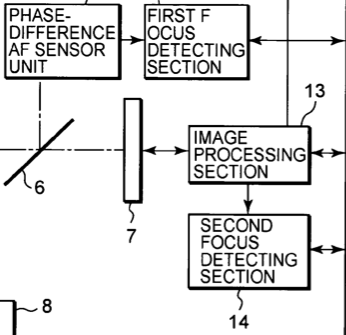
We just found an interesting new patent. It seems that Olympus is working on a double TTL and contrast autofocus system which do work simultaneusly:
“It is to be noted that the TTL phase-difference AF and the imager AF have the following characteristics, respectively.
The TTL phase-difference AF is the AF at a speed higher than that of the imager AF.
The imager AF is the AF having a precision higher than that of the TTL phase-difference AF.”
and
“an automatic focusing device is disclosed in which the TTL phase-difference AF is combined with the imager AF to perform focusing control. Specifically, in this automatic focusing device, after coarse control is performed by the TTL phase-difference AF, fine control is performed by the imager AF.”
This would be possible with the use of a half mirror which reflect portions of lights to the Phase Detection Sensor.
My speculation: would that camera not be able to record video using the faster TTL autofocus?
source: http://www.freepatentsonline.com/7711260.html

napalm
3 years ago |interesting…
this means:
1.) Olympus is really still developing for 4/3
2.) A new body is coming soon… for real. The pdf shows this is something they are going to or have already implemented.
3.) If this significantly improves AF, it really is something worth waiting for. So can we expect E-5 to have faster AF, video and better IQ? Cant wait…
binoyte
3 years ago |This also means new SWD lens especially for the super high grade. At last !!
Jimson
3 years ago |I agree with Napalm. I’ve long suspected that the E-5 will be Oly’s first HD enabled DSLR. This revolutionary dual AF system would be the best of both worlds. Fast phase detection AF for action / sports & CDAF for video. Oly may not have been the first to release a HD DSLR, but I’m hopeful the E-5 will give us well designed professional video capability, not just a sticker on the outside of the box.
I can’t wait! Might be time to sell my 14-54 MK I so I’ll be ready to upgrade to a MK II…
Duarte Bruno
3 years ago |I’ve got a theory that it is possible to perform Predictive CDAF on m43 and I think that’s where they should be investing but…alas! No bonus.
Toby
3 years ago |You dopes do realise that the filing date was in 2007?…
I don’t think it means anything, but feel free to speculate as ever.
dMS
3 years ago |Remember the old Canon EOS 1N RS film camera (10 ips), had a fixed mirror, actually it was not quite a mirror, but a glass or transparent plastic with a special coating that reflected a certain percentage of light to the ovf letting the remaining light reach the film. Something like 70/30 or 60/40%, can not remember. As a result the perceiving viewfinder image is slightly darker losing at the same time 1/3 EV. I know because I still have it.
Ab
3 years ago |I dont see why the main mirror has to be replaced with a fied mirror, why couldnt the phase detect mirrors (the ones that normally divert light to the phase detect sensor be this kind of transparent material allowing light to go to the PDAF as well as move through to the main sensor for some kind of CDAF support on only the PDAF autofocus points?
Torstein
3 years ago |I imagin that the E-5 will be a system with a fixed mirroe and two sensors tuned for different specters of the light. A system like that would give some DR…..
kesztió
3 years ago |Better work on faster contrast detect!
Alfons
3 years ago |Fixed mirror on E-5? Doesn’t that mean that Olympus would have to sacrifice light gathering? I bet they have no option to let less light on 4/3 sensor if they try to hang on the high ISO quality.
JoelH
3 years ago |Alfons: The fixed semi-transparent pellicle mirror doesn’t necessarily have to reduce much of the direct illumination. The Phase Detect AF could work with say 10% to 20% of the light split off, leaving 80% to 90% illumination. This would represent a loss of about 1/6 to 1/3 stop – not really enough to create a significant loss of high-ISO performance. And if the reflectivity were weighted towards a limited color spectrum, it would have even less effect on total noise performance for typical scenes. See also next paragraph:
dMS: In fact Canon’s experience with the pellicle mirror in the primary image path dates back to the Canon Pellix SLR of 1965, and they used in in some high speed motor-drive cameras after that. BTW that mirror also had a 1/3 stop exposure loss. Pellicle mirrors were also routinely employed in color-separation cameras from the late 19th century through the mid-20th. Semi-silvered mirrors and prisms are also common in microscopy and are part of many optical rangefinder and viewfinder systems, so Olympus is well experienced in this area as are all the traditional camera/optical firms.
Torstein
3 years ago |Why not use a fixed mirror and two sensors for capturing the image? In that way the two sensors can be tuned optimal for different ranges. One could take the darekr end of the range, while the other focus on the highlights. Such a system have to use an Electronc finder, but I guess they are starting to be quite alright?
dMS
3 years ago |Torstein
I think that with such a system each sensor would need to be exposed for longer, considerably reducing the shutter speed, due to the fact of dividing in two the same source of light. on the other hand if we consider the wasted light, by the limitations of current sensor… well, maybe not. I don’t know if I’m prepared to give up the optical viewfinder. (JoelH) At least there would be a great advantage. The absence of a mobile mirror, could undoubtedly increase the number of shots per second.That would be a great advantage for a professional target camera.
Toby McKinnon
3 years ago |HELLO, patent was filed in 07.
Olympus and Panasonic rumors » Blog Archive » (FT4) Olympus E-5 and new PEN at Photokina
3 years ago |[...] Sony NEX to be announced on Tuesday. New Samsung NX camera very soon. And Leica EVIL fullframe?New Olympus patent shows innovative double simultaneus focus systemSmall update about SigmaSony NEX vs MicroFourThirds size comparison Latest Reviews New Noktor [...]
Photo rumors from around the web | Photo Rumors
3 years ago |[...] 43rumors reports on a freshly approved Olympus patent from 2007 for double simultaneous focus system. [...]
wageslave
3 years ago |@Toby, so what if it was filed in ’07? not all patented tech see the light of day as products, and not all will be feasible enough to be mass produced right away. Sheesh.
e_dawg
3 years ago |Guys, I believe this is ALREADY in use in Olympus 4/3 cameras. There is a setting called Hybrid AF which can be used in Live View only. It’s faster than pure CDAF, which is painfully slow, but doesn’t compare to really good CDAF for Live View like we see with the G1/GF1/GH1 cameras.
Toby McKinnon
3 years ago |@wageslave
Don’t be an ass. My point is that it clearly ISN’T a new patent. It was filed around the launch of the 510 for god’s sake.
You keep dreaming though, hanging on for dear life.
Cliff
2 years ago |@Toby
Patents must be filed as soon as R&D proves the concept, lest a scientist jump ship and carry the idea to a competitor. Lots of work still has to go into creating a usable feature – something that doesn’t adversely affect battery life, camera weight, ergonomics, etc. Oly must also develop an interface that doesn’t require a revised understanding of photography (or the Evolt line) to use. A patent doesn’t mean a new camera model launch is right around the corner.
And trolling around a 4/3 forum trying to piss on everyone’s joy? YOU might be the ass.