




New Kenko 400mm T-mount to Micro Four Thirds adapter lens (+ short CES news roundup)

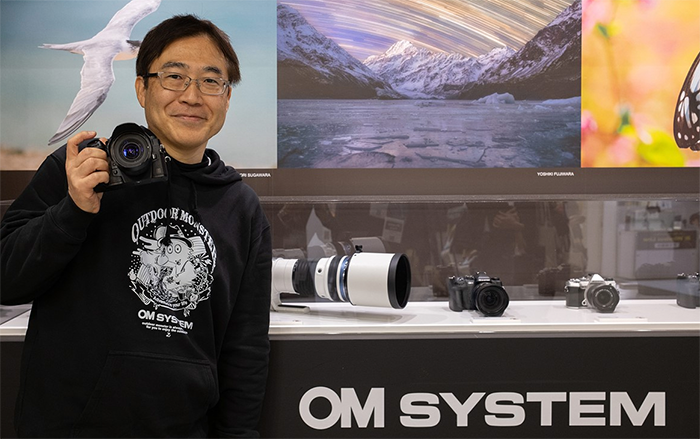
Image courtesy DC.watch
Kenko announced a new T to m43 mount adapter which will allow you to use that super 400mm f/8.0 Tokina lens (800mm full frame equivalent). There is no official price and release date yet but the adapter should cost around $200-$250. P.S.: There are many such mirrorless lenses made by Opteka (they also go far to 1.600mm!).
A short CES recap:
Panasonic showed two camera prototypes: A head camera (Click here to see the pic) and an unspectacular WIFI compact camera (Click here to see the pic).
Hands-On With Olympus’ New Digital Cameras (ePhotozine).
Panasonic stand at dpreview and Dc.watch.
Olympus stand at dpreview.

RBe
5 months ago |What is so special about this adapter except the pricing? I´m using such an adapter (ok, it´s black, not white…) for months now, paid 40$ on ebay…
lnqe-M
5 months ago |Nice lens for m43.
andy
5 months ago |Why so expensive, what is special? For a simple MFT to T-Mount adaptor you pay £12 on ebay…
mng
5 months ago |I guess cheap ebay adapter is good enough for me.
marsupial2go
5 months ago |Beautiful promo photo.
kesztió
5 months ago |Would be somebody so kind to explain how these lenses do work and why the central part of the front lens is obturated?
Miklos Rabi
5 months ago |http://en.wikipedia.org/wiki/Mirror_lens
Baronlee
5 months ago |Like this: http://en.wikipedia.org/wiki/Gregorian_telescope
And yes, there could/will be a blind spot in the center of the image, but it is usually to small to be of much consequence.
Duarte Bruno
5 months ago |Strange… I’ve own a mirror lens (a Tamron 500SP F/8) and I’ve never observed a blind spot not even when doing very close subjects. In practice when should that happen?
Miklos Rabi
5 months ago |There is no blind spot, don’t worry.
lnqe-M
5 months ago |The is not blind spot i centre photo but the will be shining ring of high light, and you have not normal aperture chosen, only ND filter if you need adjustable light.
Hon Shu
5 months ago |There is no blind spot unless you would get very very close to the lens, way beyond near focus distance. The actual (negative) consequence of such a mirror design is loss of contrast due to the obstruction.
Igor
5 months ago |http://en.wikipedia.org/wiki/Catadioptric_system
I suspect the mentioned price is for the adapter+lens, since a simple lens adapter should be 20$-25$?
Admin, what’s happen with that FT4 rumor about the Panasonic catadioptric lenses?
http://www.43rumors.com/ft2-lens-update-12-50mm-lens-is-silver-ft4two-tele-zooms-from-panasonic
admin
5 months ago |Delayed. I also know form other lenses that still didn’t make it into final production
Igor
5 months ago |That’s sad. A catadioptric (mirror) lens is nicely suited for micro 4/3.
The decent mirror lenses (such as Sony rebranded Minolta 500mm f/8) are light, provide good quality images and have an autofocus. Panasonic is capable to design a high quality mirror lens possibly even brighter (f/5.6), with fast autofocus and optical image stabilizer. They can even make it collapsible for the more compact storage.
BTW, the shape of modern astronomical telescope mirrors is often made adjustable to compensate for any flexures and aberrations, but this would be hard (but not impossible) to implement in a digital camera.
Miklos Rabi
5 months ago |“such mirrorless lenses”
You mean mirror lenses.
1
5 months ago |AF?
Dan
5 months ago |While I love the idea of 800mm or 1600mm (ff equiv) I’ve come across a few reviews that state the image quality isn’t very good with these type of lenses (I suppose you get what you pay for). I’d be interested to know if anyone has one and is very happy with the results (and perhaps share some examples)…
mpgxsvcd
5 months ago |I have been using a 1035mm F9.2 telescope that uses a similar design. I have been happy with the results so far. However, atmosphere has a lot to do with it when you are using focal lengths like this.
Moon Video
http://www.youtube.com/watch?v=KcZFet5E1is
Planets Video
http://www.youtube.com/watch?v=K6AeQECBudg
Camaman
5 months ago |$200-250 for a T adapter !?
Is it also an 32GB MP3 player?
Vivek
5 months ago |It comes with iPad mini. LOL.
For $12 you could buy them (the T-mount adapter that is) 2 years ago!..and it is filled with the same air..
Ross
5 months ago |I was trying to work out what was so special about this adapter, too. My 500mm mirror lens has an M42 mount and its adapter for m4/3 only cost around $20. Perhaps Kenko is positioning its product at the Rayqual and Novoflex end of the market?
Bob B.
5 months ago |hmm…well….I came here because there is no mirror in my camera..I certainly don’t want a mirror in my lens.
(Opteka and Kenko…… TOGETHER…WOW!)
Daemonius
5 months ago |Enjoy your donuts!
That thing allows AF or why its that expensive?
Bob B.
5 months ago |LOL!!! I was thinking …this guy talking about…I forgot about the donuts!!!!!!!
Camaman
5 months ago |And all that for an additional $250.
slomo
5 months ago |Bought a used Tamron SP 500mm mirror/cat lens + Adaptall OM mount + OM to 4/3 from E-Bay years ago and I don’t think I paid more than $200.
Camaman
5 months ago |So why this lens?
There are 800mm versions out here. Since you are going long might as well go all out. Most come with an included TC 2x, to.
800mm * included TC 2x * 2x crop factor = 3200mm !
Now that is something.
snowflake
5 months ago |I have two of these lenses. On was inexpensive and new by a manufacture that will be left unnamed. the other was a used Celestron telescope with a 5”inch mirror. I will say this, you get what you pay for and for video the softer image may be ok with a less expensive lens.
Advantage of lens
1. Light weight for the focal distance and aperture.
2. Usually lower cost.
Disadvantage of lens
1. Tricky to build with good quality. The light bounces off primary mirror on to secondary mirror that reflects the light through the center of the lens. Since the entire image collected by the primary mirror is concentrated on to the secondary mirror, any minor imperfection in the shape or the location of the secondary mirror decreases the sharpness of the lens. Real precision is needed. In good telescopes there is a process that allows one to realign the center mirror.
2. Weird donut shaped bokeh. Some times this can be interesting, but most times it is distracting. It is caused by the center mirror. In telescope versions the necessity for compactness is not that important and the secondary mirror can be further away from the primary lens. This results in a smaller secondary mirror and the donut bokeh is not as pronounced.
3. The secondary mirror reduces the true light gathering capacity of the lens.
4. Technically one would not expect any rainbow effects associated with refracting glass lenses but in practice this seems to be an issue. Perhaps it is a diffraction effect around the edges of the secondary mirror or just poorly designed lenses used to finish focus.
5. Focus is fussy. Just a turn of 1 mm on the 5 inch 1000 mm celestron lens will change the focus dramatically. Objects 200 feet away are focused within a 4 foot variation of distance. (One end of a seal will be in focus and the other end is not). Really tricky to lock into a precise focus by hand. I would say that 3/4 of my photos using this longer focal length lens are out of focus. An auto focus would be great for this kind of lens.
nico
5 months ago |Not mentionning the tons of light you need to use it… with a 1000mm equivalent focal length, you have to shoot at 1/1000sec, and this is a F/8 piece of glass.
I have a picture of a tree where the out-of-focus branches look like links of a chain.