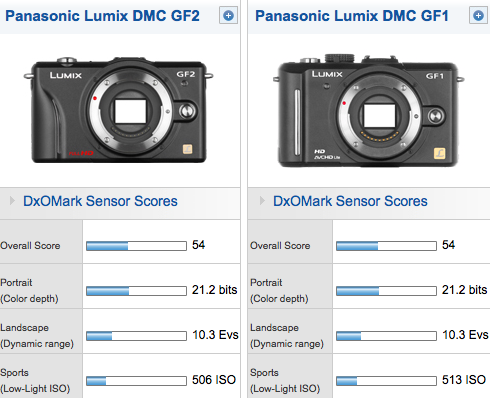




GF2 at DxOmark (+ DxO analysys by Van Den Hammer)

We already knew it and DxOmark confirms it. According to DxoMark there is virtually no difference between the GF2 and GF1 RAW image quality. Color depth, dynamic range and ISO performance are exactly on par. By far more worth to read is the article written by Peter van den Hamer and posted on Luminous Landscape. Peter explains how DxOmark works and how reliable it is: “Probably every image quality expert would have a somewhat different personal preference for a benchmark like this. But my impression is that the benchmark is pretty useful: I analyzed the model and the data, but didn’t find any serious flaws.”
He gives many hints about how DxOmarks works and one was particularly interesting: “It should be clear by now that larger sensors (rather than larger pixels!) can produce less noisy images. This is simply because a larger sensor area can capture more light – and for reasonable resolutions this is pretty independent of the amount of MPixels the sensor’s surface has been divided into.”
Click on the store name to directly check price and availability of the GF2: Amazon US , Adorama, BHphoto, Amazon UK, Amazon DE and eBay.

Seems like
2 years ago |GF1 image quality is better. GF1 is also easier to use without useless touch screen.
Dummy00001
2 years ago |“It should be clear by now that larger sensors (rather than larger pixels!) can produce less noisy images. This is simply because a larger sensor area can capture more light – and for reasonable resolutions this is pretty independent of the amount of MPixels the sensor’s surface has been divided into.”
B.S.
By that logic, one can make a perfect sensor: take a big board (say one square meter); stick a photodiod in the center; done! Since, you know, bigger sensor is better.
Rui Pereira
2 years ago |You missed the “reasonable resolutions” part…
panasonic
2 years ago |wow. equal result!
George
2 years ago |yeah it seems Panasonic choose to follow Oly and they decided to market totally unnecessary cameras. If these 2 idiot companies will keep like this, canon and nikon will come and they will kick their asses with their mirrorless
oluv
2 years ago |yeah, was thinking the same. panasonic could have used at least the GH1 sensor for the GF2. the GF2 is a worse camera in every respect compared to GF1, the only advantage it has is the smaller size, which i welcome. but i don’t need a touchscreen and remove of control-buttons and dials!
with the upcoming NEX sony will probably roll over panasonic and olympus.
Mr Hipsta
2 years ago |I think the GF2 is supposed to be the entry level rangefinder-style m43 camera and the reason why Panasonic use the same old sensor is to keep the cost down. GF2 have exactly the same price as the E-PL2 with the kit zoom lens (in my corner of the world) which also indicates that GF2 is competing with the Olympus entry level m43. Hopefully, we will soon see a “Pro” rangefinder-style Panasonic m43 with the same sensor as in GH2 and built in EVF.
Joseph
2 years ago |Yeah it’d be nice to have constant sensor improvements every new camera that comes out. But it’s not realistic.
If you look at other industries like the auto-industry, how often does a class of vehicle get a new engine? Not very often, probably every 5 years or so, but other things like the body, interior, functional bits change. Maybe the engine gets some different tunning bits.
Cameras are much the same, ergonomics, and features are shifting around in these cameras, as they try to find the best match for their market (or to create a new class, maybe a Gr-1).
Cameras tend to improve their base “engine” at a more rapid pace, and also “tune” it with better processors and algorithms.
Even Nikon/Canon/Sony don’t produce new sensors for every new model.
Jules
2 years ago |Thank you Joseph!
Some chronic comments on sensor technology are simply baffling me and I am willing to bet that most of the complaints comes from user that in fact, if not to show off their gears, needs no better than 5-6 year old technology from any of Canon, Nikon, Olympus, Panasonic, Sony or Pentax.
yes yes yes… Sony will destroy m43. Then, Nikon will destroy m43.
Spoo
2 years ago |Your typical troll comment is as usual completely inane and useless, with the decided “my dad can beat up your dad” attutude of a four-year-old.
CaNikon
2 years ago |Only problem is that Nikon mirrorless is not going to be released 2011 and Canon has not even planned of making one.
twoomy
2 years ago |And how many years until there is a wide-angle comparable to the 7-14mm, a high-quality macro, and fisheye, etc. If M43 has one thing going for it, it’s the selection of lenses. But they need to keep on the ball and keep filling in the gaps in the lineup.
the other Rob
2 years ago |I partially disagree. The Sony NEX system has none of those things and it outsells m43.
So clearly, quality lenses aren’t really that important for a camera system to be profitable in the mirrorless market. I mean, its important for the people that care enough to read this forum, which is maybe 10% of m43 users.
I wonder what percentage of interchangeable camera users actually ever interchange their lenses, and if it is the same or more for mirrorless users?
cL
2 years ago |That suggests m4/3 and P&S shares the same market…. That also suggest XZ-1 could outsold E-PL2….
Spoo
2 years ago |My comment was directed @George of course – not oluv who at least makes a rational point.
George
2 years ago |Spoo probably noone on this forum likes m4/3 more then me. Still i own a G1 i dont want to sell it. But almost 3 years passed and look at m4/3 cameras and look at lenses ffs!!!. How can you say they are doing right ???? Sorry but i am not that idiot who is trying to tell only upsides of a camera i own. In fact if i pay for a cam i criticize it to its very core. Now since you called my comment “inane and useless” please tell us what is the point of releasing this GF2 with same sensor almost same size, same image quality but after 2 years of GF1. Same for EP2. Pana and Oly basically giving mirrorless market to Nikon,Canon and to Sony on a silver plate.
Spoo
2 years ago |“Spoo probably noone on this forum likes m4/3 more then me.”
Wow, it’s sure hard to tell that, since all I seem to see are comments about how “stupid” and “idiotic” Pana and Oly are because they don’t come out with the camera you think they should RIGHT NOW. WTF do you know about about how long it takes to design, engineer, and produce a brand new camera or lens? If it was THAT EASY then CaNikon would ALREADY have something on the market after getting caught flat-footed by the success of m4/3. I have no doubt that when they finally get something to market it will be an extremely good product, but I don’t think it will completely kill the m4/3-NEX market. Call me an optimist, but I think Pana/Oly are going to come out with some great products in the not-too-distant future that will make the system even stronger. If the incremental updates WEREN’T happening, there would be a whole different crop of complainers crying doom and gloom and predicting the demise of m4/3. So – damned if you do, damned if you don’t. Personally I like seeing the choices expand, even if the product is not groundbreaking or particularly useful to me. I can use what I have right now while waiting for the Next Big Thing.
hd72
2 years ago |George, it remains to be seen whether Panasonic and Olympus are merely dumbing things down, or creating entry level categories. If they come out with high-end, “pro” rangefinder-styled models like so many are expecting them to, then they’ll be okay. But they need to do it soon. Otherwise, you may be right, Nikon will have the opportunity to eat their lunch.
calxn
2 years ago |Don’t worry about that. Canikon will soon free all of you from these consumer toys. Hopefully, Oly and Pana have recycling programs.
Zoeff
2 years ago |Exactly my thought. Bigger pixels = less noise at same ISO value. The end.
This just shows that even reviewers have fallen for the myth of sensor size being the problem, not pixel size. I’m still waiting on a compact using current day technology with a low MP count. Say, 4MP. Now THAT would be a low-light capable compact. 4 is plenty for your typical compact user. However with stuff like this on the web, this isn’t going to be made anytime soon.
Aaron Fown
2 years ago |Now, let’s not be so harsh on Panasonic. Just because the GF2 uses the same sensor as the GF1, that doesn’t mean it’s an ‘unnecessary camera’. Sure, a current owner of the GF1 body probably won’t spring for a GF2, but hell, who doesn’t skip a generation or two with their camera bodies? The real improvements in the GF2 relate to the video and (yes!) the touch screen.
First off; this camera can take 1080i video of a really good quality. Even the 720p video looks better than what the GF1 could manage. It has a newer processor, so it can handle data better and focus faster. And the touch screen lets you set the focus point easily and intuitively. Sure, some of you might prefer spending a minute moving the focus point around manually, but being able to just point at what I want to focus on is a big selling point to me. And, of course, the GF2 is capable of rack focusing during video using the touch screen, which is a much more intuitive and easy way of rack focusing than is otherwise possible. As a videographer _and_ a photographer, these features are compelling, and I think justify the existence of the new body unto themselves. Frankly, in the contest between the more expensive (and sadly, unavailable) GH2 and the smaller and less capable GF2, the GF2 seems increasingly appealing. I just wish that it had bulb exposure, I love night shooting. . .
Uwe
2 years ago |A larger sensor does not capture more light, this is nonsense.
In the first instance, it’s the objective’s front lens which captures the photons emitted / reflected by the target (i.e. the framed object).
Thus, the diameter of the front lens plays the most important role when it comes to light captureing…
Okay, let’s assume the aperture being constant for, say, full frame and mFT, by using one full frame lens. Indeed, three quarters of the collected light is not hitting the smaller sensor. So, 1/4 of the light is hitting 1/4 of the area. Do you see the point? The density of photons is keept constant. Hence, according to the assumption in the article of a constant fill factor (i.e. photo-sensitive fraction of the sensor), the ratio of ‘photons per photosensitive unit area’ is the same. Concludingly, a larger sensor area does not capture more light per unit area.
Sure, the total amount of light hitting the sensor is higher for the larger sensor. But the light is distributed over a larger area – especially the assumption of a constant fill factor for both systems does not lead to any advantage of the larger sensor.
The only thing which potentially gives larger sensors some advantage over smaller ones regarding low-noise is the possibly lower density in electronics. Due to the larger diameter of the sensor there is more space to accomodate converters, wires and amplifiers (nowadays mostly on the back-side of the photo sensitive area).
Consequently, a lower pixel-count will help to decrease the dark noise of the sensor – this holds even if the fill factor is keept constant by using micorlenses or whatsoever (because it touches not the ability of catching light, but of processing signals and thus producing noise).
This potentially gives larger sensors an advantage as long as the two pixel-counts divided by each other give the same fraction as the two sensor areas (e.g. 5MPix mft vs. 20 MPix Full Frame, same fill factor). This is a question of priorities in the engineering phase…
To my opinion, it would be a smart move for mFT as well as for APS-C to stop increasing pixel count (we have enough of them…) in order to keep dark noise down – not in order to capture more light.
Voldenuit
2 years ago |+1
Luminous Landscape contributors have proven time and again that they do not understand the basic principles and mechanisms of image capture.
Catastrophile
2 years ago |épouvantable!!!
getta2
2 years ago |GF is designed for your “Girl Friends,” not pro users like you guys. For a female user, a compact size is an upside for sure. The touch screen, on the other hand, is more straight forward and intuively for them to use. Non-pro users don’t even switch their dial, auto mode and an acurate white balance is enough. In my country, girls and non-pro users LOVE this little beauty.
hd72
2 years ago |You’re right, only girls – like Henri Cartier-Bresson or Robert Capa – would want a compact camera.
You’re not a real man unless you lug around a 10 lb tripod with you everywhere.
As a man, I don’t carry around a “bag” with me all the time like most girls i know. If a camera can’t comfortably hang around my neck, or fit in a jacket pocket, it’s going to stay at home. A compact camera can be an upside for anyone.
CRB
2 years ago |Can anyone objectively tell me why the APS-C sensors improvement are on a faster pace than 4/3 ones? Panasonic make some excellent lenses and Oly has the nicest OOC jpegs (and awesome 4/3 lenses also)…but all that will be lost if they dont improve the sensors…sony is close (i think) to release their NEX 7…with some high specs. So panasonic and olympus, first to the game, will be behind the competition?
mahler
2 years ago |DxOMark measures mostly “raw” noise. There is no indication, if the noise is patterned and if it is unpleasant at the desired output. A good raw engine can easily cope with the noise. More important is the quality of the lenses, the accuracy of focusing, and the image detail preserved.
With the small sensors we get the benefit, we have to pay for: small, high quality lenses. This advantage comes at the expense of a higher noise level if the m4/3 sensors.
It remains to be seen if Sony can for the larger E-mount, lenses of the same size, quality, and range than Olmpus and Panasonic did so far. The standard kit lenses with only a small zoom range do not really count as these lenses are the most easy to design and high quality might not be of priority vs. price.
So as a small camera system m4/3 might be overall much better. As point & shoot, pocketable stuff (no or only one extra lens will be purchased), m4/3 might be cornered by NEX and Olympus XZ-1. Thus the strategy of Olympus and Panasonic to concentrate on large volume point & shoot like m4/3 models is too shortsighted.
Joel
2 years ago |I have to agree with this I find the G2 at ISO 800 very easy to clean up, I don’t feel disapointed coming from the Canon 50d…
pdc
2 years ago |I skipped the G2 because the sensor was the same as the G1. I will skip the G3 unless there is a marked improvement for higher DR and ISO. Blown highlights and shadow clipping are my only real complaint about the G series to date – the lens line-up continues to improve and some are very good.
Ganec
2 years ago |> Can anyone objectively tell me why the APS-C sensors improvement are on a faster pace than 4/3 ones?
- Sony (+ chips from Pentax and Nikon) and Canon produces more chips and has more profit
=> they can invest more to the research
… look for Samsung and their APS-C: noise performance is the same as with 43 senzors
- they are used mainly by “sport” people, where high ISO is important
=> more research is spent for this aspect
… Olympus & Panasonic are concentrate for “normal” people, where low ISO is more important
- Sony must compete aggresively .. “to broke CaNikon fanclub”
- DSLR-s (which uses mainly APS-C) are already evolved: they do not have much more to really improve…
But in reality: Panasonic chips improves similar (or better) than Canon’s
=> see their DxO scores since 350D (looks similar, only increase megapixels)
getta2
2 years ago |Man, you really have a great logical thinking. When I said “GF is designed for…,” it means the target consumer market is for…(girls and daily snap users in this case, or “low-end” if you like). Of course anyone can buy any item, it is also fine if you want to buy a pink female bag as your camera bag.
Yes, HCB, Capa, and masters all around the world use “compact” camera. But I don’t see the point you picked them out.
Just go on the street and ask 100 high school student/business man/office lady if they want to carry a GF2 or a D3x everyday. By the way, you may study some marketing while making these questionnaires. Have fun :>
Ganec
2 years ago |What Peter van den Hamer does not understand:
random noise is greatly reduced when more megapixels is used – more megapixel cameras have small advantage
for example wedding: white bride + black man and you see the difference
(IMHO he just complains thet his Canon is not best in this category)
just turn on DRO/ALO/Gradation/… and you will see
look 4/3 and “1.6x” => similar maximum (and note than 43 does not have real ISO 100!)
=> look “1.6x” and “1.5x” => ups?
No. Because they use bigger capacitors, they are better on lower sensitivities.
See: http://www.aptina.com/products/technology/aptina_dr-pix.jsp#video
But I like this sentence:
- I analyzed the model and the data, but didn’t find any serious flaws.
Ganec
2 years ago |again:
- Sensor Overall Score is normalized for 8Mpix result
–> random noise is greatly reduced when more megapixels is used – more megapixel cameras have small advantage
- Why measure Color Depth at low ISO?
–> for example wedding: white bride + black man and you see the difference
(IMHO he just complains thet his Canon is not best in this category)
- I doubt people can actually see color noise at low ISO
–> just turn on DRO/ALO/Gradation/… and you will see
- The data in Figure 5 confirm that larger sensors tend to have a larger Dynamic Range than smaller ones
–> look 4/3 and “1.6x” => similar maximum (and note than 43 does not have real ISO 100!)
–> look “1.6x” and “1.5x” => ups?
- the newest APS-C models (Nikon’s D7000 and Pentax’ K-5 and Sony Alpha 580) outperform the older 1.3× sensors .. due to a significantly lower noise floor.
–> No. Because they use bigger capacitors, they are better on lower sensitivities.
See: http://www.aptina.com/products/technology/aptina_dr-pix.jsp#video
Peter van den Hamer
2 years ago |Maybe I am taking him too serious – this is after all a rumors site. But Ganec wrote:
“- the newest APS-C models (Nikon’s D7000 and Pentax’ K-5 and Sony Alpha 580) outperform the older 1.3× sensors .. due to a significantly lower noise floor.
–> No. Because they use bigger capacitors, they are better on lower sensitivities.
See: http://www.aptina.com/products/technology/aptina_dr-pix.jsp#video”
1) Compare the D7000 and D5000 “Full SNR” data at 100% exposure (=white). The D5000 actually has almost the same amount of noise “in white” at 100 ISO as the D7000. In fact, full-well-capacity has decreased slightly in the D7000 (smaller pixels), but this small difference goes away if you normalize an image. If you need formulas to calculate the full-well capacity: http://harvestimaging.com/blog/?p=430 . So the dynamic range improvement of the D7000 comes at the dark end of the scale (where noise floor matters) rather than “capacity” (in the bright end the amount of charge you can hold matters): 0 dB SNR is achieved in shadows that are over 2x less darker. This increases the dynamic range. So the D7000 compared to the D5000 has less circuitry noise and there is no evidence of an increase in full-well capacity.
2) You are very enthusiastic about Aptina’s explanation of their new technology (which which show up in future cameras). The trick they describe to increase the voltage by “pouring” the charge into a small capacitance is their way of amplifying the voltage. It creates a higher ISO setting: more signal when there isn’t enough light. It has no impact on dynamic range at low ISO (as measured by DxOMark) because you can use the Aptina trick of reducing capacitance at higher ISO only. Whether the Aptina trick reduces noise at high ISO compared to using an AGC is a separate discussion.
3) You suggest that I overlooked (“don’t understand”) the impact of “capacity” on dynamic range. In the article it is call “full-well capacity” or lambda. It is extensively covered, including diagrams, a page or two of text, various calculations and a reference (www.clarkvision.com).
Just trying to keep the signal-to-noise level down.
Peter van den Hamer
2 years ago |Olympus PEN EPL2 and Olympus XZ-1 data have been added to the article’s diagrams.