





(FT5) Continually updated -> The Ricoh GXR is here!!! Not really a MicroFourThirds competitor!?!?

http://www.dpreview.com/news/0911/09111001ricohgxr.asp
And Photographyblog has a size comparison with the Panasonic GF1: http://www.photographyblog.com/news/ricoh_gxr_vs_panasonic_gf1/
Also preorder is available at amazon:Ricoh GRX
A special Ricoh website can be seen here: http://www.ricoh.co.jp/dc/gxr/special/ (Thanks GUWI for sending the link!)
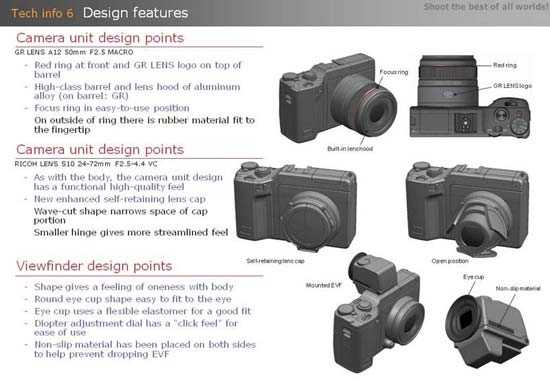
£420 for the “unit”
£600 for the 12.3MP CMOS sensor & 50mm Macro Lens (HD Video)
£300 for the 10MP CCD sensor & 24-72mm Zoom Lens (5fps RAW, VGA video)
They say the Ricoh GX3 is smaller than the include("buy/gf1.php"); ?> and Olympus include("buy/e-p1.php"); ?>.
Let’s start the poll!
P.S.: Our “Batman” source were right with the specs. I hope you can help us in future again
—
One of the most favorite sites for 70-562 exam preparation. The test king offers you complete exam training to pass professional exams. Join today and get excellent discount package for VCP-410 exam.
Related Posts
- (FT4) Ricoh is the first MicroFourThirds competitor
- (FT4) UPDATED -> Ricoh camera to come with two lenses (one prime and one zoom)
- (FT4) Fuji joins MicroFourThirds???


Nuevo concepto de Ricoh. - Canonistas.com
November 9, 2009 |[...] [...]
guwi
November 9, 2009 |VIDEO here http://www.youtube.com/watch?v=spbMQ960j8U or here http://dslr-links.blogspot.com/2009/11/removed-video-of-ricoh-gxr-camera.html
Bob
November 9, 2009 |It looks army like to me.
Possibly those lens/sensor modules are splash or water proof since lens and sensor exist inside a closed box.
Imagine how easy and fast you can change those modules while not worrying about getting water and dush inside the camera.
If you could change the sensor as a separate module as well strange configuration could occur where the projected image would not match the sensor size. Also the very critical alignment between sensor and lens would be hard to obtain between reshuffable modules.
And its pocketable…. pretty cool.
Hopefully Ricoh can change the sensor and chip set when an update is wanted… at a price of course.
I think these babies are going to be in demand.
If I am right, it is a very flexible, rugged, pocketable and unfortunately pricey solution. Still spells a magical formulay to many, not bad!
Just my ten cents.
Jón
November 9, 2009 |http://dmitry.blogg.no/1257801334_revolusjonerende_nytt.html
Full blog with photos and all…
WT
November 9, 2009 |I wonder if they’ll have a sensor/lens combo where the sensor is small to give you a super-zoom in a small package, but a larger sensor for normal and WA. That’d be interesting.
But, this has got to be the UGLIEST camera seen in several years! This thing makes Kodak point and shoots look fashionable.
Danz
November 9, 2009 |Typical hate. If you don’t like it, don’t buy it.
Me, I’m waiting for the full review and IQ reports. But I’m liking the fact there lens will never get dirty when changing.
Afterwards, I’ll check out the ergonomics at my local cam shop.
Then that’s when I’ll make a decision to either love it. Or not.
Will they come up with a full frame sensor + lens combo for that form factor is my real query.
say ricoh
November 9, 2009 |WHICH ONE WOULD YOU PREFER UPGRADE
LENS OR SENSOR ?
I WOULD SAY BOTH !!!!!!!!!!!
central squared
November 9, 2009 |This is so innovative! So many people are beating this down when they should be applauding new ideas and technology. I think this seems like a super cool idea, with the possibilities being almost endless for various modules. You can match specific lenses with sensors and price accordingly. Not an entry level system, but if the image quality is good, this could be great.
guwi
November 10, 2009 |japanese website Ricoh: http://www.ricoh.co.jp/dc/gxr/index.html?sscl=rtop_gxr
GXR special site: http://www.ricoh.co.jp/dc/gxr/special/
David Bateman
November 10, 2009 |I really like the concept. One major advantage of digital MF is that the lens, camera and sensor can all be changed. This is similar, but people will have to get used to it.
Why, I don’t think it will sell is the cost. Very expensive!! And it is missing a critical element for the cost, A name.
Sony is doing very well in the market, because of the sony name, and more critical the Zeiss name on there best lens. I own Olympus, but would love to have A850 with the zeiss 85mm f1.4 (the only high quality zeiss that auto focuses, auto apterture!)
Panasonic does very well with the Leica name.
So if Ricoh whats this to work, they should team up with a medium format company and call this a pocket MF Digital. In that case Hassy would be the best name as the H3D was called the best DSLR.
robm
November 10, 2009 |all I can say is, it makes no sense. Regardless of the attempt by Ricoh to think outside of the box, if I put it into the context of actually using a type of camera for a specific situation… I’m left with only contradictions and confusing.
, or fast zooms), I just need to swap lenses. but, of course, I would have to carry them with me. with the ricoh, I would have to carry more lens/sensor combos too, but would they make such top flight lenses for it? I doubt it if their 50 prime is that slow and that big.
1. the 50mm (35 equivalent) f2.5 is big and slow. compared to the gf-1 40mm (35 eq) f1.7, the gf-1 remains small even though the sensor is nearly the same size.
2. the 24-70 (35 eq) f.25-4.4 is small and so is it’s sensor so it’s basically a glorified poor low light point and shoot. and it’s not as small as a p & s.
3. I would have to adjust constantly to using a different sensor and attendant sensor characteristics.
4. seriously, how many sensors do I really need? that can’t be cheap. it makes more sense to just have the sensor replaceable (sorta like different focusing screens) so that the lenses would take on different characteristics based on the changed ratio factor.
5. a pancake lens on a gf-1 or ep-2 is small and easily the same size as the smallest from this new camera can be, but it doesn’t loose on poor low light shooting because the ricoh needs a micro sensor to get the lens size down.
6. if I needed top notch lenses (either primes, if they were made
my point is if you actually anticipate using this thing for the different purposes different lens/sensor combos offer, it doesn’t stack up to the versatility that a conventional system offers, especially an m4/3 camera. Yes it’s great to have new sensors without buying the whole camera, but then one begs the question: why not just replaceable sensors?
this camera seems too big compared to a real p&s, too limiting compared to large sensor cameras, and too wasteful/spendy having to buy a lens with a sensor.
regards,
rm
Enche Tjin
November 10, 2009 |In defense, Ricoh GR 50mm f/2.5 macro should not be compared to 20mm f/1.7, they are different lens. It is closer to Leica 45mm f/2.8 macro which is bigger.
for 24-70mm + small sensor, there is a time/situation where you want depth of field rather than shallow depth of field, and also there is a time when you like versatility of zoom and small, pocket-able size.
You can argue rather to buy the module, why not buying compact camera instead. Yes, you can, but you need to carry extra bulk and learn and adapt to two camera interface.
With GRX, you don’t have to, because the interface, buttons everything are the same.
Enche Tjin
November 10, 2009 |Also consider this, 50mm with APS-C sensor (bigger than 4:3) plus the sensor is specially designed and optimized with the lens. total price is $830.
Leica 45mm f/2.8 Macro stand alone is $899
which one is more spendy?
Boyan
November 11, 2009 |Innovative but useless
pgoros
November 12, 2009 |I love seeing out-of-the-box thinking and Ricoh is no stranger to innovation, but I think this one’s going to be a flop. If the lens and sensor weren’t mated, then I think it would have been a different story.