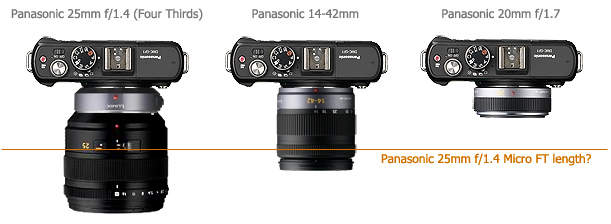




(FT4) Panasonic 25mm f/1.4 almost as big as the kit lens.

One of our sources told us the upcoming Panasonic 25mm f/1.4 Micro Four Thirds lens will be almost as big as the current Panasonic 14-42mm kit lens. If the rumor turns out to be true than the size will be a bit more than we expected (or hoped) to be for a lens that is “rumored” to come without in lens stabilization (OIS). It has almost double the size of the Panasonic 20mm f/1.7 lens pancake. We still don’t have the 100% certain specs so I hope there is room for a surprise that can explain the size (a bit faster than f/1.4? Incredible image quality? or last moment added OIS?). The lens is expected to be announced late March/early April.
Links:
- I used the awesome Four Thirds matching simulation to compare the lens size!
- The Four Thirds Panasonic/Leica 25mm f/1.4 lens (which should have almost double the size compared to the little Micro Four Thirds sister)
- The Panasonic 20mm pancake at Amazon, Adorama, B&H, J&R, eBay
UPDATE: Samsung doesn’t make any big secret about their lens roadmap and they just announced 5 new NX lenses (Click here to read more at MirrorlessRumors.com)

twoomy
2 years ago |The 14-42mm is a tiny lens. Coming from Nikon SLRs, a prime lens that is a little smaller than the 14-42mm is still teeny weeny in my book.
Miroslav
2 years ago |Agree.
If 25mm is two times bigger than 20mm it won’t look out of place even on GF2. Totally acceptable for me.
theEel
2 years ago |14-42 size for 25/1.4 is ultra ok if the quality of Pany 25/1.4 is equal to Leica 25/1.4.
Leave a reply
2 years ago |+1
mpgxsvcd
2 years ago |+2 I am fine with it being twice the size of the 14-42mm. I just want a good quality lens and IS for video would be awesome as well.
Tropical Yeti
2 years ago |I have never designed any lens, but nevertheless – it is obvious:
OIS, can never be the “last moment” afterthought, when the lens is almost ready. If you plan to have OIS, you have to consider it in the very beginning of the design phase.
emde
2 years ago |Look at the size of the Nokton. It is bigger than the kit lens. Speed needs space…
Robbie
2 years ago |It’s wholly acceptable!!! Ship out the goods, Panasonic!
Miroslav
2 years ago |20mm F1.7 + 5mm – F0.3 = 2 x 20mm F1.7
Every bit adds a little to the size.
Bigger lens also means less digital distortion correction will be needed ( more glass = less distortion ).
Bob
2 years ago |They might be after the af100 customers with this lens. Let’s hope it designed for video.
TheVoiceoverman
2 years ago |First post I can recall in a long time wherein nearly every reply was positive. What happened? Will it last? The suspense is killing me…
Ulli
2 years ago |imo its pretty big, even with this speed, but prob its lightweight.
can anyone explain why lenses such as this one and the nokton 25mm have a lenght spec which is twice(or even more) its focal length? I thought such dimensions only occur with retrofocus design.
for comparison: the nokton 50mm 1.1 is shorter then the nokton 25 mm
Ranger 9
2 years ago |(All other factors assumed equal) Wider maximum aperture requires more lens elements to achieve equal correction of optical aberrations. More elements require longer barrel. Also, because of the greater difficulty of correcting a wide-aperture design, other design factors such as the refractive index of elements needs to be kept more “conservative” to make it economic to manufacture.
You can see an example in the 50mm lenses designed for 35mm cameras from the 1930s through the present. A 50mm f/2 or f/1.8 can have excellent correction with six lens elements. A 50mm f/1.4 usually requires seven elements, and more elaborate designs may need even more. (Canon made an excellent 50mm f/1.4 lens for its rangefinder cameras using only six elements, but it required thick elements with dramatic surface curvatures, which would have been much more difficult to manufacture than using more elements with less drastic shapes.)
Ulli
2 years ago |Ranger9, i was just expecting that a fast 25mm lens, designed for a short flange system such as MFT or even rangefinder film cameras, would not be physically longer then its focal lenght. In the case of the 0.95 Nokton as comparison for the upcoming Lumix 1.4 Lumix, I would expect the Panasonic lens to be considerably smaller, since its a full stop slower then the Nokton.
Mr. Reeee
2 years ago |Thanks for the explanation! All this seems like alchemy to me.
Would the longer Nokton M4/3 be because it needs to be long to compensate for the smaller M4/3 mount/lens diameter to reach the same 50mm equivalent?
Ulli
2 years ago |Like Ranger9 said, prob more correction is needed, with more elements, to correct the aberrations..i just counted, the 0.95 has 11 elements (!!)
What if Panasonic relies on correction by software, can such be done adequately? So, resulting in a design with lesser elements, I thought this was only done with their pancake concepts.And btw,the nokton is not longer in order to reach the 50mm equiv
cL
2 years ago |I think the reason it drops the Leica brand is because it is software corrected. That means the lens could be even bigger if it’s not. Because of the smaller sensor, 4/3 lenses actually require extra large elements (in term of ratio) than an APS-C lens of the same aperture and focal length. So yeah, won’t be a lot of weight reduction if go by regular design and optically correct. 2x crop factor doesn’t mean its lenses would be half the weight of FF equivalent. That’s how regular 4/3 hits the wall in term of not able fulfill the size part of the equation. m4/3 design reduces the mirror box, uses smaller elements plus software correction, so it’s significantly smaller.
Pancakes are not top IQ lenses by design. It’s only gathering interests lately because people are more size conscious nowadays. Top glasses are never pancakes. I’ve never used Panny 20mm, but from what people said, it seems Panasonic did a good job with 20mm (maybe one of these days I’ll rent one and play with it and see how far m4/3 has gone). Software correction probably eliminated a lot of design limitation and allows such design to come forward.
snowflake
2 years ago |Ulli, Thanks for the interesting observant question, and Ranger 9 for the answer. Interesting.
Ulli
2 years ago |Snowflake,
Brod1er
2 years ago |This really should be at least f1.2 or OIS to make it worth buying over the 20mm for stills. My guess is that it is video centric with continuously variable aperture and fast/silent AF (neither possible with 20mm) – this does not interest me as a stills shooter however given the size penalty. The other question is price?
WT21
2 years ago |Sounds about right.
Bunfoolio
2 years ago |To me this lens sounds big and I would not buy it. However, I am upgrading from a point and shoot and am not the intended market. I value small size. So if people who are photo enthusists like it then it is a good thing. More options the better we all are.
spanky
2 years ago |It would still be 1/2 as large as the 4/3 version, so it’s completely expected and acceptable. Not sure what folks were hoping for exactly. Physics is physics, and it can’t be suspended on a wish.
cL
2 years ago |Sometimes I wonder if people have seen the APS-C version of the lenses. Thinking these lenses are large is very weird. Voightlander 50mm f0.95 is large and heavy? Voightlander is famous for making compact size lenses. With an F number of 0.95, what are people expecting? Larger aperture = large elements = heavy and expensive.
adventsam
2 years ago |14-42 is absolutely tiny, this sounds awesome, please Pana incl OIS though, not so much for stills, at this FL no big deal, what we need though is OIS for video!
Duarte Bruno
2 years ago |Are you kidding? Compared to the Olympus m43 equivalent, it’s a mammoth! :O
Cheers!
tgutgu
2 years ago |Come on. Not really. It is bigger than the Olympus equivalent, but still tiny. Not everybody likes a collapsible design.
leuis
2 years ago |ft is 38.85 mm
mft is 20mm
so you can built easily a small 25mm lens for mft, because 25mm is bigger than 20mm.
what i want to say:
i would wonder, if the 25mm prime is almost a big as the kit lens!
Al Jimenez
2 years ago |I’d love a 25mm f1.4 lens for portraits. I have been using Minolta 50mm and 58mm, both f1.4, with great portraits. With the adapter, the Minolta’s are the same length and slightly larger lens barrel (55mm) as the 14-45mm Pany lens. I am not surprised about the rumored length, since this new lens should have automatic focus, at least… Al
Boss
2 years ago |I hope they will just come out with it soon, or at least show us a sneak peek.
I’m planning on buying the 25 f1.4 or the 20mm f1.7 very soon, so I hope it comes out sooner than later or I’ll just get the cheaper, and currently available, 20mm.
I also really hope Olympus will introduce the 50mm MFT macro lens soon too…. What is taking so long to release these lenses.
Elniorg\'s Journeys
2 years ago |You DO want to get the 20m 1.7 in any case, believe me. Flexibility, super portability and image quality all on one. It is a must on the m43 system.
Really.
tgutgu
2 years ago |Good news! Image quality, fastness, and usability (broad focus ring) is more important than pocketability! Enough pancakes!
If they would include a distance scale …
Per
2 years ago |Quality costs, booth weight and money. Enough with tiny, great considering the small size, lenses. Looking at the quality I get with my old Zeiss 50/1.7 on E-P1 and GF1, having that AND autofocus skuld be great!
MP Burke
2 years ago |Let’s hope it’s optimised for image quality rather than size. I’m more concerned about the price of the lens and what image quality it can give at F1.4 and f2. The current Leica 50mm f1.4 M mount lens has 8 elements whereas the 25mm f1.4 for four thirds has 10. This just confirms the point that a high degree of optical correction requires lots of glass.
Ulli
2 years ago |it sounds logical, more glass needed for more correction. but since i have absolutely no knowledge about optical designs, i look at my 50mm 1.1 Nokton which has 7 elements only…so i assume that shorter focal lenghts need more correction when a fast speed design is involved. On the other hand, the 20 mm Lumix is pretty fast too, is praised for being very sharp and its a pancake. In other words, if i owned this 20mm, i would see no reason for my kind of photography (modelstuff) switching to the 25mm.
mpgxsvcd
2 years ago |What is the fastest lens ever made with IS? F2.8 maybe? What makes everyone think this lens will have IS when it is two stops bigger than any other IS lens? I hope Panasonic does the impossible but I am not holding my breath for IS.
YouDidntDidYou
2 years ago |image stabilization really isn’t need for a 25mm f1.4, when I use mine on my Olympus (with in body stabilization) the images come out just the same as when I use it on my Panasonics
mpgxsvcd
2 years ago |The 25mm needs IS for video not necessarily stills. With the ETC feature a 25mm lens becomes a very nice 65mm or 97.5mm lens. You need IS for both of those focal lengths in video.
Angry Olympus Owner
2 years ago |Wide open in low light at around 1/13 of a second with your ISO pushed to 1600, im sure you will see a difference with the IS of olys bodies, regardless of focal length.
It may not be much, but when I turn off my IS in low light doing night scene shots at 14mm, I see a difference for sure.
I know it may not be as demanded as OIS for focal lengths of 50mm+….But IS will make a difference in low light, especially when no tripod is accessible.
Oly wins here, Panny should have used in-body IS in my opinion, that would make all those old vintage prime lenses even more valuable and desirable
It would also make these engineering trade-off decisions easier… OIS? vs Smaller build? vs Faster Aperture? vs Quality?
Just an opinion
YouDidntDidYou
2 years ago |Panasonic put stablisation into lenses when it’s appropriate ie longer focal lengths or smaller apertures, btw I use the Leica f1.4 25mm weekly for professional and more often for personal video work with my GH1 and I’m pretty sure stablisation wouldn’t make much of a difference shooting at the larger apertures, if I need stablisation I use the kit lens etc
just my thoughts…
fta
2 years ago |Hey Admin,
When are you giving us your E-P3 information?
Daemonius
2 years ago |I dont think it needs OIS, its short and fast.
Why is it big? Quite simple, you confused pancake design (that actually is design) with regular design. Pancake is optimised to be smallest possible, not optimised for high optical performace.
This one is regular design, ergo its not small. None of 50mm/f1.4 is small neither will be this, unless they would decide to do new pancake design, but I highly doubt that.
Nokton 25/0.95 isnt small from same reason, regular design and very fast lens.
YouDidntDidYou
2 years ago |have you seen that Canon has pulled out of the UK’s biggest consumer photo show Focus on Imaging, less than a fortnight before the event is due to start
http://www.amateurphotographer.co.uk/news/canon_pulls_out_of_focus_in_shock_move_news_305783.html?aff=rss
shep
2 years ago |Panasonic shows only a modest interest in going for size/weight reduction for its lenses. A small body (like a Sony NEX) isn’t much help when the lenses are big. The need for in-lens IS in each lens makes this even worse.
For low size and weight of a body with several lenses (size was a major reason for launching m4/3), Olympus best meets the goal at present.
Michael Meissner
2 years ago |Shep:
I tend to agree with you. One of the 3 reasons I chose the E-P2 over the G-1 was the size of the Olympus 14-42mm lens when it was folded down compared to the Panasonic 14-45mm lens. IIRC, the G-1 + 14-45mm lens was the same size as the Olympus E-620 + 14-42mm Granted the 20mm is small, but most of the other Panasonic lenses tend towards the large size.
I suspect people who already have a DSLR with good lenses, probably are looking for something small as a companion camera when they want to ditch the shoulder bag or backpack and may not feel the need for speed. While people who are using the camera as their main camera, probably aren’t as concerned about the size of the gear.
Thom Hogan
2 years ago |Take a look at the Nikkor 24mm f/1.4G in terms of size. It would dwarf even Panasonic’s 25mm f/1.4.
As many people noted, if you want fast, the lens gets bigger, especially if we’re going to put VR elements in it. It’s an acceptable size, I think. The real question is weight. The Nokton 25mm f/0.95 is a very heavy lens, and even makes a GH-2 feel a bit front-heavy.
To me, this has always been one of the trade-offs of 4/3 and m4/3: we want fast lenses to be able to get reduced depth of field, but that negates much of the advantage of going with the small sensor in the first place. If everyone can accept f/2.8 lenses, you can have pancakes out the wazzo.
Jonathan
2 years ago |The Nikon 24/1,4 covers an image circle four time the size of the Panasonic 25mm, what’s the point of comparing those lenses for size?
Joel
2 years ago |I think it was just because people are saying the 25/1.4 is not small (infering no lens size advantage to u4/3), but compared to the full frame equivelent it is small…
Chris
2 years ago |Full frame equivalent in terms of field of view would be a 50mm f/1.4, which would be roughly the same size.
Also, if you look at rangefinder lenses, a Leica 24mm f/1.4 is roughly the same size, or larger, than the planned Panasonic lens. So no size advantage is apparent at this field of view or focal length.
With that in mind, though, comparing a Canon 28mm f/2.8 and the Panasonic 14mm f/2.5 shows there definitely is a size advantage to m43 at the wide end.
juavel
2 years ago |And in terms of DOF around a 50 f2.8
Guy McLoughlin
2 years ago |>>> One of the 3 reasons I chose the E-P2 over the G-1 was the size of the Olympus 14-42mm lens when it was folded down compared to the Panasonic 14-45mm lens.
…But the 14-45mm Panasonic lens is significantly sharper than the Olympus equivalent, especially at full-telephoto.
DpReview of Olympus 14-42mm Lens
http://www.dpreview.com/reviews/OlympusEP1/page22.asp
DpReview of Panasonic 14-45mm Lens
http://www.dpreview.com/reviews/panasonicGF1/page19.asp
Joel
2 years ago |Exactly if you want higher quality it will be a bit bigger, the Panasonic 14-45mm is a great quality lens and still smaller (if not much shorter it is thinner) than any other kit lens of that range..
El Aura
2 years ago |To get the the DOF of a 100 mm f/2 on FF, you need a 50 mm f/1 lens on (m)43. And both these lenses will have the same minimum front lens diameter.
Essentially, the lens size and weight of tele lenses for a given DOF will be independent of sensor size.
Tobias W.
2 years ago |Just a couple of thoughts:
I own the FT 25mm. It’s HUGE and HEAVY. But it performs incredibly. There’s no way a lens half the size is going to perform equally well. Another Indication(?): the MFT version does NOT have the Leica branding (as it has not been designed by Leica).
If you want IS, then buy/use an Olympus body. It’s that easy. That’s my reason why I chose the E-PL1 over the GF1 when I bought mine. I use a lot of old Minolta glass, enjoying IS on it.
Since it’s a Panasonic lens, the price is going to be horrendous. Just a reminder: you can get the FT 25mm for about 800EUR or less. The MFT will probably cost about the same, maybe even more. And I really doubt that it will come close in image quality.
I own the MFT 20mm and I am very happy with it. I have both an E-5 and an E-PL1. The E-PL1 with the 20mm I can put into my jacket and I pretty much carry it everywhere. I wouldn’t even trying with the MFT 25mm. If I want better quality and a better camera, I dedicate a day to photography and carry the E-5 with the Panasonic/Leica.
Boss
2 years ago |I still have not seen any shots from the E-5 with the 25 mm Summilux. I can only imagine that the results are amazing. Sounds like a heavy, but super high-qaulity combination.
Godot
2 years ago |“Since it’s a Panasonic lens, the price is going to be horrendous. Just a reminder: you can get the FT 25mm for about 800EUR or less. The MFT will probably cost about the same, maybe even more. And I really doubt that it will come close in image quality.”
I keep seeing people say this, but I don’t completely understand why.
Look at the price of every Panasonic 4/3 lens with an m43 equivalent (14-150 vs. 14-140, both versions of 14-50 vs. 14-45 and 14-42) and you’ll see that whatever the reasons, so far every m43 equivalent of a Panasonic four-thirds lens has turned out to be much less expensive.
No Leica badge, no aperture ring, no distance scale, standard Panasonic m43 build, digital correction, not a pancake… I’ll be surprised if this new lens turns out to be more than $600 — about 20% more than the original list price of the 20/1.7. I don’t know what that implies about the price in Euro, but 800 sounds like a big stretch to me.
Tobias W.
2 years ago |The Panasonic 45mm is not selling for below €670 in Germany. If Panasonic is positioning the 25mm as a higher quality product, I doubt it will be cheaper. I am pretty sure the price point will be in the same league if not more expensive.
Godot
2 years ago |Like all Panasonic 4/3 lenses, the 45/2.8 is Leica-branded. By all accounts, the 25/1.4 will not be a Leica.
So I stand by my speculation that it will be in the $600 range for that and all the other reasons mentioned. I’m not too familiar with European pricing, but from what little I know that should mean a price around 600 Euro including VAT. Not cheap, but still considerably less than the 4/3 version.
Joel
2 years ago |“There’s no way a lens half the size is going to perform equally well.”
Why? there is an immediate size advantage just from the shorter distance to the sensor.. All those small m mount lenses from zeiss, leica etc must all be rubbish???
NativeFloridian
2 years ago |The upcoming specs on the new lens remind me of something that I have begun to take for granted… the Panny 20mm f1.7 is an amazing lens. It’s combination of size, brightness, and quality is unsurpassed.
My 2 cents.
Boss
2 years ago |It really is…
frank
2 years ago |+1, people keep underestimating the quality of the 20/1.7 just because it is small, the quality is amazing, I have no other lens that is as useable as this is wide open, this makes it a uniquely useable lens
marsupial2go
2 years ago |Interesting comments about internal vs lens stabilization. I was initially excited to read that Oly has internal stabilization that is useful for legacy prime lenses. The caveat, of course and imho, is the lack of full HD and limitations of motion jpeg in the Oly bodies. I’m looking for something to compliment the GH2 without buying another GH2. At this rate it’ll be the GH3.
pdc
2 years ago |Check out:
http://en.wikipedia.org/wiki/Image_stabilization
Simon
2 years ago |It sounds that projected lens will come with MACRO
pdc
2 years ago |The IBIS vs. lens-IS debate will live forever.
Here is a link explaining Nikon’s VR (lens-IS) technology:
http://www.nikon.com/about/technology/core/software/vr_e/index.htm
Canon also uses lens-IS.
Here is a Wikipedia link explaining image stabilization in general,
and describing advantages and disadvantages of each. One aspect
of IBIS worth thinking about is the extra image circle area required,
which might impact the size and weight of the lens optics.
http://en.wikipedia.org/wiki/Image_stabilization
Tobias W.
2 years ago |“The IBIS vs. lens-IS debate will live forever.”
In fact, it really is easy. If you want IS on lenses without IS then you go to Olympus. If you’re willing to go without IS on some newer lenses and all legacy lenses, then go to Panasonic.
Jim Ramsey Khoury
2 years ago |Depending on the price, I may get this in the place of the 20mm f1.7
Jules
2 years ago |To be honnest, if the image quality is top notch, I will take the extra bulk and weight.
Gadfly
2 years ago |I am often bemused by the demands of the folks around here with regard to size/weight and aperture. Have any of you actually seen an f/1.4 normal lens for an SLR? They are not small. Did you really think a micro-4/3 version of such a lens would be the same size as the (extraordinarily small) 20 mm f/1.7? Really? Do you also believe in the tooth fairy?
The demands from the peanut gallery around here for kit-lens-sized f/2.8 zooms are even more comical.
Larger apertures means more glass. Period. This means more size, more weight, and more cost. Please learn to deal with this fact, and quit whingeing about it every time Oly or Panny doesn’t provide you with the magical pancake-sized f/2 superzoom you feel you really deserve.
Ulli
2 years ago |well, if we argue about the size of this upcoming lens, it doesn’t automatically mean we expect a pancake (except for a few “optimists” here).
btw a nikkor 50 mm 1.4 afd is quite compact; 40mm lenght 220 gr
The question for me remains if a 25 mm 1.4 needs a complexer design then a 50mm version
juavel
2 years ago |Glass size on the front depends on the format to cover, I don´t see so much glass in the 6-24 f/1.8-2.5 lens of the XZ-1, and yes, it is having an equivalence of a 112mm f2.5 in the tele side.
Considering that the aperture is a division between the focal length (mm) and the front pupil diameter (mm). Being a M43 normal lens 25mm instead of a 50mm leaves room for being smaller at a given aperture than its 35mm counterpart.
25mm f1.4: front pupil = N x f = 25mm / 1.4 = 17.85mm
50mm f1.4: front pupil = N x f = 50mm / 1.4 = 35.7mmm
100mm f1.4: front pupil = N x f = 100mm / 1.4 = 71.4mmm
Ok, but the fron pupil diameter it is expressed as effective diameter, depends on the design and the format to cover, being the M43 a small format and the distance register so short (no retrofocus design needed) I can understand the people claiming for smaller lenses.
A normal lens in medium format it is a 80mm, they are huge, so why not compare apples to oranges, we can compare a M43 25 f1.4 with a hypothetical medium format 80mm f1.4 and claim that the 25mm it´s not big.
What I think that it is the critical factor is that with digital sensors maybe they are looking for some telecentricity, that can be the reason for the extra bulk, not the comparison with bigger format sizes.
Check online the size of the Pen F half frame lenses.
http://www.cameraquest.com/jpg3/adpen2.jpg
The 42mm f1.2 it´s about the size of the Olympus 14-42 collapsed, and the half frame format it´s still bigger than four thirds and APS-c.
Half frame: 24 x 18
4/3: 17.3 x 13
Biggest APS-C (Nikon): 23.6 x 15.7