




After Panasonic also Olympus announces that it will cut jobs!

As we told you a couple of days ago Olympus financial results are pretty bad (Click here to read the article). Yesterday the new CEO from Olympus (the brit Michael Woodford) said “he will cut jobs to achieve his mid-term cost targets and reverse what he said was an unacceptable slump in earnings, but would avoid forced redundancies in Japan for cultural reasons.“…”He said that he planned to cut expenses by 30 billion yen (100 yen = RM3.75)in four years, describing this as a target that took into account Japan’s conservative culture.” (Source: btimes.com.my).
Hmmm, I think cutting jobs is the worst way to save a company. The real problem from Olympus is the camera division which is doing very bad. The rest of the company is quite healthy. That kind of news sounds like, “hey we don’t know what to do with our camera business and that’s why we will cut the expenses to save our ass”. What about making better products instead of cutting jobs???
P.S.: A month ago Panasonic announced that it will cut 35,000 (overseas) employees (Click here to read that article).

Ranger 9
12 months ago |Right. “I will cut jobs to achieve my targets so I can give myself a huge bonus…”
tmrgrs
12 months ago |This is not an uncommon business practice. Which jobs are being cut? R&D & production facilities or marketing & administrative positions that don’t affect the final product or maybe weren’t doing a good job anyway. Wasn’t Sony also doing something like this as well in a recent news story?
MP Burke
12 months ago |In the UK we call it “empire building” when a manager starts hiring lots of people to perform various administrative and marketing roles. If the company is doing well, it can go unnoticed. When things are not going well, then they have to start cutting jobs. The important thing is to be cutting the right people, those who are contributing little or nothing to productivity and profitability. If you look hard enough, you can find plenty of them in any large company, trying to make themselves look busy and important.
spam
12 months ago |Looks like they already fired most of the system camera designers and lens designers, who’s next?
Duarte Bruno
12 months ago |Looking at their latest product cycles, I have to say that unfortunately I have to agree with you.
WT21
12 months ago |Companies get bloated. They hire the wrong people. It’s not a tremendously negative sign. Cash is king, and business fail for lack of cash. If they are burning cash, they need to right-size. If they missed the market with bad or poorly timed products, they will need to rationalize (downsize) their offerings. I have no view into their business, of course, so only they know what they are facing. I just hope the EP3 body is what I need. If it is, I can get 3 years out of that camera, regardless of what happens to Oly going forward.
Per
12 months ago |Olympus have not managed to create cameras that people buy. The 4/3 adventure was à big mistake. The extensive lens line up – very costly. No income = job cuts.
Inge-M
12 months ago |Olympus have not managed made camera so people need. to E-5 is the empty on store over all, not only in Germany and Norway, the is empty, empty and empty OVER ALL
Din
12 months ago |Looks like Olympus will go before Samsung from the camera business.
Dummy00001
12 months ago |I do not see immediate problem with Sammy’s Imaging. They are still in early phase: until they would have established camera brand, I think, Samsung would go on investing into the Imaging. But yes, if Imaging wouldn’t become self-sufficient, Sammy would cut it, and very fast at that.
Boooo!
12 months ago |And with this announcement Olympus has finally died.
RIP. You’re completely done now.
leendert
12 months ago |bullshit
tmrgrs
12 months ago |+1 leendert
Dummy00001
12 months ago |“30 billion yen” is 260M Euro. “In four years” translates into 65M€/year.
But do they really have something that large to cut outside the Japan?
And IMO they need to get rid off precisely the old farts sitting in Japan. That’s if they want to reinvigorate the company.
Thom Hogan
12 months ago |> But do they really have something that large to cut outside the Japan?
The primary thing they have outside Japan is marketing, distribution, and sales. Most of you know what I think of the Japanese companies overseas capabilities in those areas ;~). So we lose some marketing people (you can’t cut the sales people or else you’d have no sales). So the already crummy marketing gets worse. So sales go down. Anyone else see a problem with this picture?
But it goes further. The subsidiaries are the only conduit for ANY customer feedback from 90% of their customers. So when they make choices, it takes even longer to get back to them and it is communicated even more poorly (through even poorer translation).
No, this is NOT the way to cut. However, note that outside of cameras, Olympus’ sales are heavily weighted towards the home market, so such a pronouncement looks good to their strongest customers outside cameras.
> And IMO they need to get rid off precisely the old farts sitting in Japan. That’s if they want to reinvigorate the company.
I’m not of the belief that you reduce staff except as a last resort or if you can find staff that aren’t doing anything at all. A company’s best assets leave the building every night and you hope they come back in the next morning (except in Silicon Valley where I worked, where we created environments where people never went home ;~).
You very well may need to repurpose and redeploy people. And you need to find a way to reinvigorate some. But if you don’t reinvigorate your staff, you have no hope of reinvigorating your company. What you do when you have big layoffs, preannounced no less, is you demoralize your company. Everyone slows down to see if they’re the ones. The ones that are left have to take up the slack created by the ones that left and stay demoralized because they’re doing more and getting nothing more for it. Plus, they wonder if there’s another round of layoffs coming. You get a downward spiral that doesn’t reinvigorate anyone or anything.
If you have to do a layoff, you do it quickly and without preannouncement, and you make sure that you cut enough that you don’t have to do it again. Then you work YOUR butt off trying to get the staff that’s left happy and productive.
tmrgrs
12 months ago |“If you have to do a layoff, you do it quickly and without preannouncement, and you make sure that you cut enough that you don’t have to do it again. Then you work YOUR butt off trying to get the staff that’s left happy and productive”
That’s not the way IBM did it
cL
12 months ago |IBM is conservative like Japanese culture. If you laid people off, you essentially kill the entire company and fire yourself in the process….
I am glad you brought IBM up. Because Japanese corporate culture (the way I understand it), is the same as IBM’s old culture where you work for the company for life. The retirement is entirely fixed with the company, so to whoever who think to fire those “old fart” you don’t know what you’re talking about…. If the company fired those near retirement people, they’ll end up on the street and without any money to retire. It’s not exactly the most moral thing to do. Wait until you are near the retirement age and see if you want to be fired at that time.
Like Thom said, once you laid people off, your company is pretty much demoralized. The only way you can bring the company back to where it was is pretty much obliterate it and start a new company…. When I studies management, I realized one thing that is the hardest to achieve is set a good company culture. If the company is restructure-happy, you know which way it’s heading…, political in-fight heaven….
Jack Welch is deitized when he was in GE, once he is out of the company, he was demonized…. He fired 5% of workers each year, even if they’re good workers, to “reinvigorate work force.” This could only happen in the U.S…. Where such practice is considered normal practice and not being questioned for morality….
Yes, like Thom said, in Silicon Valley everyone works their butts off…. People either keep their jobs and work 12+ hours/day, or have no jobs…. Those who have no jobs want to get one, those who have jobs want to quit (because everyone is trying evict each other from their jobs, so they won’t end up the next one to be laid off…) but can’t quit or they’ll starve like The Grapes of Wrath. So having a nice company culture and give your employees a sense of job security is almost like a central dogma of management, so please be careful of what you guys said.
When I was in business school studying finance, we did projects like pro forma and decide how to fix a company we were assigned to. You can do math like what they did in school, but one issue I raised a question was: how many people can you laid off before a company will become dysfunctional? Think about that. Is a company still a going-concern once the entire company is filled with managers and no workers?
People management is not very easy. You can destroy a company overnight because of it and no amount of money you inject into a company can return to its happy old days. Like I said, once a company is sad like that, it’s easier to start a company over than try to fix it.
It’s not only for morale reason, but also for social responsibility reason. Please be more considerate when there is human life as stake. Use the old cliche, life is destroyed one at a time.
Olympus hand the CEO job to a British probably because no Japanese CEO would want to do the butchering…. It’s a nasty work.
Thom Hogan
12 months ago |First things first: the case study method works great in MBA school, but it fails in the real world. Why? For exactly the reason you suggest: it’s easy to come up with the right numbers and “solve the problem.” But in real life, people get in the way. Virtually every case study we used at the IU business school came up in my first management job out of school (a startup that hit 3000 employees in one year). None of the solutions studied in school worked, because people would always get in the way. Sometimes literally. But often just people’s attitudes were enough to disrupt the “right answer.” Managing a business from the top is about doing the right thing for the right people.
Which brings us to company culture. The other thing I learned via the real world is that company culture is created and maintained by one thing and one thing only: storytelling. Who in management (and on down) is telling stories, where did those stories come from, and what is the moral of those stories?
At one company I worked for, we execs all told stories about risk/reward. Higher risk = higher reward. Risk doesn’t = failure, it means you have to jump back in and accept more risk. You start learning these stories at the initial job interview. If you don’t, you might not want to work for that company ;~). This particular company I’m referring went to hell in a hand basket when a new CEO came in and started telling new stories, and stories that had nothing to do with what we were in business for nor had any moral or payoff that we could put into practice. The stories were mostly ego boosting, not “here’s a problem and how we solved it.” Stories don’t have to be deep, don’t have to be complex, but they have to be consistent and useful in the context of the business. When you start seeing others repeat the stories or build similar ones of their own and repeat them, you know the company culture is forming.
To greatly simplify one such case: when Mulally came into Ford as CEO, one “story” he established was “we couldn’t solve a problem when people hid bad data.” He pushed the execs to not obfuscate or dilute bad data at Ford. The bad data, after all, is likely telling you what your biggest problem is. Knowing what the biggest problem is surely helps in solving it ;~). No blame gets assigned to bad data, only to those that HIDE bad data. Very quickly, this idea has filtered downward in the management at Ford. I’d bet it’s one of the reasons why Ford got through the Detroit crisis the best.
Which brings us to Olympus. There’s clearly a lot of bad data hiding in the Imaging division. At least to the outside world. A great company not only doesn’t hide bad data from itself, but it doesn’t hide it from the outside world, either. Customers are happy to know that you know what your biggest problem is and that you’re on the job to fix it. Customers get upset when they think that the company doesn’t know what the problem is and isn’t actively trying to fix it. That accounts for a lot of the Internet forum fodder, by the way. We’re all debating what’s wrong with Olympus. We’re doing it from the data (or lack of data) we have, not the data that actually may describe the real problem.
frosti7
12 months ago |Sounds very logical and true, i wouldnt mind if olympus will announce “ok we got it wrong, but now we are working hard on a good plan”
instead of just repeating “we will continu our four thirds development” all the time, when everyone knows that they are not developing new lens or not in shape to support 2 systems
cL
12 months ago |@ Thom. My opinion isn’t too different from yours. I also don’t like to hide bad news, because it’s like in denial… (and when the spoil breaks, it’s ugly). In the case study I mentioned in the previous post, my team mates and I discussed whether or not to disclose the finding I ultimately suggested, which is basically “sell” on the company’s stock. My team mates were for not telling, because they sort of guessed the reason we were assigned to that company was because the professor also owned the stocks. My rebuttal was (I am pretty good at doing devil’s advocate, as you probably are aware by now) it’s better to let her know now so she could react in time…. We’re actually doing her a service by telling the truth, though hard to swallow as it may be. So my team mates left me deliver the bad new. Of course my team mates were right (and I believed them); the professor admitted she owned the stock. I certainly hope she didn’t get all emotional about her stocks and sell them as I suggested, or I would have been the villain, but for what?
I have to admit I am not very successful at my career so far and unemployed more often than not (that’s why I am out of business world trying for something else now). I like to tell the truth but not terribly tactful (bad combination, no doubt). A successful devil is the one with sweet tongue and I don’t have one. But I hope you do realize the moral of the story I’m telling (I know I am preachy, so I really should just let Steinbeck do the job for me), and perhaps you’re better at letting your clients know my true intention which is of course, hopefully good for the company who hears it. I always say it’s hard to fix a problem unless you know there is a problem. Hiding the bad data is not the solution, but a problem. Though here is what I differ from you. It’s okay to be honest among insiders, but not always good for outsiders (stress on “not always”). Sony CEO admitted their stock was over prices (right thing to do). Guess what…, Sony’s stock never really recovered since, the brand suffered, investors relationship suffered…. I am for slowly prepare everyone for the truth…. I believe that’s what Olympus is doing. Japanese tend to be a lot more indirect so not every Americans would get the drift.
Another thing I learned in B-school is, your prediction is only as good as the data provided. Again, we agree with each other (trust me, I agree with you more than you realized; it’s the method we deliver that differ from each other, but not the fundamentals).
I am certainly sure you’re aware of Maslow’s Hierarchy of Needs as that’s the foundation of modern human resource management. Maslow comes from the Humanistic Psychology school of thought, and that’s also what I believe in. Management doesn’t have to be slave driver. After all, what’s the point of destroying morale only so you could spend money on those supposedly morale boosting party (come on, admit it, those parties usually have stupid and corny activities and does very little to its original intention, which can be achieved by simply respect your work force as human beings).
One of the gigs I did after graduated from B-school (undergrad, btw) was this really low-end work, sort of front line management thing. I took it as an opportunity to test whether what we learned in school was actually useful or merely theories (I always tries to be open-minded about everything, but remains critical. Basically, “trust, but verify” attitude). I had nothing to lose in that position. Guess what, it works. The caveat is, the management has to believe in the theory fully, not “I’ll try it, but I am sure it won’t work” kind of fatalistic attitude or the employees will sense it and negate the whole effort. What I was doing was just the common stuff like “set the good example” or “golden rule” or “criticize in private, but praise in public” type of stuff. I could go on and on and but I think you get the drift.
Anyways, I am a no BS type of person. If something can’t be solved, then don’t make a fuss. So go back to Olympus issue and my proposal would be the same as yours, we don’t have the data. Trust me, if I have it, I would give more concrete and constructive opinion. Back when I was still a finance wiz, I could know the story from income statements even when someone was BS their way through. It’s not that hard to burst a lie, but sometimes we do have to do what we have to do…, and turn a blind eye. Anyways, the hint is always use DuPont formula first. Sometimes things can be fixed a lot of times without cutting jobs. There are more bad management than people think. With the new management theories we have now, a lot of things can be done, but the older generation of people just didn’t it could be done because they don’t have the know-how (but I still wouldn’t say “old farts” should be fired like another poster said…, probably someone who has never had much experience. People from different age group have different skill sets, and obviously, different values…). Anyways, there is no shame in admitting mistakes (though probably hard for Japanese company to do).
Another thing, though probably too romantic a notion for US corporations, executives must be willing to cut their own salary (on their own, nothing we could do as analysts). Always share the pain with your workers. Just golden rule. Percentage of sales type of budgeting does not discriminate, so if the result says 30% budget cut that means every division, every position must be cut by 30%. Not the best budgeting method, we all know that, but it’s the easiest way to do it, and the only way you can meet the deadline if the company laid off too many accounting/finance staffs. That being said, if the executives aren’t willing to take the 30% salary hit themselves, that means the money has to come out of somewhere…, and you’ll cut too much work force biased toward front end, which tend to be the ones who do the actual works (like sales and accounting). That’s why I said how much people you can lay off before a company becomes dysfunctional.
Thom Hogan
12 months ago |Your business professor seems to have a very poor sense of ethics, and if she isn’t in violation of University policy, then the University itself has a very poor sense of ethics. Unfortunately, “undisclosed vested interest” seems to be common amongst professors in MBA programs. Perhaps that’s why we get all those Wall Street folk coming out of MBA programs that think that “anything goes.”
As someone who’s often accused of being too blunt this next bit will sound a bit strange: being truthful and direct comes in different flavors. HOW you deliver bad news is as important as delivering it in the first place. Some people are better at that than others. I have to really work at it to be good at the delivery. I often worked with another person who was sort of the opposite of me (less able to get to the root of a problem, better able to deliver the message to others). It’s one reason why parts of my career seem a bit hidden. Indeed, I was hidden behind the scenes and letting someone else do the message delivery.
cL
12 months ago |Well, you can attack my arguments or even to me personally (though the latter is obviously an ad hominem), but attacking my school and professor is bad form…, if that’s what you’re doing. All she did was gave us some company to work on, and she didn’t give me bad grade because I was telling the truth, so I don’t know where your argument came from.
Those who work in Wall Street often don’t have a business degree. You can read Liar’s Poker about that. By the way, my brother was in Wall Street. Likewise, Google finance people often are engineers…, not trained finance people. Banking industry is filled with non-business people. Just to name a few examples. They don’t really have the insight and learn enough case studies to know all the aspects of business. They do not go under the proper business ethics training. They were there because they were just trying to get their family fed, so they did what you said “anything goes….” Desperate time, desperate measures.
cL
12 months ago |The Grapes of Wrath.
Dummy00001
12 months ago |> If you have to do a layoff, you do it quickly and without preannouncement, and you make sure that you cut enough that you don’t have to do it again.
Having lost many colleagues recently in precisely that way – I can’t disagree more. The quick layoff led to a halt in one of the important projects, because there were literally no time to transfer the knowledge they had and work they did to others.
> Then you work YOUR butt off trying to get the staff that’s left happy and productive.
And how often you seen that being done? Me – never. (IT/Telco industry worker in Europe. No Silicon Valley experience.)
Large public companies grew large and unmanageable and they can’t be managed anymore by e.g. an engineer with a skills in people management. It is now much more about bean counting (accounting, administration) than it ever was before. The required skill is not in making a successful product, but in writing a good quarterly report.
This is rather sad that digital cameras are so complicated that they can’t be built by an independent 5-10 people team anymore.
Thom Hogan
12 months ago |> The quick layoff led to a halt in one of the important projects
Well, if you fire people are KEY to a project, you may be firing the wrong people.
But to your comment: NO mass layoff is ever pleasant and they all have complicated effects on the staff. My point was that if the choice is a partial layoff announced far in advance followed by another partial layoff followed by… versus one quick (and yes painful) reset that’s well thought out (yours doesn’t sound like it was), well, you should always take the latter. The former puts you into a tail spin that’s hard to recover from. The latter puts you at a lower altitude at a slower speed, but the plane is still under control (if it was done right).
Nathan
12 months ago |Look, they’re still selling 8-10 million cameras per year. Their overall sales have improved, but the market has increased faster. They need a flagship that captures peoples’ imaginations. This means they need to get serious about PEN cameras, producing a range from inexpensive to professional (enthusiast).
If they don’t come up with some fast glass and some serious tech, they’ll die.
They must aggressively MARKET their cameras on US television and Japanese and European venues. They hardly ever advertise and they need to either go all-in or leave the game.
robin
12 months ago |Horse shoe FXXking crap
why not they look into there products and rethink of everything… E-5 is just like a D7000 you can’t compare it to a D700 or D300 or D3s….
M43 camera… its a very nice concept but comparing it to samsung its seems samsung is at the edge of technology need just a little time…
now where are the 43 lens…
(but still im using a 43 camera and m43 and Xz1)
i still believe in the company but not cutting the jobs of others … “cut those who are not useful”
KL32
12 months ago |They desperately need a game changer product. Perhaps something that looks as stylish as the X100, only with interchangeable lenses. And it can do video as well as the GH2 and has the high bit rate and manual controls that videographers desire. The XZ1 looks to be a money maker. Maybe after these next cameras are released, which I suspect will be uninspiring, they should rethink their entire strategy and put the development of any future 4/3 sensor cameras on hold and move to APS.
sderdiarian
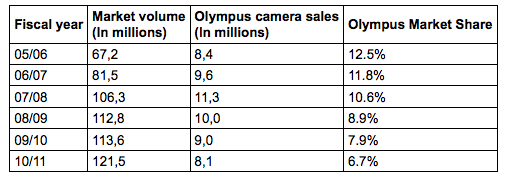
12 months ago |In 5 quick years they’ve gone from 12.5% market share to about 1/2 that, they’re camera sales peaked 3 years ago (coincidentally the time of the release of the E-510) and have now returned to where they were in ’05, all the while the world camera market has doubled.
Everyone talks about the PEN’s as their saviour, but their reign has been characterized by a precipitous drop in sales and red ink flowing in their quarterly reports like a scene in The Shining. They seem to be trying to appeal only to their gadget happy Japanese market and ignoring the 80% of sales comprised by the rest of the world.
Yet, Sphinx-like, they just maintain they’re silence to those remaining loyal owners with nothing more than occasional sound bites from places like China, and those statements basically saying they’ve left 4/3′s small bodied full-featured DSLR’s behind and will only produce PEN’s with $250 add-on EVF’s and $150 adapters for their FT lenses.
Is it any wonder they’re in the place they’re in? At this point I’m just left in a funk, the manufacturer that makes the pieces I like (IBIS and Truepic processor) simply won’t throw a bone out there with even a full-featured mFT, just more iterations of the bloody brick.
Life in Oly-world, it doesn’t get better than this!
mahler
12 months ago |Well said. While the competion exploits the full potential of m4/3 with a diverse body strategy from small to videocam, Olympus relies on releasing again and again the same old brick (called pseudo rangefinder). All what the EPL-2 has, could have been in the first m4/3 model of Olympus, the competition did that! Customers still wait (more than 2 years) for a m4/3 model, which has a tilt screen! This was one of the key differences of true live view cameras vs. DSLRs, but now DSLRs started to have that too. Olympus has that technology (E-3, E-5), but they still don’t use it where it really belongs to: an m4/3 body.
Someone in management thought, it would be enough to reinvent an old mythos (the PEN mythos) to be successfull, but they did not see that this mythos does not mean a lot for the younger generation and even to a lot of customers out of Japan. Due to this narrow product policy, NEX could take over quickly. Currently, Olympus has only one selling m4/3 model, the EPL-2, which is not enough to transport the notion of establishing a new camera system.
The competition is much more creative to showcase the possibilities of m4/3 (different body concepts, one lens system). Even Samsung becomes now a lot more attractive with its different bodies and very attractive lenses.
Olympus, get rid of the PEN-only strategy quickly, otherwise you’ll sink in the mud even deeper.
(and stop this silly unclear, official statements regarding your camera system strategy. They were the same since more than a year, did not make anything clear with regard to the survival of 4/3 and the future of m4/3, and were thus discouraging potential customers more than assuring them).
Steve T.
12 months ago |I don’t know…
I think Olympus has a great formula with e-pl2. Having decided not to use touchscreen technology means the camera has more manual physical controls.
Would I have preferred, for example a dedicated dial for ISO or EV? A m4/3rds version of a Canon G12 body would be great (because of the manual control dials)!
Regardless, the e-pl2 stands above Olympus’ entire m4/3rds range and tops Panasonic’s G series (not GH) as far as I’m concerned. It’s a camera made for enthusiasts who don’t mind tinkering while requiring the utmost in customization. The sensor could be better… but then again, sensors can ALWAYS be better. It takes great pictures and the body is the best of the m4/3rds (not comparing to panny GH series… those are like mini-DSLR bodies).
Also, the vf2 viewfinder is excellent – there when you want it, gone when you don’t.
I was lucky enough to buy the Panasonic 20mm f1.7 prime lens and I feel like I’ve got a cheap Leica M9 in my hands.
With the EP3 (assuming that’s what’s coming), I only ask for an extra dial for ISO and maybe EV and a better sensor. The e-pl2 screen is fine and the vf2 viewfinder works great. I like the control dial on the back and the other buttons are positioned logically and ergonomically.
Scratch that.
Honestly, the ONLY thing I really care about is an e-pl2 with a better sensor. Everything else could stay the same and I’d still pay $100 more for it.
Oh yeah… it would also be nice if Olympus made the red dots issue go away…
mahler
12 months ago |The image quality of the EPl-2 is no doubt very good and in some aspects (JPEG engine) better than Lumix G. However, the control layout is awkward to say the least, the 4-way-flimsy-wheel “controller” can hardly be used without looking at it and is very prone to misoperation. If Olympus ever dares to make a higher-end body, they have to get rid of this layout concept.
A camera body should not get in the way of the user, the EPL-2 does it too much. It gets even worse, when you try to work with it through the attachable view finder. A Lumix G can be operated mostly “blindly”, that is with teh eye on the finder, just using the right hand.
Thus, I think it is a problem that Olympus has only this single (from an ergonomics view not so great) formula, whereas the mirrorless competition has several (Panasonic, Samsung).
Michael Devitt
12 months ago |Olympus keeps its costumers in blur and marketing statements make it even more unclear.
).
1) E-System E-xxx users don’t have any real upgrade yet (E-6xx series for example). These series have brought most money from E-System and SG/HG lenses (not high-end E-x line with SHG). Now they can upgrade only to PEN or E-5 (or go elsewhere
2) E-5 with SHG glass is great, but most professionals (the market that can handle SHG prices) are shooting nothing but 135 format or even larger sensor/film.
3) With MFT, Olympus can be more successful and 4/3 format really match the overall system size here. Still no true enthusiast model though (and only very few decent primes yet).
4) Olympus is making great lenses but their 4/3 sensors aren’t up to best APS-C ones (because they are using old gen technology from Panasonic) but they are first company that claims 12 MP is enough so keeping one parameter fixed it may increase ISO/DR performance more quickly. Rumors says they are going this way with own engineered sensor.
BS Artiste
12 months ago |That chart measures camera units sold. Oly probably made things worse by moving down the food chain to sell more lower margin Pens instead of higher margin products. Also, given the dearth of m4/3 lenses, Oly likely crippled the sales of add-ons despite inventories of regular 4/3 lenses waiting to be sold. The chart does not show product mix, profit margins of products, or peripheral and lens sales.
Last fall I was ready to drop another $5K USD on additional body and some SHG lenses to go along with the $8K I had previously invested in an E-30 system. Then the E-5 came out with the same sensor as my 2+ year old E-30 and with a weak video offering.
I am still using my E-30 system, and would love a Pro Pen with a body size along the lines of the E-30. That would allow me to keep using the E-30 and lenses, use the Pro Pen as a second body while maybe purchasing a few m4/3 lenses along the way. The Pro Pen would need a better sensor than my E-30, 1080p, a compact flash slot, and a swivel-tilt screen.
Other than that, I am waiting on the 5Diii release. Hopefully, Canon adds better AF, 5 fps raw, a swivel-tilt LCD, and a consumer pop-up flash.
BS Artiste
12 months ago |Also, the Pro Pen needs a built in EVF. Taking lots of pictures with a camera held to arms length for viewing the LCD or using up the hot shoe is not acceptable.
BS Artiste
12 months ago |Moreover, Oly’s marketing probably needs a shake up. Most of the sales problems are a result of things the Oly marketing did wrong, not what other manufacturers did tremendously right. Oly’s problems are almost totally self-inflicted. It is a shame because the company has a history of innovation and is capable of making some fine products.
you know my name
12 months ago |Ive got a good way to start cutting jobs and restoring profit
sack the board! and make better cameras
restore SRL sales so that Europe and the US get back on the sales register with products they prefer
Danyyyel
12 months ago |He should fire himself and his management first for lack of vision. When you see the HDSLR video revolution, I always ask myself why those small (pentax, olympus, samsung) manufatures don’t put some good, solid or event groundbreaking solution. Just put an uncompressed hdmi, good audio etc hdslr or even a limited raw or high bit-rate codec in one of your camera and take this market by storm. It is not a matured market as the technology is quite new and that the canon has a lot of flaw like moire/aliasing etc. When you see that the main attraction for the last 3 years at NAB (the main event for broadcast industry) has been the hdslr it is not something that is hard to see. The HDSLR sales might be only one of every 5 cameras for Canon but for a manufacturer like olympus it would have doubled their sales.
Retards
8 months ago |The new management doesn’t have a clue how to run a company. They only know how to fire top employees and keep the wrong ones! They aren’t done yet. They already closed Canada (big mistake) and is now closing Hauppuage and will sub out the work. Good luck gents, you will need it! Another mistake getting rid of repairs to outside vendors….This isn’t Europe and they didn’t have this economy!